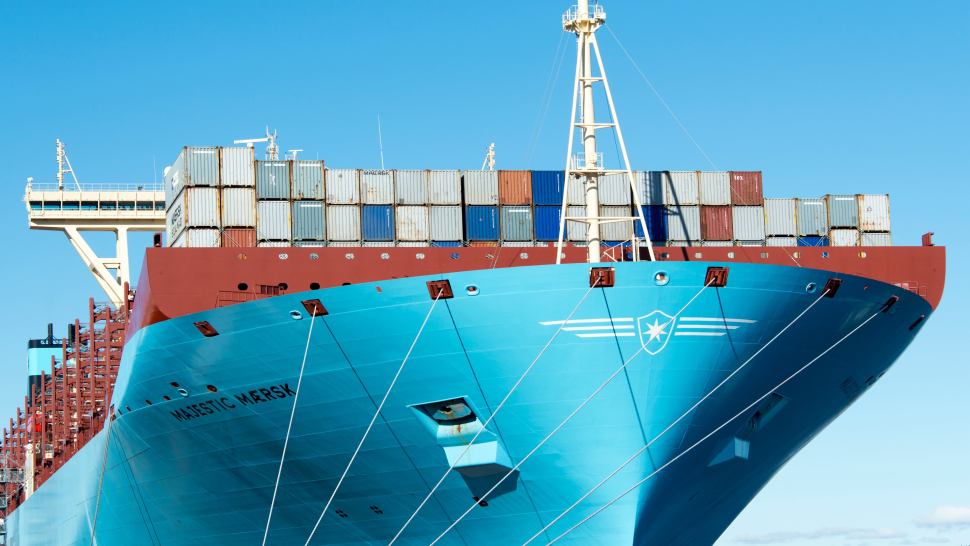
Calling 2024 its “third-best financial year,” Maersk reported across-the-board gains in revenue and earnings in 2024 on buoyant freight rates and sustained demand.
The world’s second-largest ocean container line on Thursday reported full-year 2024 revenue of $55.4 billion, up from $51 billion in 2023; pretax profit (earnings before interest, taxes, depreciation and amortization) of $12.1 billion, up from $9.6 billion; and operating profit (earnings before interest and taxes) of $6.5 billion, increased from $3.9 billion.
“Our ability to navigate shifting circumstances and ensure steady supply chains for our customers was put to the test throughout 2024,” said Vincent Clerc, CEO of Maersk parent A.P. Moller-Maersk (OTC: AMKBY), in a release.
“We successfully capitalized on increased demand while enhancing productivity and rigorously managing costs. With three strong businesses — ocean, logistics & services, and terminals — plus integrated offerings across the supply chain, we are uniquely positioned to support our customers in an era where geopolitical changes and disruptions continue to reinforce the need for resilient supply chains.”
Revenue from the ocean division came to $37.4 billion from $33.7 billion; logistics sales totaled $14.9 billion from $13.9 billion; and terminals revenue was $4.5 billion, up from $3.8 billion.
Container volume grew 0.8% compared to worldwide gains by all carriers of 5.3%, the latter according to published sources. That also compares to gains reported by new Gemini alliance partner Hapag-Lloyd of 3.3%, and Ocean Network Express (ONE) of 4.5%.
Maersk said its container rates climbed 38.1% in 2024, against a global improvement of 38.6%. Maersk bettered Hapag-Lloyd at 31.4% and equaled ONE at 38.1%.
Ocean pretax profit totaled $9.2 billion from $6.9 billion the previous year. Operating profit was $4.7 billion, up from $2.2 billion.
Ocean EBITDA margin was 24.6%; EBIT margin was 12.7%. That compares to EBITDA of competitor and new Gemini alliance partner Hapag-Lloyd at 24.2% and ONE at 31.2%.
The Denmark-based vessel operator said capital spending in the ocean business in 2024 increased to $2.7 billion from $1.9 billion.
Ocean fuel costs rose just 1.7% in 2024 despite the effects of the Red Sea crisis, which forced Maersk to reroute ships on longer voyages from Asia to the Mediterranean, Europe and North America around Africa’s Cape of Good Hope.
In an earnings release, Maersk said: “Higher bunker [fuel] consumption by 14% and higher container handling costs by 5.5% were attributable to the re-routing south of the Cape of Good Hope. Network cost excluding bunker decreased by 1.5%, mainly due to the lower port and canal cost associated with fewer Suez Canal crossings offsetting the increased transshipment, time charter equivalent and slot charter costs. SG&A [selling, general and administrative expenses] decreased by 10% reflecting the continuous efforts to streamline the organization.”
For 2025, Maersk forecast container volume growth of around 4%, in line with global estimates.
“It is further expected that 2025 is likely to show greater supply-demand imbalance with continued new [vessel] deliveries in the container shipping industry and a potential re-opening of the Red Sea,” Maersk said in the release, offset by supply-side drivers and strong market demand.
Full-year EBITDA is forecast from $6 billion to $9 billion, and EBIT unchanged to $3 billion, contingent on either a midyear (low end) or late-year (high end) reopening of the Red Sea route.
The company also announced a dividend and $2 billion in share buybacks.
Find more articles by Stuart Chirls here.
Related coverage:
ILA sets wage review as longshore contract nears ratification vote
What shippers should know about ocean carrier alliance changes in 2025
Texas Gulf Coast ports see year-over-year gains in freight volumes
Brokerage Compliance Symposium
The day before F3. Every compliance issue you face - fraud exposure, carrier liability, FMCSA rules, cargo theft, insurance gaps - navigated by attorneys and operators defining best practices in a changing industry.
F3 Awards Dinner
The night before F3. FreightTech100 companies honored. FreightTech 25 and Shipper of Choice winners revealed live. Cocktail reception into dinner and live music - 300 industry leaders in one purpose-built room.
F3: Future of Freight Festival
Industry-defining keynotes, rapid-fire technology demos, and industry leaders networking in experiences across Chattanooga - plus the inaugural F3 Awards Dinner featuring the FreightTech and Shipper of Choice reveals.
The day before F3. Every compliance issue you face - fraud exposure, carrier liability, FMCSA rules, cargo theft, insurance gaps - navigated by attorneys and operators defining best practices in a changing industry.
The Signal at Chattanooga Choo Choo • Chattanooga, TN Register NowThe night before F3. FreightTech100 companies honored. FreightTech 25 and Shipper of Choice winners revealed live. Cocktail reception into dinner and live music - 300 industry leaders in one purpose-built room.
The Signal at Chattanooga Choo Choo • Chattanooga, TN Register NowIndustry-defining keynotes, rapid-fire technology demos, and industry leaders networking in experiences across Chattanooga - plus the inaugural F3 Awards Dinner featuring the FreightTech and Shipper of Choice reveals.
The Signal at Chattanooga Choo Choo • Chattanooga, TN Register Now