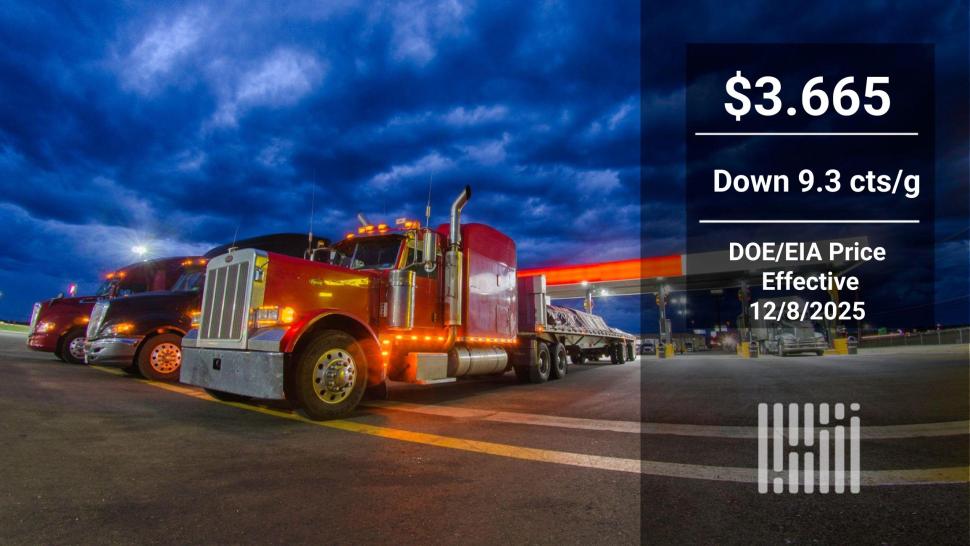
The diesel price used as the benchmark for most fuel surcharges recorded the biggest two-week decline in two years with its latest posting.
Retail prices are catching up to a decline in futures prices that has been stunning. That decline isn’t coming because of a drop in crude prices, which have been trending downward but without a sharp fall. Instead, it is the price of diesel relative to crude coming back closer to recent levels after the spread between the two blew out in October and into November.
The Energy Information Administration/Department of Energy price dropped 9.3 cents gallon to $3.665/g. The price is effective Monday and published Tuesday
The last time the EIA/DOE price fell that much was two years ago, almost exactly. On December 18, 2023, the price fell by the same amount as the latest number, 9.3 cts/g.
That date also is significant because it marked a two-week stretch where the price fell 19.8 cts/g over two weeks. The 16.6 cts/g price slide over the last two weeks is the largest decline for that duration since then.
Refineries ramping up
Diesel and gasoline, having soared relative to crude in October and November, are now falling back to more normal levels as refineries come out of fall maintenance.
For example, the EIA reported that for the week ended November 28, the most recent report available, the nation’s refineries operated at a 94.1% operating rate. That number has risen for four consecutive weeks, coming off an 86% operating rate for the week ended Halloween.
That has helped drive down the price of diesel, first on the CME commodity exchange and then, with the usual lag, the price at the pump.
Ultra low sulfur diesel (ULSD) on CME peaked in November at $2.7011/g on November 18. Its steady decline since then–it settled down nine of the next 14 days through Monday–brought it to a Monday settlement of $2.2982/g, the lowest it settled at since October 22.
The decline has come even as crude has moved down directionally but far from showing any sort of significant bearish trend.
On the same day ULSD hit its peak, Brent settled at $64.89/barrel. It declined to $62.49/b at the Monday settlement, a decline of 3.6% during that period. By contrast, the parallel decline in ULSD during that time was just under 15%.
Glut on the horizon?
The relative stability of Brent is coming even as the drumbeat of a growing supply/demand imbalance in 2026 continues to grow.
According to a report by Bloomberg, the chief economist of Trafigura, a leading oil trader, said this week on a company video that 2026 is likely to be marked by “a glut or a super glut.” “It’s kind of hard to get away from that,” Saad Rahim said on the video.
Rahim’s view is not out of the mainstream. The International Energy Agency has been seeing a growing supply/demand balance that could have the latter exceeding the former by an average of 4 million b/d later in the year.
A glut in 2026 would follow a year in which Brent so far has fallen 17.7% so far from the first day of trading.
More articles by John Kingston
Trucking credit metrics at BMO slide as the business gets smaller
Inside the Amazon-Teamsters showdown: What’s next?
Likely 1st AB5 trucking enforcement action in California snags 3 companies
Brokerage Compliance Symposium
The day before F3. Every compliance issue you face - fraud exposure, carrier liability, FMCSA rules, cargo theft, insurance gaps - navigated by attorneys and operators defining best practices in a changing industry.
F3 Awards Dinner
The night before F3. FreightTech100 companies honored. FreightTech 25 and Shipper of Choice winners revealed live. Cocktail reception into dinner and live music - 300 industry leaders in one purpose-built room.
F3: Future of Freight Festival
Industry-defining keynotes, rapid-fire technology demos, and industry leaders networking in experiences across Chattanooga - plus the inaugural F3 Awards Dinner featuring the FreightTech and Shipper of Choice reveals.
The day before F3. Every compliance issue you face - fraud exposure, carrier liability, FMCSA rules, cargo theft, insurance gaps - navigated by attorneys and operators defining best practices in a changing industry.
The Signal at Chattanooga Choo Choo • Chattanooga, TN Register NowThe night before F3. FreightTech100 companies honored. FreightTech 25 and Shipper of Choice winners revealed live. Cocktail reception into dinner and live music - 300 industry leaders in one purpose-built room.
The Signal at Chattanooga Choo Choo • Chattanooga, TN Register NowIndustry-defining keynotes, rapid-fire technology demos, and industry leaders networking in experiences across Chattanooga - plus the inaugural F3 Awards Dinner featuring the FreightTech and Shipper of Choice reveals.
The Signal at Chattanooga Choo Choo • Chattanooga, TN Register Now