




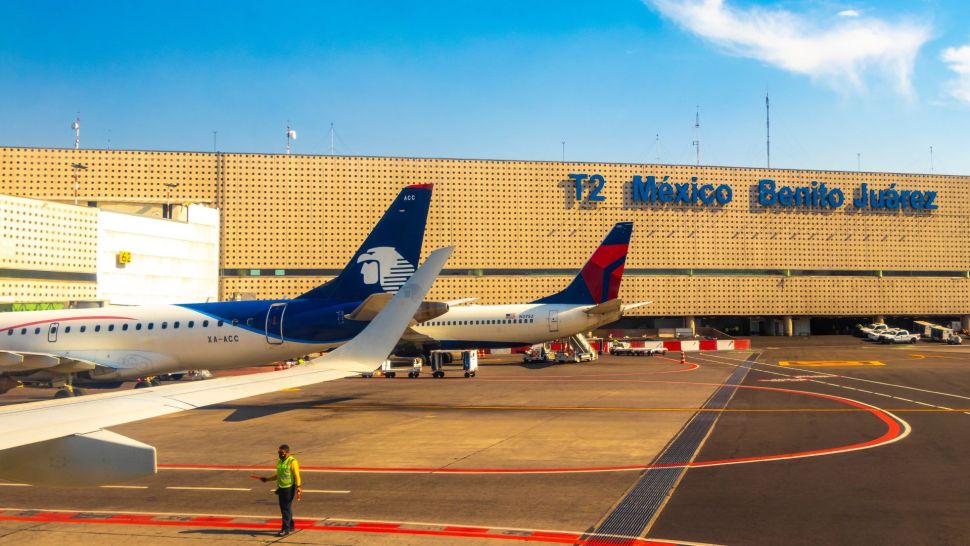
The U.S. Department of Transportation on Saturday threatened to dissolve Delta Air Lines joint venture with Aeromexico and restrict Mexican flights in response to alleged anti-competitive behavior by Mexico’s government, including the forced relocation of all-cargo carriers in 2023 to a secondary airport.
It also put European countries on notice that similar measures could be taken against them if U.S. airlines are restricted from their airports in ways that disrupt the competitive balance established under air transport agreements in an effort to limit noise levels in city centers.
The Department of Transportation said the Mexican government has impaired the operating rights of U.S. airlines under the 2015 U.S.-Mexico Air Transport Agreement.
Mexico banned freighter operators from the country’s main international airport in Mexico City ostensibly to relieve chronic congestion and allow expansion projects. The government also rescinded some take off and landing slots allotted to passenger carriers.
Cargo airlines were forced to switch to Felipe Angeles International Airport, a former military airfield about 31 miles away. The relocation, which involved airlines from all countries, not just the United States, added operational costs and complexity for cargo operators, especially hybrid carriers that continued to move shipments in passenger planes serving Mexico City International Airport (MEX) and now have dual facility and delivery systems to manage. Felipe Angeles also was not fully developed and ready to efficiently handle the cargo aircraft, leading airlines to invest in more equipment and facilities.
The slot restrictions and mandate that all-cargo operations move out of MEX disrupted the market, cost American companies millions of dollars and represent a “blatant disregard” of the air transport agreement, according to the Department of Transportation.
“Joe Biden and Pete Buttigieg deliberately allowed Mexico to break our bilateral aviation agreement,” said Transportation Secretary Sean Duffy in the announcement. “That ends today. Let these actions serve as a warning to any country who thinks it can take advantage of the U.S., our carriers, and our market. America First means fighting for the fundamental principle of fairness.”
The slot seizures impacted American Airlines, Delta Air Lines and United Airlines, as well as Mexican carriers. The Mexican airlines with confiscated slots have since been able to restore certain services to the United States.
The DOT said in an enforcement notice that Mexico has yet to provide any analysis that MEX is oversaturated, assurance that U.S. carriers can recover their slots when construction is completed and that any construction projects have been initiated.
The department has initiated a three-pronged initiative to pressure Mexico into changing its policy.
The DOT said it will require Mexican airlines to file schedules with the department for all their U.S. operations by July 29 so it can review whether any services violate the law or affect the public interest. Filings must include the type of aircraft used, flight frequency, origin-and-destination airports and arrival/departure times.
A second order prohibits Mexican airlines from operating large aircraft for passenger or cargo charter flights to or from the United States without prior DOT approval. The charter restrictions, the DOT said, are a response to U.S. cargo airlines being prevented from repositioning aircraft within Mexico on non-revenue flights or making multiple stops in Mexico to pick up or drop off international traffic without carrying domestic shipments, as allowed under the transport agreement.
The DOT also proposed to withdraw the approval of antitrust immunity for the joint venture operated by Delta and Aeromexico. The U.S. government extended the approval beyond a 2020 deadline to allow for further review, but the Trump administration now says the conditions for immunity no longer exist and that the joint venture no longer serves the public interest.
A final order terminating approval of the joint venture would not become effective until Oct. 25, at the earliest.
If antitrust immunity is revoked, Delta and Ameromexico would be required to discontinue cooperation on pricing, capacity management, and revenue sharing. They would, however, be allowed to continue their partnership through arms-length activities such as codesharing, marketing and frequent flyer cooperation. Delta will also be able to retain its equity stake in Aeromexico and maintain all existing flying in the U.S-Mexico market unimpeded.
The Department also said it reserves the right to disapprove flight requests from Mexico should the country fail to take corrective action.
In 2023, the Biden administration expressed concern that the Netherland’s decision to reduce nearly 10% of takeoff and landing slots at Amsterdam Schiphol Airport to reduce pollution and noise was done unilaterally and would impact U.S. flight levels. It said the issue should be negotiated in the context of the existing U.S.-European Union Open Skies agreement. The U.S. warned the Dutch government that flight cuts could open the door for retaliatory cuts to KLM’s frequencies to the U.S. And the U.S. position is believed to have caused CMA CGM Air Cargo and Air France-KLM to abandon their cargo alliance’s application for antitrust immunity on North American routes last year.
Click here for more FreightWaves/American Shipper stories by Eric Kulisch.
RELATED READING:
Uprooted cargo airlines relocate to secondary airport near Mexico City
Brokerage Compliance Symposium
The day before F3. Every compliance issue you face - fraud exposure, carrier liability, FMCSA rules, cargo theft, insurance gaps - navigated by attorneys and operators defining best practices in a changing industry.
F3 Awards Dinner
The night before F3. FreightTech100 companies honored. FreightTech 25 and Shipper of Choice winners revealed live. Cocktail reception into dinner and live music - 300 industry leaders in one purpose-built room.
F3: Future of Freight Festival
Industry-defining keynotes, rapid-fire technology demos, and industry leaders networking in experiences across Chattanooga - plus the inaugural F3 Awards Dinner featuring the FreightTech and Shipper of Choice reveals.
The day before F3. Every compliance issue you face - fraud exposure, carrier liability, FMCSA rules, cargo theft, insurance gaps - navigated by attorneys and operators defining best practices in a changing industry.
The Signal at Chattanooga Choo Choo • Chattanooga, TN Register NowThe night before F3. FreightTech100 companies honored. FreightTech 25 and Shipper of Choice winners revealed live. Cocktail reception into dinner and live music - 300 industry leaders in one purpose-built room.
The Signal at Chattanooga Choo Choo • Chattanooga, TN Register NowIndustry-defining keynotes, rapid-fire technology demos, and industry leaders networking in experiences across Chattanooga - plus the inaugural F3 Awards Dinner featuring the FreightTech and Shipper of Choice reveals.
The Signal at Chattanooga Choo Choo • Chattanooga, TN Register Now