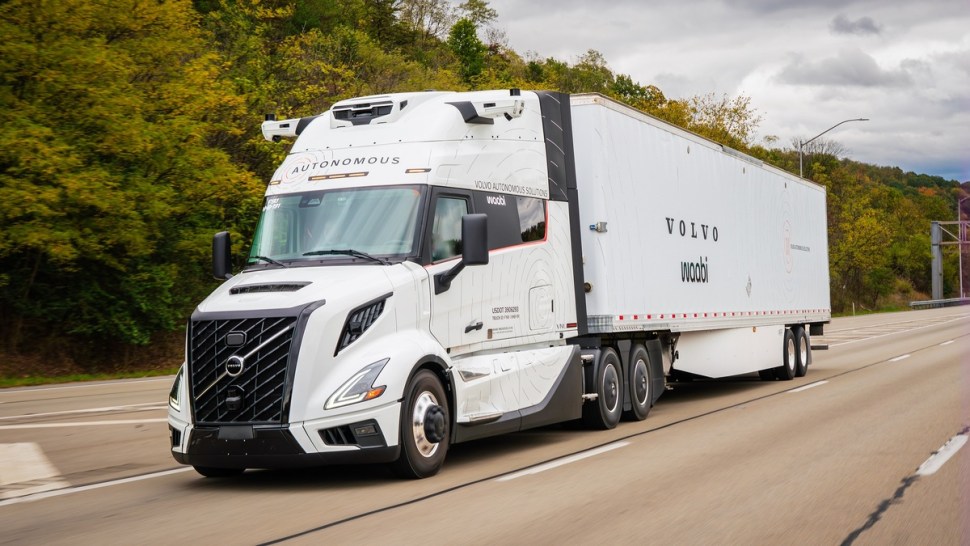
Autonomous truck technology maker Waabi and Volvo Autonomous Solutions recently announced the successful integration of the Waabi Driver with the Volvo VNL Autonomous. The milestone marks a new chapter in the strategic partnership, which was announced earlier in February. With the integration complete, both companies are now looking toward the next steps—broader commercial deployment.
“The future of autonomous trucking hinges on three critical areas: autonomous technology that is safe, scalable, and can deliver on customer needs; hardware that is purpose-built for autonomous operations from the ground up; and a commercial deployment model that solves problems in the supply chain without added friction,” said Raquel Urtasun, founder and CEO of Waabi, in the release.
For Volvo, the addition of the Waabi virtual driver will augment its custom-built Volvo VNL autonomous truck, which is designed with redundant systems to handle fully autonomous operations. These redundant systems include braking, steering, and communication, among others.
Earlier this year, Urtasun spoke with FreightWaves about the Volvo partnership and noted that the path forward for autonomous trucking technology companies relies on vertical integration and a willing OEM partner.
“We don’t believe that retrofit is an option for that redundant platform; we believe that our technology, and any AV player for that matter, should be vertically integrated into a redundant platform that is purposefully built for self-driving,” said Urtasun.
Waabi’s successful integration is part of a larger push toward commercialization, with the company telling FreightWaves in August that it is preparing for a driver-out milestone by the end of the year. The company also recently appointed former Uber Freight CEO Lior Ron as its chief operating officer in August to help scale operations ahead of an eventual commercial launch.
Volvo’s collaboration with Waabi is part of a yearslong effort in which Volvo Group Venture Capital became a strategic investor in the company back in January 2023, then later invested during the company’s $200 million Series B round.
Brokerage Compliance Symposium
The day before F3. Every compliance issue you face - fraud exposure, carrier liability, FMCSA rules, cargo theft, insurance gaps - navigated by attorneys and operators defining best practices in a changing industry.
F3 Awards Dinner
The night before F3. FreightTech100 companies honored. FreightTech 25 and Shipper of Choice winners revealed live. Cocktail reception into dinner and live music - 300 industry leaders in one purpose-built room.
F3: Future of Freight Festival
Industry-defining keynotes, rapid-fire technology demos, and industry leaders networking in experiences across Chattanooga - plus the inaugural F3 Awards Dinner featuring the FreightTech and Shipper of Choice reveals.
The day before F3. Every compliance issue you face - fraud exposure, carrier liability, FMCSA rules, cargo theft, insurance gaps - navigated by attorneys and operators defining best practices in a changing industry.
The Signal at Chattanooga Choo Choo • Chattanooga, TN Register NowThe night before F3. FreightTech100 companies honored. FreightTech 25 and Shipper of Choice winners revealed live. Cocktail reception into dinner and live music - 300 industry leaders in one purpose-built room.
The Signal at Chattanooga Choo Choo • Chattanooga, TN Register NowIndustry-defining keynotes, rapid-fire technology demos, and industry leaders networking in experiences across Chattanooga - plus the inaugural F3 Awards Dinner featuring the FreightTech and Shipper of Choice reveals.
The Signal at Chattanooga Choo Choo • Chattanooga, TN Register Now