While the United States and Iran continue to negotiate the terms of an agreement to end their hostilities and shipping slowly resumes through the Strait of Hormuz, the global container market can’t seem to move on from the plethora of critical issues pushing up rates.
Daily transits have collapsed from pre‑conflict levels of around 100–130 vessels per day – mostly tankers – to single- or low-double-digit daily crossings during the crisis, with some analyses reporting traffic at under 5–10% of normal levels at peak disruption. Several trackers and intelligence reports show hundreds of vessels stranded inside the Persian Gulf.
One of the largest to exit was the 16,000-TEU HMM Daon, which transited the strait on Monday, noted analyst Lars Jensen of Vespucci Maritime.
Fuel costs are easing as oil flows recover, said Freightos research chief Judah Levine, in a note to clients. “Bunker prices are down 25% from March highs and 12% since early June, while jet fuel is down more than 40% from its peak – though both remain well above pre-war levels,” Levine said.
Soaring costs and fears of tightening supplies at key bunkering centers had led shipping lines to implement emergency fuel surcharges on top of contractual adjustment mechanisms. That led at least one analyst to warn that shippers could be paying twice for increased fuel costs.
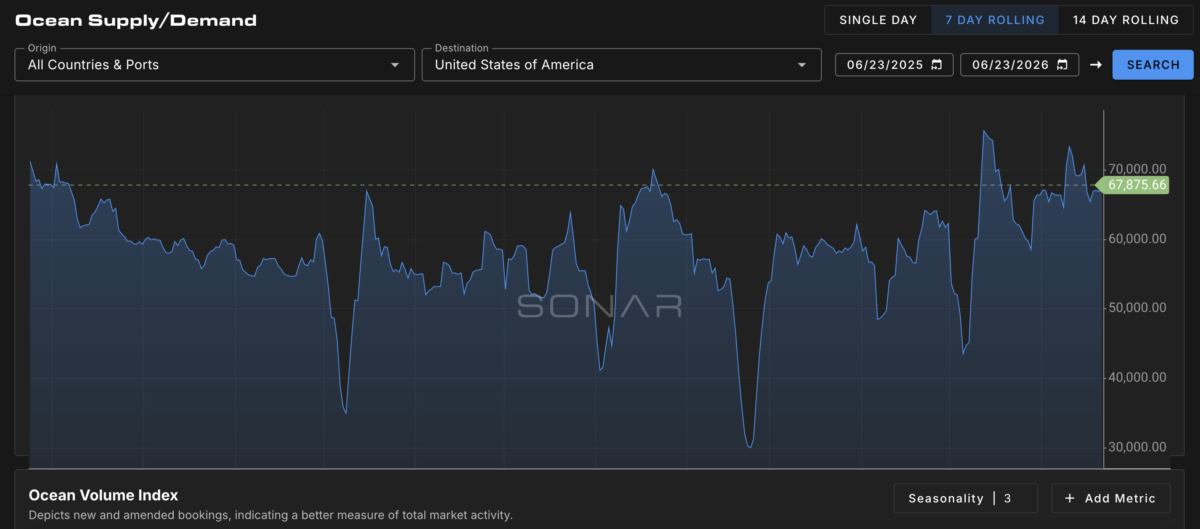
Those increases are just one factor behind climbing container rates as frontloading importers look to get ahead of Asia tariff deadlines and higher prices slated for July by manufacturers.
Trans-Pacific West Coast prices surged 19% to more than $5,700 per forty foot equivalent unit, according to the Freightos (NASDAQ: CRGO) Baltic Index – with daily rates already past $6,000. East Coast rates surged 13% to $7,400 with the daily level now above $8,000 and above the peak season high in 2025.
Asia-Europe rates climbed 13% to $4,700 per FEU and Mediterranean jumped 16% to $6,300 per FEU, both above last year’s peak season highs, wrote Levine. Carriers are targeting $1,000-$3,000 per FEU increases for July, “though resistance to increases may be stronger than what carriers have encountered so far if demand is approaching its peak.”
Read more articles by Stuart Chirls here.
CSX officially opens $495 Baltimore intermodal rail tunnel project
Are you overpaying? Why shippers should revisit emergency fuel surcharges now
After $450M project, Port of Virginia goes deep to raise the bar among East Coast container gateways
Cargo thieves are following the AI boom
Flexport: New tariff wave could replace expiring trade duties by late July
Brokerage Compliance Symposium
The day before F3. Every compliance issue you face - fraud exposure, carrier liability, FMCSA rules, cargo theft, insurance gaps - navigated by attorneys and operators defining best practices in a changing industry.
F3 Awards Dinner
The night before F3. FreightTech100 companies honored. FreightTech 25 and Shipper of Choice winners revealed live. Cocktail reception into dinner and live music - 300 industry leaders in one purpose-built room.
F3: Future of Freight Festival
Industry-defining keynotes, rapid-fire technology demos, and industry leaders networking in experiences across Chattanooga - plus the inaugural F3 Awards Dinner featuring the FreightTech and Shipper of Choice reveals.
The day before F3. Every compliance issue you face - fraud exposure, carrier liability, FMCSA rules, cargo theft, insurance gaps - navigated by attorneys and operators defining best practices in a changing industry.
The Signal at Chattanooga Choo Choo • Chattanooga, TN Register NowThe night before F3. FreightTech100 companies honored. FreightTech 25 and Shipper of Choice winners revealed live. Cocktail reception into dinner and live music - 300 industry leaders in one purpose-built room.
The Signal at Chattanooga Choo Choo • Chattanooga, TN Register NowIndustry-defining keynotes, rapid-fire technology demos, and industry leaders networking in experiences across Chattanooga - plus the inaugural F3 Awards Dinner featuring the FreightTech and Shipper of Choice reveals.
The Signal at Chattanooga Choo Choo • Chattanooga, TN Register Now