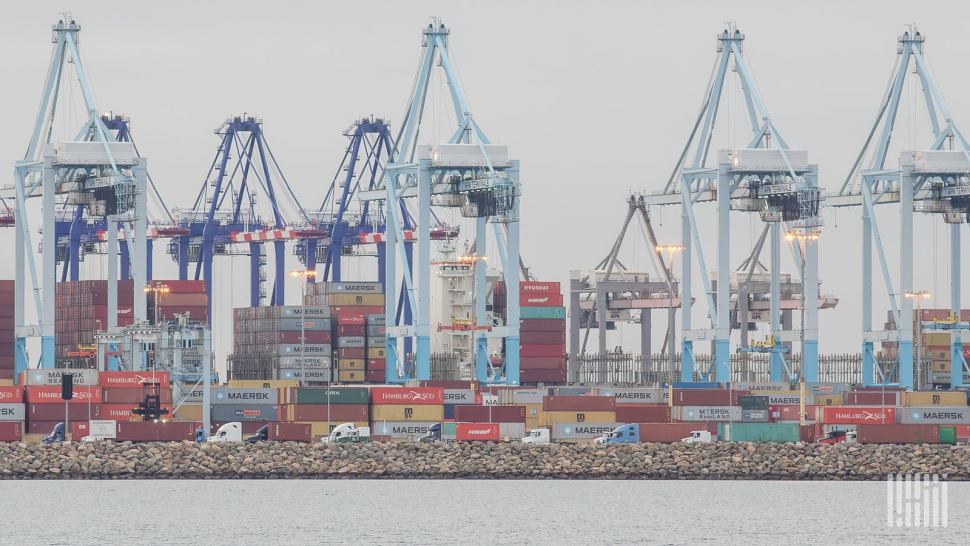
Global container volumes maintained a strong pace in April, turning in strong year-on-year gains in the first full month since Iran closed the Strait of Hormuz.
Despite serious disruptions from the Iran war, where hostilities now stretch from the Persian Gulf to the Mediterranean, global container traffic remained ‘remarkably resilient’ at 16.2 million twenty foot equivalent units in April, according to Container Trade Statistics.
That’s up 4% from April 2025, and a narrow 1.6% improvement from March.
CTS, which gets its data directly from many of the largest shipping lines, said year-to-date volumes remain 5% above 2025 levels.
“This reinforces a long-standing maxim of global trade: Cargo behaves much like water, finding alternative routes when traditional pathways become restricted,” the British-based analyst said.
The CTS Global Price Index rose sharply to 89 points in April, up more than 12% from 79 in March, pressured by the Hormuz crisis. That’s the biggest gain since June 2024, at the height of carriers diverting vessels away from the Red Sea, substantially removing market capacity.
All regions saw growing imports except North America and, unsurprisingly, the Indian Sub-continent and Middle East, which declined by 2% and 4%, respectively.
A decline in North America came on reduced volumes originating from Europe, the Indian Sub-continent and Middle East, and South and Central America.
Rates on the benchmark trans-Pacific have been surging over the past month. Carriers have been managing capacity with blankings while issuing a storm of surcharges and rate restoration fees. Market observers say some importers have begun bringing in goods ahead of schedule – or frontloading – as uncertainty swirls and the peak season gets underway.
Exports compare similarly with the import market. India/Mideast and North America were the only regions to see volume drops, of 15% and 3%. Year-to-date, Europe exports are off 2%, an improvement from March’s 3% slide. While European exports have shown gradual improvement throughout early 2026, those results have been undermined by a substantial reduction in cargo moving into the India/Mideast region.
Still, ‘while volumes have softened slightly in affected regions, overall trade remains robust,” CTS said. Sub-Saharan Africa continues to emerge as one of the strongest performing regions globally. Year-to-date, exports are up 10% and imports are up 15%, where alternative trade routes and emerging markets are increasingly supporting global growth.
A key unknown is when and if higher transport costs begin to exert meaningful pressure on global volumes.
Read more articles by Stuart Chirls here.
Related coverage:
Peak indicator: $2,600 increase on one U.S. shipping service
Box rates soar $1,000 in one week on peak
Swearing-in of commissioner returns U.S. maritime regulator to full strength
Brokerage Compliance Symposium
The day before F3. Every compliance issue you face - fraud exposure, carrier liability, FMCSA rules, cargo theft, insurance gaps - navigated by attorneys and operators defining best practices in a changing industry.
F3 Awards Dinner
The night before F3. FreightTech100 companies honored. FreightTech 25 and Shipper of Choice winners revealed live. Cocktail reception into dinner and live music - 300 industry leaders in one purpose-built room.
F3: Future of Freight Festival
Industry-defining keynotes, rapid-fire technology demos, and industry leaders networking in experiences across Chattanooga - plus the inaugural F3 Awards Dinner featuring the FreightTech and Shipper of Choice reveals.
The day before F3. Every compliance issue you face - fraud exposure, carrier liability, FMCSA rules, cargo theft, insurance gaps - navigated by attorneys and operators defining best practices in a changing industry.
The Signal at Chattanooga Choo Choo • Chattanooga, TN Register NowThe night before F3. FreightTech100 companies honored. FreightTech 25 and Shipper of Choice winners revealed live. Cocktail reception into dinner and live music - 300 industry leaders in one purpose-built room.
The Signal at Chattanooga Choo Choo • Chattanooga, TN Register NowIndustry-defining keynotes, rapid-fire technology demos, and industry leaders networking in experiences across Chattanooga - plus the inaugural F3 Awards Dinner featuring the FreightTech and Shipper of Choice reveals.
The Signal at Chattanooga Choo Choo • Chattanooga, TN Register Now