




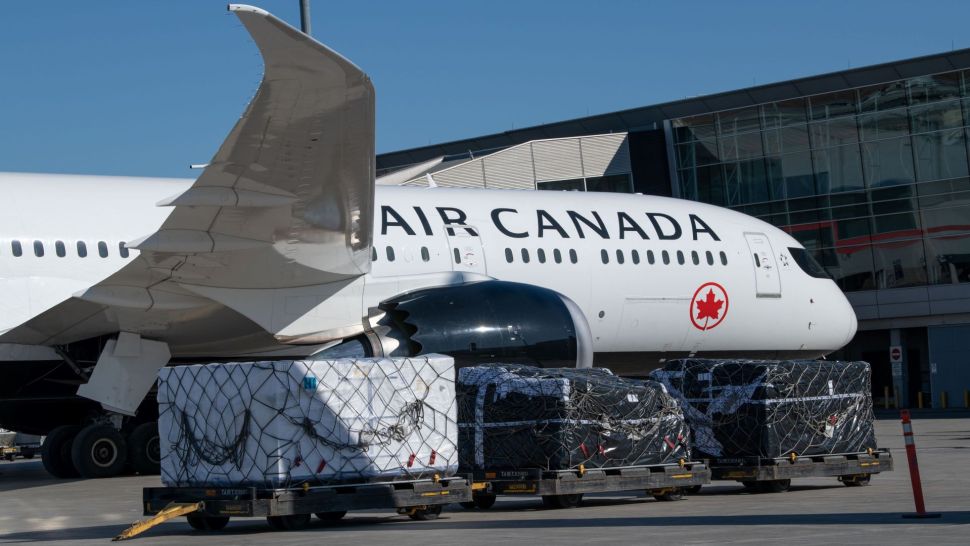
Air Canada has postponed its plan to gradually resume operations and suspended third-quarter and full-year financial guidance after the union representing 10,000 flight attendants instructed members to ignore a federal order to return to work, extending a strike that has caused hundreds of flight cancelations and disrupted cargo shipments.
Air Canada (TSX: AC), which halted all operations on Saturday because of the strike, had intended to restart some flights on Sunday. After flight attendants refused to return to work, the airline pushed back the restart until Monday evening.
A notice on Air Canada’s website Monday morning indicates that all Air Canada and Air Canada Rouge flights remain suspended indefinitely.
The Canadian Industrial Relations Board on Sunday declared the ongoing strike activity illegal and ordered the leadership of the Canadian Union of Public Employees to direct its members by 12 noon on Monday to return to work under the existing collective bargaining agreement, with unresolved terms to be settled via binding arbitration. Union leaders could face fines or jail terms for violating a government order.
Flight attendants walked out on Saturday after contract talks over wages and work conditions reached an impasse, with the union demanding an end to unpaid work hours during the boarding process and what it calls “poverty wages.”
Minister of Jobs and Families Patty Hajdu on Saturday invoked Canadian labor law to intervene in the dispute, directing the Canada Industrial Relations Board to arbitrate the dispute because of the economic impact of shutting down the nation’s largest airline.
CUPE President Mark Hancock on X said the strike “won’t be over until we say it is.”
Unions unite
Labor groups in Canada are rallying behind CUPE, which called the back-to-work order unconstitutional and condemned the Liberal government for siding with Air Canada in the contract dispute. It said that Maryse Tremblay, the new head of the Canadian Industrial Relations Board, should recuse herself from ruling on whether to end the strike because of an “almost unthinkable” conflict of interest. Tremblay once served as general counsel for Air Canada and has worked at law firms where she represented corporate interests on labor issues.
Kiavash Najafi, a high-ranking member of the Canadian Labor Congress said unions at an emergency meeting Sunday supported the decision of flight attendants to defy the government’s order and will raise money for their legal fight.
Air Canada pilots, represented by the Air Line Pilots Association, on X issued a statement of solidarity with CUPE.
Air Canada, which operates about 700 flights per day, says 500,000 people have been affected so far by flight cancellations. It has warned that it could take at least a week to fully restore normal operations once the work stoppage ends.
Canadian business groups had urged government intervention to stop a strike, saying that suspending service would harm businesses that need to move critical goods such as pharmaceuticals and perishable goods, especially since supply chains are already under stress from the recent U.S. trade war against Canada. The Bank of Montreal issued a note estimating the strike so far has cost Air Canada more than $100 million in operating profit.
Air Canada has said its six Boeing 767-300 freighter aircraft are continuing to operate during the work stoppage, but with modified schedules.
Click here for more FreightWaves/American Shipper stories by Eric Kulisch.
Write to Eric Kulisch at ekulisch@freightwaves.com.
RELATED READING:
Air Canada to restart operations after government blocks strike
Supply chain disruptions feared as Air Canada prepares for strike
Brokerage Compliance Symposium
The day before F3. Every compliance issue you face - fraud exposure, carrier liability, FMCSA rules, cargo theft, insurance gaps - navigated by attorneys and operators defining best practices in a changing industry.
F3 Awards Dinner
The night before F3. FreightTech100 companies honored. FreightTech 25 and Shipper of Choice winners revealed live. Cocktail reception into dinner and live music - 300 industry leaders in one purpose-built room.
F3: Future of Freight Festival
Industry-defining keynotes, rapid-fire technology demos, and industry leaders networking in experiences across Chattanooga - plus the inaugural F3 Awards Dinner featuring the FreightTech and Shipper of Choice reveals.
The day before F3. Every compliance issue you face - fraud exposure, carrier liability, FMCSA rules, cargo theft, insurance gaps - navigated by attorneys and operators defining best practices in a changing industry.
The Signal at Chattanooga Choo Choo • Chattanooga, TN Register NowThe night before F3. FreightTech100 companies honored. FreightTech 25 and Shipper of Choice winners revealed live. Cocktail reception into dinner and live music - 300 industry leaders in one purpose-built room.
The Signal at Chattanooga Choo Choo • Chattanooga, TN Register NowIndustry-defining keynotes, rapid-fire technology demos, and industry leaders networking in experiences across Chattanooga - plus the inaugural F3 Awards Dinner featuring the FreightTech and Shipper of Choice reveals.
The Signal at Chattanooga Choo Choo • Chattanooga, TN Register Now