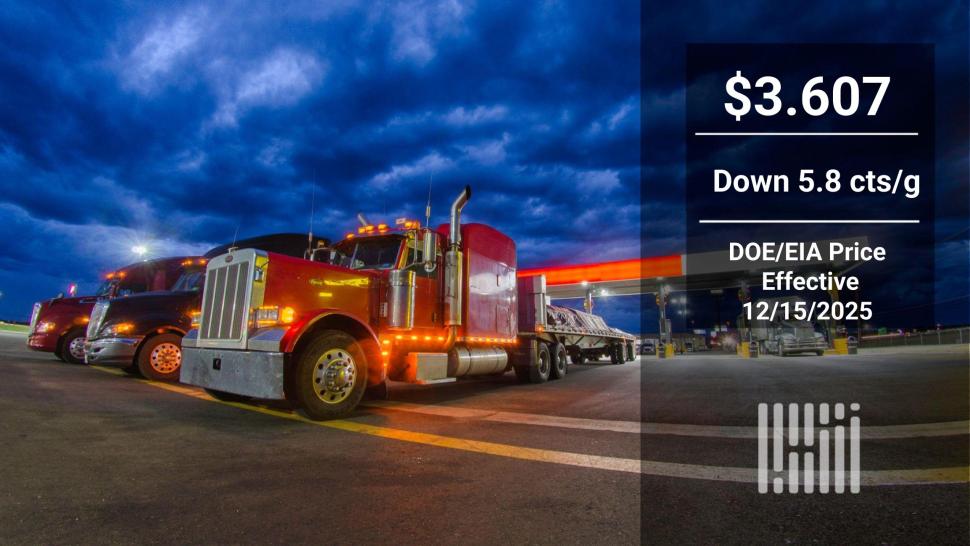
The benchmark diesel price used for most fuel surcharges continued its downward slide this week, but still may have some significant catching-up to do given the sharp downturn going on in petroleum futures markets.
The weekly Department of Energy/Energy Information Administration average weekly retail diesel price slid 5.8 cents/gallon to $3.607/gallon. It’s the fourth week in a row the price has fallen, a period during which it has declined 26.1 cts/g.
With Tuesday’s settlement of ultra low sulfur diesel (ULSD) Tuesday on the CME commodity exchange of $2.1286/g, a decline of 5.2 cts/g from Monday, the futures price is now down almost 21.2% from the November 18 settlement of $2.7011/g, a recent high water mark.
Retail prices as measured by the DOE/EIA number have a ways to go to catch up. The retail benchmark before the recent decline was $3.868/g. After four weeks, it’s down 6.8%, far less than the fall in the ULSD futures price.
As far as where the current retail benchmark price stands compared to the rest of the year, after several weeks of increases through late October and into November, it is not that much lower than it was through most of the summer and into fall. The latest price, effective Monday but published Tuesday, is only a few cents more than the $3.571/g posted June 16. Monday’s price is the lowest since then.
While talk of a possible truce or settlement in the Russia-Ukraine war has been a factor in the recent selloff, the bigger background to the decline in petroleum prices is that forecasts into 2026 have been suggesting for many weeks that supply and demand are going to be out of whack enough that it might create an imbalance enough to be considered a glut.
And while the trend has been generally lower–Brent settled at $70.13 on September 26, the last time it settled above $70–the decline has not been a rout.
That may be starting to break. Both Brent and WTI settled Tuesday at less than $60/b, the first time that has happened since February 5, 2021, when demand was still restrained as a result of the pandemic. WTI declined $1.55/barrel to $55.27, while Brent fell $1.64/b to $58.92/b.
While the possibility of a Ukraine deal continues to be a bearish factor in the market, that glut possibility appears to be a far stronger force in the current decline.
A key report from last week gave more fuel to that sentiment.
Although the monthly report of the International Energy Agency released last week was less bearish than recent reports, the fact is it still continues to show an enormous imbalance in supply and demand going into 2026.
The numbers in the latest report are that global demand is expected to rise by 830,000 barrels/day when all is tallied for 2025. Demand was seen a month earlier to be rising 790,000 b/d for the year, so that was an upgrade.
The IEA forecast for global demand increase in 2026 was raised by 90,000 b/d to 860,000 b/d.
But while IEA’s estimates for global supply growth this year and next year were trimmed, they still remain far more than the estimates for the increase in demand. IEA’s demand outlook for this year now stands at 3-million b/d more than 2024. On top of that, an increase next year of 2.4 million b/d is expected..
The bottom line is that global supply is projected at 108.6 million b/d in 2026, against a demand projection of just under 104.8 million b/d. That imbalance is where the glut projection comes from.
These projections are not new. Markets had slowly drifted for several months under the weight of the growing imbalance. But the drop appears to have picked up speed in recent weeks that now puts both crude benchmarks–Brent for the world and West Texas Intermediate for the U.S.–less than $60/barrel.
More articles by John Kingston
New Prime faces almost $40 million nuclear verdict from fatal Texas wreck
Strange bedfellows as states say brokers not protected under ‘safety exception’
Logistics startup founder loses appeal on conviction, 20-year sentence
Brokerage Compliance Symposium
The day before F3. Every compliance issue you face - fraud exposure, carrier liability, FMCSA rules, cargo theft, insurance gaps - navigated by attorneys and operators defining best practices in a changing industry.
F3 Awards Dinner
The night before F3. FreightTech100 companies honored. FreightTech 25 and Shipper of Choice winners revealed live. Cocktail reception into dinner and live music - 300 industry leaders in one purpose-built room.
F3: Future of Freight Festival
Industry-defining keynotes, rapid-fire technology demos, and industry leaders networking in experiences across Chattanooga - plus the inaugural F3 Awards Dinner featuring the FreightTech and Shipper of Choice reveals.
The day before F3. Every compliance issue you face - fraud exposure, carrier liability, FMCSA rules, cargo theft, insurance gaps - navigated by attorneys and operators defining best practices in a changing industry.
The Signal at Chattanooga Choo Choo • Chattanooga, TN Register NowThe night before F3. FreightTech100 companies honored. FreightTech 25 and Shipper of Choice winners revealed live. Cocktail reception into dinner and live music - 300 industry leaders in one purpose-built room.
The Signal at Chattanooga Choo Choo • Chattanooga, TN Register NowIndustry-defining keynotes, rapid-fire technology demos, and industry leaders networking in experiences across Chattanooga - plus the inaugural F3 Awards Dinner featuring the FreightTech and Shipper of Choice reveals.
The Signal at Chattanooga Choo Choo • Chattanooga, TN Register Now