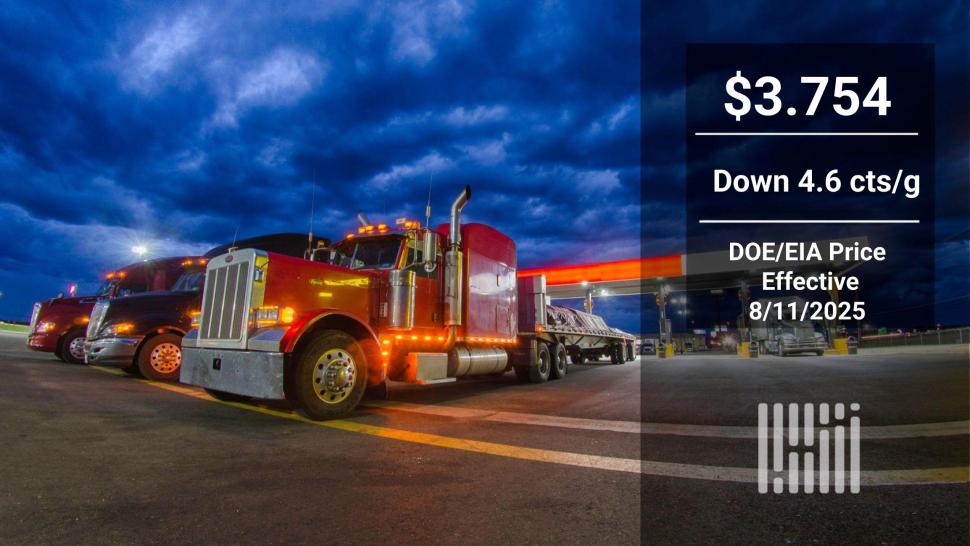
The benchmark average retail diesel price fell Monday for the third week in a row, catching up to declines in futures markets that prevailed from the end of July and into August.
The Department of Energy/Energy Information Administration average weekly retail price, which is the basis for most fuel surcharges, declined 4.6 cents/gallon to $3.754/g. The price was published Tuesday and effective Monday.
Besides being the third consecutive weekly decline, it was also the largest one-week slide since the end of June. The first two of those three were small declines, and the drop over the three weeks is just 5.8 cts/g.
The futures price of ultra low sulfur diesel (ULSD) on the CME commodity exchange has been in a relatively tight range in the last week after an earlier decline in late July and going into the first days of August. After a recent high settlement of just over $2.50/g on July 21, the price has gradually drifted down, hitting a recent low settlement of $2.2502/g on August 5. Monday’s settlement was only slightly higher at $2.291/g.
Most commentary on the reason for the decline has been focused on the on-again, off-again nature of a possible agreement between Russia and Ukraine that would bring the war between the two countries to an end.
Other factors include a gradually strengthening dollar coming on the heels of almost six months of declines. Oil prices tend to move in inverse direction to the movement of the dollar. The recent increases are said to be a factor in the downward direction of oil in the last two weeks.
One thing that has not happened is a flood of oil coming out of the OPEC+ group, despite its monthly unwinding of production cuts that have been in effect since spring 2023.
In its latest monthly report, S&P Global Commodity Insights said OPEC+ production in July, after a huge increase in June, fell by 140,000 barrels/day in July, on the back of a drop of 190,000 b/d out of countries that are part of OPEC.
The increase in quotas that OPEC+ has been putting into effect for several months have been in the range of more than 400,000 b/d to 500,000 b/d. But lifting quotas and lifting production have been different processes, and as the SPGCI report shows, one does not necessarily follow the other.
More articles by John Kingston
In brief comments, Trimble CEO introduces new product for matching capacity with shippers
Each driver’s payout in Lytx Illinois biometrics case will be between about $650 and $850
Truck sales in the second quarter might have been the worst performing metric of all
Brokerage Compliance Symposium
The day before F3. Every compliance issue you face - fraud exposure, carrier liability, FMCSA rules, cargo theft, insurance gaps - navigated by attorneys and operators defining best practices in a changing industry.
F3 Awards Dinner
The night before F3. FreightTech100 companies honored. FreightTech 25 and Shipper of Choice winners revealed live. Cocktail reception into dinner and live music - 300 industry leaders in one purpose-built room.
F3: Future of Freight Festival
Industry-defining keynotes, rapid-fire technology demos, and industry leaders networking in experiences across Chattanooga - plus the inaugural F3 Awards Dinner featuring the FreightTech and Shipper of Choice reveals.
The day before F3. Every compliance issue you face - fraud exposure, carrier liability, FMCSA rules, cargo theft, insurance gaps - navigated by attorneys and operators defining best practices in a changing industry.
The Signal at Chattanooga Choo Choo • Chattanooga, TN Register NowThe night before F3. FreightTech100 companies honored. FreightTech 25 and Shipper of Choice winners revealed live. Cocktail reception into dinner and live music - 300 industry leaders in one purpose-built room.
The Signal at Chattanooga Choo Choo • Chattanooga, TN Register NowIndustry-defining keynotes, rapid-fire technology demos, and industry leaders networking in experiences across Chattanooga - plus the inaugural F3 Awards Dinner featuring the FreightTech and Shipper of Choice reveals.
The Signal at Chattanooga Choo Choo • Chattanooga, TN Register Now