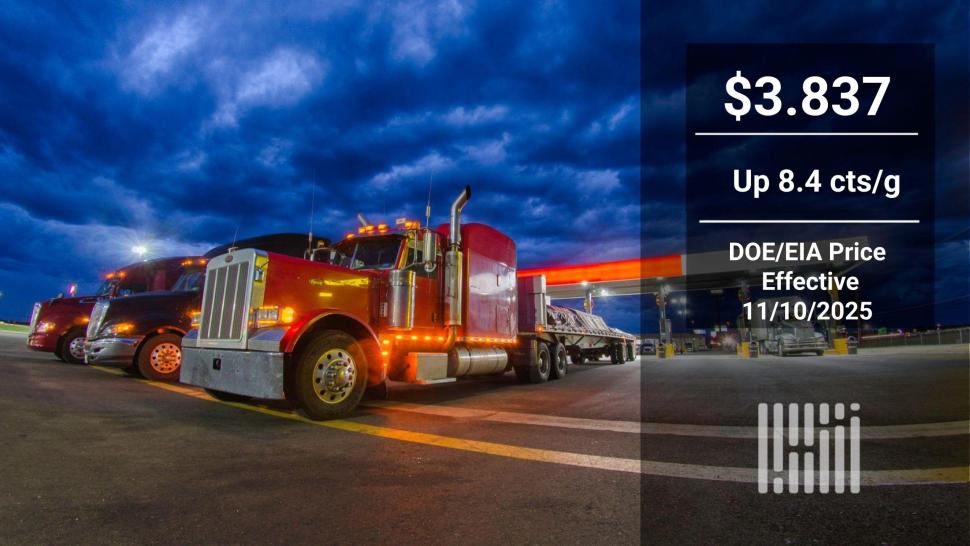
The wild ride of surging diesel prices has sent retail prices up to their highest level since summer 2024.
The average weekly retail diesel price published by the Department of Energy/Energy Information Administration (DOE/EIA) rose 8.4 cents/gallon effective Monday, published Wednesday (a day later than usual due to Veteran’s Day) to $3.837/g. The last time the price was that high was July 8, 2024, when it was $3.865/g.
It’s the third straight week of higher levels in the price used for most fuel surcharges. During that time, the price has risen from $3.62/g to its current level, an increase of 21.7 cts/g. Before this latest run of increases, the price had not risen three consecutive weeks since July.
The strength of diesel in recent weeks has been attributed primarily to levels of global inventories.
The most transparent data on inventories is the weekly EIA report on stocks. For all non-jet fuel distillates–jet fuel is a distillate but is reported separately–the size of U.S. inventories fell from 123.6 million barrels in the week ended September 26 to 111.5 million barrels in the week ended October 31. The next report will be published Thursday, reflecting inventories through Friday, November 7.
About 88% to 90% of those distillate inventories are ultra low sulfur diesel (ULSD), which is the fuel consumed by trucks.
This period on the calendar is normally a time when distillate inventories are building in anticipation of winter, as heating oil is a distillate. Instead, they are declining, helping to drive diesel higher at a rate that significantly exceeds increases in crude. It is likely, in fact, that recent gains in crude are being driven by diesel dragging it higher.
The performance of ultra low sulfur diesel (ULSD) on the CME commodity exchange has reflected the diesel strength in the petroleum complex–the oil-related contracts that trade on CME–in several ways.
- ULSD settled at $2.4053/g on November 3, its recent low. In just six trading days, that price moved up to a Tuesday settlement of $2.5757, an increase of 17.04 cts/g, up 7%.
- During that time, Brent crude, the global benchmark, climbed just 0.4%, to a settlement Tuesday of $65.16/barrel from $64.89 on November 3.
- The backwardation between first month and second month ULSD has risen from about 3 cents/gallon on October 23 to as wide as 5.94 cts/g on November 6 before easing back the past few days. Backwardation describes a market structure where the highest-priced commodity contract is the first month, which at present is for ULSD to be delivered into New York harbor in December. The second month is cheaper, the third month cheaper still until somewhere along the date curve the market flips into what is known as contango. A contango, with the price rising as the contract goes out into the future, is the structure of a perfectly balanced market, with the higher prices each month reflecting the costs of storage and the time value of money. Backwardation develops when inventories are especially tight, as they are now.
- A straight comparison of the front month price of Brent on CME versus the front month price of ULSD shot up to $1.02/gallon on Tuesday after normalizing the Brent price to gallons. It had not been at a plus-dollar spread since February 2024. Before that, it hadn’t “breached the buck” since October 2023.
- The EIA releases a weekly gasoline average retail price as well as diesel. The spread between those two–the higher price of diesel compared to gasoline–was 91 cts/g this week. It’s the highest spread since the end of 2023/early 2024.
And because markets are volatile, diesel Wednesday was going through a big selloff. ULSD Wednesday at approximately 11 a.m. was down 8.93 cts/g to $2.4864/, a drop of 3.47% from Tuesday’s settlement. That was near the low of the day. And while the ULSD decline was larger than the slide in Brent at that hour, which was down 3.15%, the difference is small enough that it does not suggest a significant unwinding of the Brent-diesel trading play that has grown the past few weeks.
What appeared to be driving oil prices lower Wednesday was the monthly report from OPEC.
While the International Energy Agency has been forecasting a supply/demand scenario that would see the latter far exceed the former, OPEC/s monthly report had been more bullish. But in its latest forecast, the group said it expects supply and demand to be in balance, which is a more bearish stance than what it had been saying recently. That report was being seen Wednesday as the likely driver behind lower oil prices.
More articles by John Kingston
RXO faces a rate squeeze: what it means for the 3PL
Beautiful women, open doors and drivers: trucking cybersecurity risks proliferate
Aifleet’s bold move: cutting its fleet size to survive in freight recession
Brokerage Compliance Symposium
The day before F3. Every compliance issue you face - fraud exposure, carrier liability, FMCSA rules, cargo theft, insurance gaps - navigated by attorneys and operators defining best practices in a changing industry.
F3 Awards Dinner
The night before F3. FreightTech100 companies honored. FreightTech 25 and Shipper of Choice winners revealed live. Cocktail reception into dinner and live music - 300 industry leaders in one purpose-built room.
F3: Future of Freight Festival
Industry-defining keynotes, rapid-fire technology demos, and industry leaders networking in experiences across Chattanooga - plus the inaugural F3 Awards Dinner featuring the FreightTech and Shipper of Choice reveals.
The day before F3. Every compliance issue you face - fraud exposure, carrier liability, FMCSA rules, cargo theft, insurance gaps - navigated by attorneys and operators defining best practices in a changing industry.
The Signal at Chattanooga Choo Choo • Chattanooga, TN Register NowThe night before F3. FreightTech100 companies honored. FreightTech 25 and Shipper of Choice winners revealed live. Cocktail reception into dinner and live music - 300 industry leaders in one purpose-built room.
The Signal at Chattanooga Choo Choo • Chattanooga, TN Register NowIndustry-defining keynotes, rapid-fire technology demos, and industry leaders networking in experiences across Chattanooga - plus the inaugural F3 Awards Dinner featuring the FreightTech and Shipper of Choice reveals.
The Signal at Chattanooga Choo Choo • Chattanooga, TN Register Now