




March data from Cass Information Systems showed freight shipment declines narrowed while rates continued to move higher.
Cass’ (NASDAQ: CASS) multimodal shipments index increased 3% sequentially in March (up 1% seasonally adjusted), building on a 10.4% increase in February (plus-4.3% seasonally adjusted). The index was down just 4.5% year over year in the recent month, the smallest y/y decline since June. On a two-year comparison, freight volumes tracked by Cass were off less than 10%.
| March 2026 | y/y | 2-year | m/m | m/m (SA) |
| Shipments | -4.5% | -9.5% | 3.0% | 1.0% |
| Expenditures | 4.2% | 2.1% | 4.9% | 2.4% |
| TL Linehaul Index | 1.8% | 3.4% | -0.5% | NM |
The dataset has lagged other indicators, which are showing a more upbeat demand environment.
Cass data includes a significant mix of less-than-truckload transactions. Less-than-truckload demand is weighted to the industrial economy, which has been under pressure for the majority of the past three years. However, an LTL inflection may be nearing as the Purchasing Managers’ Index for manufacturing has signaled growth in the first three months of the year.
The Tuesday report said the shipments index is “starting to catch up with other indicators” as “tightness in dry van truckload (TL) conditions is starting to radiate to other markets.” The index is expected to be off 5% y/y in April, assuming normal seasonal patterns hold, moving into positive territory in the back half of the year (plus-1.5% is the current forecast).
Even with the volume headwind, Cass’ expenditures index, which measures total freight spend including fuel, increased 4.9% from February (up 2.4% seasonally adjusted). A 4.2% y/y increase during the month coupled with the 4.5% decline in volumes implies actual freight rates were roughly 9% higher in the month. However, changes in freight mix can alter the implied rate assumption.
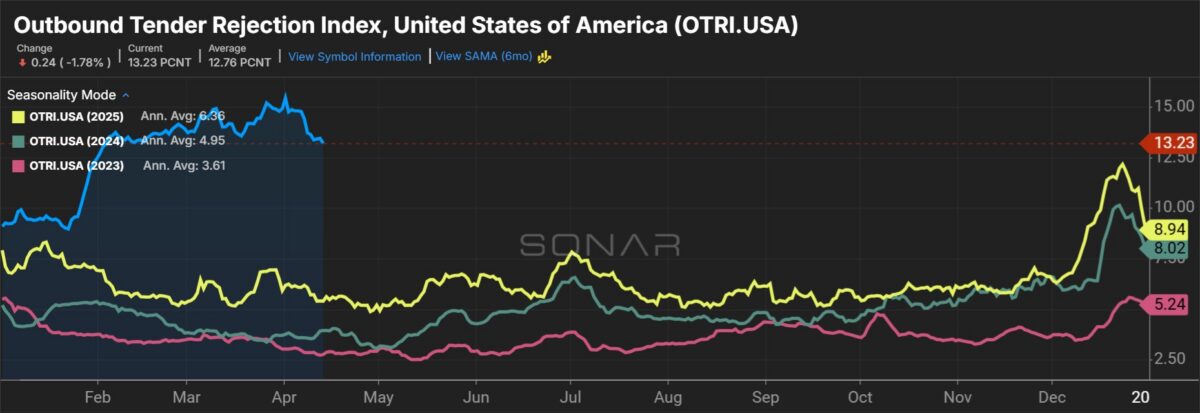
The report said a recent survey of midsize and large fleets showed some tightening in driver availability as new non-domicile CDL rules took effect in the month.
“Driver availability is a key component of capacity in the market, and additional scarcity seems likely, supporting higher freight rates,” the report said.
Cass’ TL linehaul index, which tracks rates excluding fuel and accessorial surcharges, increased 1.8% y/y in March, marking 15 consecutive y/y increases. A modest 0.5% step down from February was the first sequential decline in seven months. (The dataset includes for-hire spot and contract rates.)
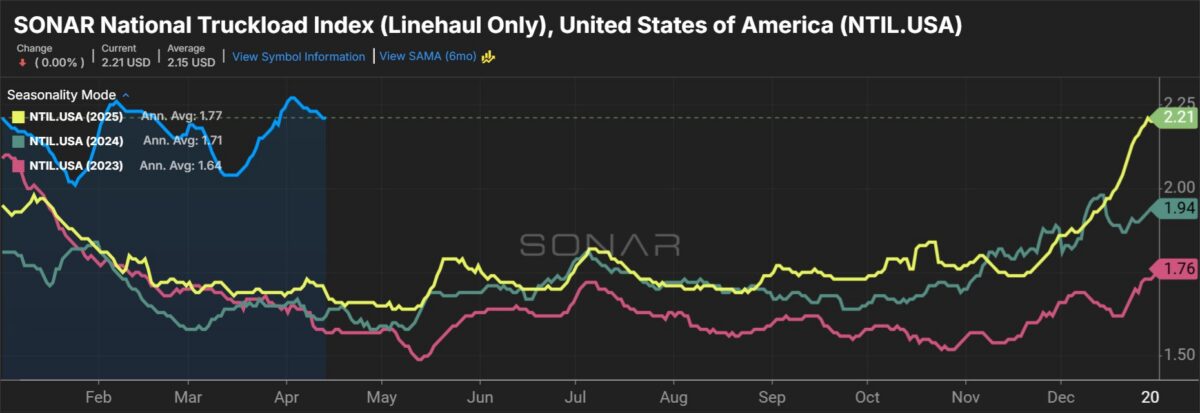
Higher diesel fuel prices, which pushed some operators to the sidelines, offset incremental capacity availability as carrier networks recovered from severe winter storms, the report said.
“Considerable increases in contract rates are likely for the truckload market. After a four-year bottoming phase of the for-hire cycle, we believe we’ve moved to the early cycle phase where capacity becomes short and rates rise.”
Data used in the indexes comes from freight bills paid by Cass, a provider of payment management solutions. Cass processes $37 billion in freight payables annually on behalf of customers.
Brokerage Compliance Symposium
The day before F3. Every compliance issue you face - fraud exposure, carrier liability, FMCSA rules, cargo theft, insurance gaps - navigated by attorneys and operators defining best practices in a changing industry.
F3 Awards Dinner
The night before F3. FreightTech100 companies honored. FreightTech 25 and Shipper of Choice winners revealed live. Cocktail reception into dinner and live music - 300 industry leaders in one purpose-built room.
F3: Future of Freight Festival
Industry-defining keynotes, rapid-fire technology demos, and industry leaders networking in experiences across Chattanooga - plus the inaugural F3 Awards Dinner featuring the FreightTech and Shipper of Choice reveals.
The day before F3. Every compliance issue you face - fraud exposure, carrier liability, FMCSA rules, cargo theft, insurance gaps - navigated by attorneys and operators defining best practices in a changing industry.
The Signal at Chattanooga Choo Choo • Chattanooga, TN Register NowThe night before F3. FreightTech100 companies honored. FreightTech 25 and Shipper of Choice winners revealed live. Cocktail reception into dinner and live music - 300 industry leaders in one purpose-built room.
The Signal at Chattanooga Choo Choo • Chattanooga, TN Register NowIndustry-defining keynotes, rapid-fire technology demos, and industry leaders networking in experiences across Chattanooga - plus the inaugural F3 Awards Dinner featuring the FreightTech and Shipper of Choice reveals.
The Signal at Chattanooga Choo Choo • Chattanooga, TN Register Now