




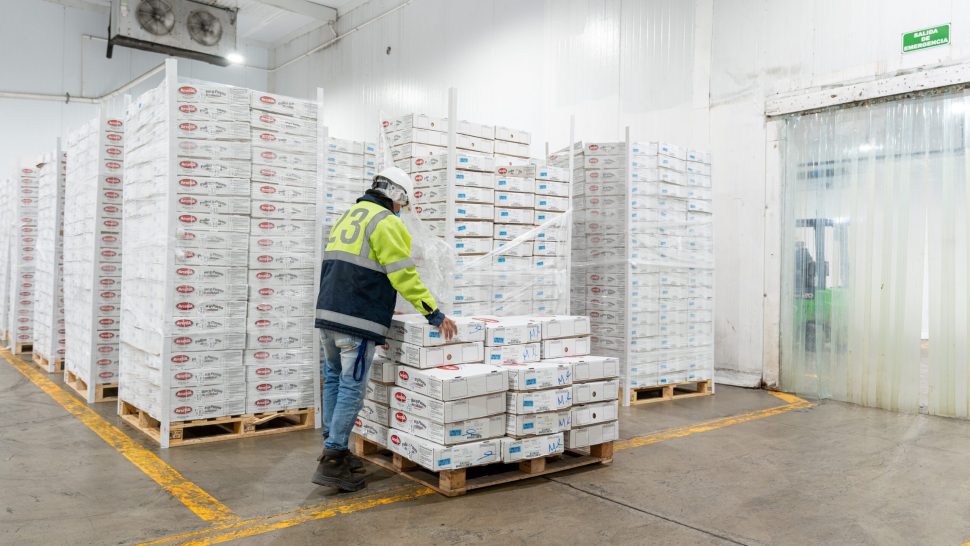
The U.S. cold storage market may be nearing the end of a downturn, which was triggered by a record surge in new facility construction and slowing consumer spending. As a result of pandemic-fueled overbuilding and declining food inventory trends, vacancy rates have climbed to a 20-year high. Despite these headwinds, the market recorded roughly 3.5 million square feet of positive absorption in 2025, signaling that underlying demand is solid, according to a report from Newmark.
The Thursday market report from the commercial real estate services firm noted several headwinds still shaping the near-term outlook. Persistently high food prices continue to strain consumer budgets, which is “slowing consumption growth.” Inventory carrying costs remain high as rents have doubled since 2020 and interest rates remain elevated.
The firm expects the supply-demand gap to narrow this year as the development pipeline moderates. “The U.S. cold storage pipeline has dropped from record highs to roughly 5.9 MSF, its lowest level since 2020,” the report said. However, supply will likely continue to outpace absorption in the immediate future as projects currently under construction are completed.
Newmark noted a “flight to quality” is creating a bifurcated market between new and old assets. Occupants are exploring build-to-suit projects and increasingly prioritizing automation, energy efficiency and high-throughput capabilities. An exodus out of older facilities facing functional obsolescence accounted for 73% of industry vacancies last year. Legacy locations carried a 7.6% vacancy rate, while modern sites that went into service prior to the pandemic sat only 2.7% vacant in the fourth quarter.
Beyond the cyclical reset, several favorable catalysts support the sector’s long-term health, the firm said.
“Fundamentally, the sector continues to benefit from durable structural drivers: population growth; expansion of domestic food production and North American agricultural trade; the rise of online grocery sales; and the complex, expanding needs of pharmaceutical and biologics cold chains.”
It noted e-grocery sales were up 32% year over year in the fourth quarter. These networks require more extensive footprints to meet tight customer delivery windows.
“As order mix continues to shift toward delivery and ship-to-home—both more cold-chain intensive than pickup—retailers are scaling capacity by leveraging existing stores, partnering with 3PLs, and selectively developing dedicated fulfillment nodes to meet rising expectations for speed and flexibility,” the report said.
Also, some large metro areas like Dallas-Fort Worth and Houston are seeing notable population growth, which is projected to create demand for millions of additional square feet of capacity over the next decade.
Further, the rise of GLP-1 drugs and other biologics is expanding the need for specialized temperature-controlled storage space.
The report said the weight-loss drugs could cut caloric demand by up to 3% ($50 billion annually). However, it said the event is more likely a “reallocation of demand across food categories rather than a simple contraction,” pointing to a likely shift in consumption trends toward proteins and fresh produce. A change in GLP-1 delivery from injectable to oral, however, would be a headwind for the industry.
Brokerage Compliance Symposium
The day before F3. Every compliance issue you face - fraud exposure, carrier liability, FMCSA rules, cargo theft, insurance gaps - navigated by attorneys and operators defining best practices in a changing industry.
F3 Awards Dinner
The night before F3. FreightTech100 companies honored. FreightTech 25 and Shipper of Choice winners revealed live. Cocktail reception into dinner and live music - 300 industry leaders in one purpose-built room.
F3: Future of Freight Festival
Industry-defining keynotes, rapid-fire technology demos, and industry leaders networking in experiences across Chattanooga - plus the inaugural F3 Awards Dinner featuring the FreightTech and Shipper of Choice reveals.
The day before F3. Every compliance issue you face - fraud exposure, carrier liability, FMCSA rules, cargo theft, insurance gaps - navigated by attorneys and operators defining best practices in a changing industry.
The Signal at Chattanooga Choo Choo • Chattanooga, TN Register NowThe night before F3. FreightTech100 companies honored. FreightTech 25 and Shipper of Choice winners revealed live. Cocktail reception into dinner and live music - 300 industry leaders in one purpose-built room.
The Signal at Chattanooga Choo Choo • Chattanooga, TN Register NowIndustry-defining keynotes, rapid-fire technology demos, and industry leaders networking in experiences across Chattanooga - plus the inaugural F3 Awards Dinner featuring the FreightTech and Shipper of Choice reveals.
The Signal at Chattanooga Choo Choo • Chattanooga, TN Register Now