Following several days of declining prices in the key futures market, the benchmark diesel price used for most fuel surcharges recorded its biggest one-week decline in about two months.
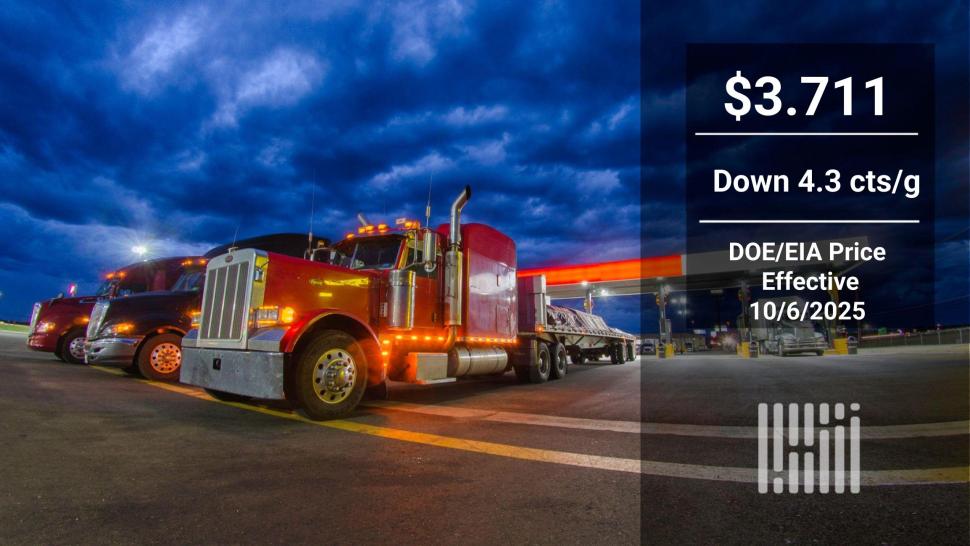
The Department of Energy/Energy Information Administration average weekly retail diesel price declined 4.3 cents/gallon to $3.711/g, effective Monday and posted Tuesday. It’s the lowest price since a $3.708/g posting on August 25, and it’s the biggest one-week decline since a 4.6 cts/g slide on August 11.
It still fits into the tight range that the DOE/EIA diesel price has found itself in since the second week of August. The low was that August 25 price, and the high was $3.766/g on September 8. Every price since August 11 has fit in between those numbers.
After a sharp decline in oil markets last week, there was a slight rebound Monday and into Tuesday, primarily on the news that over the weekend the OPEC+ group chose not to add as much oil back on to the market as had been anticipated.
Ultra low sulfur diesel on the CME commodity exchange declined about 19.25 cts/g in just five days of late September/early October trading through Friday. A recent high settlement of $2.4289/g on September 26 fell hard by Friday to a $2.2363/g settlement Friday before rebounding in the first two days of trading this week following the OPEC+ news.
At approximately 11:30 am EDT Tuesday, ULSD was up 1.33 cts/g for the day at $2.2676/g.
OPEC+, meeting virtually, said it would increase output in November by 137,000 barrels/day, the same amount it plans on increasing output this month, according to various news reports. That was considered slightly bullish for the market since there had been some anticipation OPEC+ might go for a higher output increase.
The smaller-than-anticipated increase came with speculation that maybe the group can’t plan on adding more to world supply because it doesn’t have the capacity to do so, a sentiment that certainly would be considered bullish.
But at the same time, there is increasing reference to longer-term models that see a glut developing in 2026. Those models also predicted a similar excess this year but heavy Chinese buying is seen as having sucked up a lot of those added supplies.
Without any guarantee that will occur next year, the bullish case has been having a day.
A tsunami of oil
Javier Blas, an opinion columnist with a long history covering oil and commodity markets, described the possible supply glut as a “tsunami.”
That term was used in a broader discussion about where to store that crude if such an excess develops. The incentive to store oil is created by the shape of the forward curve in a commodity market. Are prices for delivery in future months enough to incentivize putting oil into storage, given the cost of storage and the cost of money to finance it which Blas notes is at higher than normal levels?
To get to a price chart that incentivizes storage, the market needs to develop into a steeper structure known as contango, with forward prices more expensive than current prices.
Oil markets are now the opposite of that, a structure called backwardation. And Blas’ argument is that the structure will need to flip to find a home for that excess oil.
Discussing the crude market, Blas said the market developing into a contango is inevitable. And it might get there by taking current prices lower.
“The only question is how wide it will get, and whether it will be driven by lower spot rates or higher forward prices — and my guess is that the $60-a-barrel threshold looks extremely vulnerable to the tsunami of supply that’s about to be unleashed,” Blas wrote.
More articles by John Kingston
ATBS: how a driver can make it in a tough trucking market
SCOTUS grants review on broker liability case; fate of 2nd unclear
Brokerage Compliance Symposium
The day before F3. Every compliance issue you face - fraud exposure, carrier liability, FMCSA rules, cargo theft, insurance gaps - navigated by attorneys and operators defining best practices in a changing industry.
F3 Awards Dinner
The night before F3. FreightTech100 companies honored. FreightTech 25 and Shipper of Choice winners revealed live. Cocktail reception into dinner and live music - 300 industry leaders in one purpose-built room.
F3: Future of Freight Festival
Industry-defining keynotes, rapid-fire technology demos, and industry leaders networking in experiences across Chattanooga - plus the inaugural F3 Awards Dinner featuring the FreightTech and Shipper of Choice reveals.
The day before F3. Every compliance issue you face - fraud exposure, carrier liability, FMCSA rules, cargo theft, insurance gaps - navigated by attorneys and operators defining best practices in a changing industry.
The Signal at Chattanooga Choo Choo • Chattanooga, TN Register NowThe night before F3. FreightTech100 companies honored. FreightTech 25 and Shipper of Choice winners revealed live. Cocktail reception into dinner and live music - 300 industry leaders in one purpose-built room.
The Signal at Chattanooga Choo Choo • Chattanooga, TN Register NowIndustry-defining keynotes, rapid-fire technology demos, and industry leaders networking in experiences across Chattanooga - plus the inaugural F3 Awards Dinner featuring the FreightTech and Shipper of Choice reveals.
The Signal at Chattanooga Choo Choo • Chattanooga, TN Register Now