




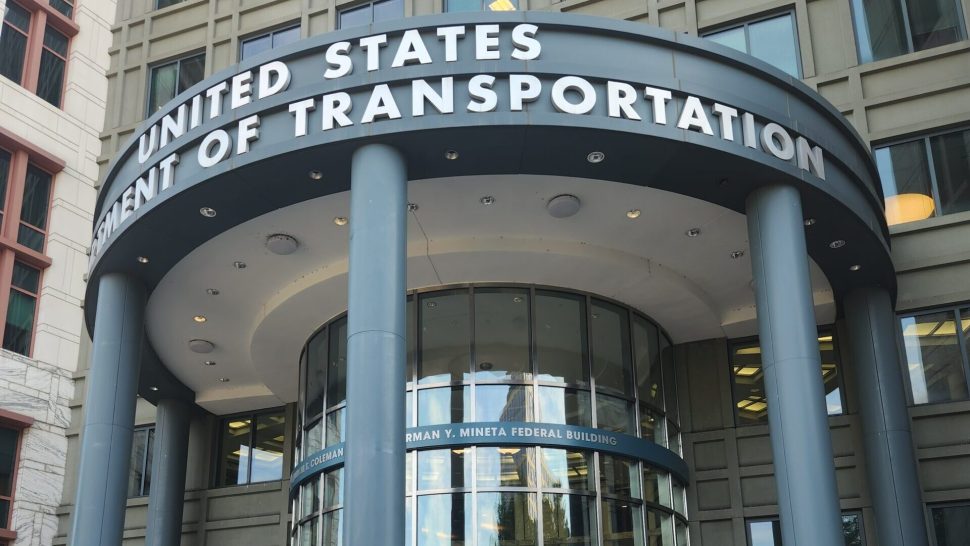
WASHINGTON — A panel of private-sector advisors to the U.S. Department of Transportation is recommending that DOT coordinate two major infrastructure projects that could have significant implications for truck markets.
A tunnel under the Hudson River connecting New Jersey and Manhattan dedicated specifically for trucks and the construction of 1,000 truck parking facilities to add 40,000 new parking spaces for trucks were among plans discussed at the second meeting of the DOT Advisory Board on Wednesday.
“We wanted to start with what we thought would be large-scale projects with national implications – and there’s no shortage of them,” Gregg Reuben, the advisory board’s chair, told Transportation Secretary Sean Duffy, who attended the meeting.
The truck tunnel would be the freight piece of a new transportation corridor – which Reuben recommended be dedicated as a “9/11 Memorial Project” – that would include a multi-modal bridge spanning the Hudson River that would accommodate passenger vehicles, bicyclists, and pedestrians.
“We believe it can all be done without any taxpayer burdens,” Reuben said. “It could be set up as a public-private partnership, with DOT’s leadership and local leadership.”
Reuben contended that, with an estimated 125,000 trucks coming into New York per day, “the entire northeast – and probably even the country – would be able to benefit from the improved freight flow,” he said.
“There’s just not enough thru-way for them. And that’s only going to increase – some estimates are up to 30% over the next five years in terms of truck input coming through.
“We believe that the relief that we could provide to that chokepoint would increase the throughput for both cars and trucks and eliminate a lot of delays, fuel waste, and emissions – there’s an environmental benefit to doing this.”
Duffy, who pointed out at the meeting that President Trump “believes no project is too big,” asked about the prospects for buy-in on the project from state and local governments.
“Certainly stakeholders in New York, New Jersey, the New York port authority would have to be brought along,” a board member responded.
“For the communities and the economy, it would be a game-changer project. And being able to do this as a [public-private partnership] without requiring the largesse of the federal taxpayer, if there’s anywhere in the country it can be done, it’s in that dense New York-New Jersey environment.”
1,000 parking facilities in 3 years
Fixing America’s truck parking problem was also brought up at the meeting, and to help fix it, the board recommended DOT take the lead in sponsoring 1,000 DOT-certified truck parking facilities over the next three years to create 40,000 new truck parking spaces that would meet minimum standards of safety, quality, and amenities.
Reuben, who is founder and CEO of Centerpark, a New York City-based parking management company, said that “we hot-mapped the country to identify areas where truck parking shortages are occurring and where we think those parking facilities can be well-served and utilized.”
The plan would include recycling “unproductive and vacant properties and turning them into a higher better use that would be well-served,” Reuben said.
“Once we begin to create these DOT-approved facilities, and the reservation system that could allow the drivers and logistics companies to identify where these truck parking facilities are, they can make advanced reservations so they can plan their routes accordingly.”
The board’s truck parking expansion plan envisions going beyond providing rest spaces to incorporating “digitally enabled consolidation centers” within them – which Reuben said would improve truck-hauling capacity.
He noted that while roughly 90% of available trucks are being used, the load capacities of individual trucks average only about 50%.
“If we can get those load capacities up to 80% the impact would be profound,” Reuben said, “by getting goods delivered more efficiently and expeditiously without putting more vehicles on the road and without more strain on the current infrastructure.”
Reuben emphasized that the freight tunnel and parking projects are still in the early recommendation stage and have not been finalized.
Related articles:
Brokerage Compliance Symposium
The day before F3. Every compliance issue you face - fraud exposure, carrier liability, FMCSA rules, cargo theft, insurance gaps - navigated by attorneys and operators defining best practices in a changing industry.
F3 Awards Dinner
The night before F3. FreightTech100 companies honored. FreightTech 25 and Shipper of Choice winners revealed live. Cocktail reception into dinner and live music - 300 industry leaders in one purpose-built room.
F3: Future of Freight Festival
Industry-defining keynotes, rapid-fire technology demos, and industry leaders networking in experiences across Chattanooga - plus the inaugural F3 Awards Dinner featuring the FreightTech and Shipper of Choice reveals.
The day before F3. Every compliance issue you face - fraud exposure, carrier liability, FMCSA rules, cargo theft, insurance gaps - navigated by attorneys and operators defining best practices in a changing industry.
The Signal at Chattanooga Choo Choo • Chattanooga, TN Register NowThe night before F3. FreightTech100 companies honored. FreightTech 25 and Shipper of Choice winners revealed live. Cocktail reception into dinner and live music - 300 industry leaders in one purpose-built room.
The Signal at Chattanooga Choo Choo • Chattanooga, TN Register NowIndustry-defining keynotes, rapid-fire technology demos, and industry leaders networking in experiences across Chattanooga - plus the inaugural F3 Awards Dinner featuring the FreightTech and Shipper of Choice reveals.
The Signal at Chattanooga Choo Choo • Chattanooga, TN Register Now