In The Tempest, Shakespeare wrote, “what’s past is prologue,” meaning history sets the context for the present and dictates future events. Except, apparently, when it comes to transcontinental railroads.
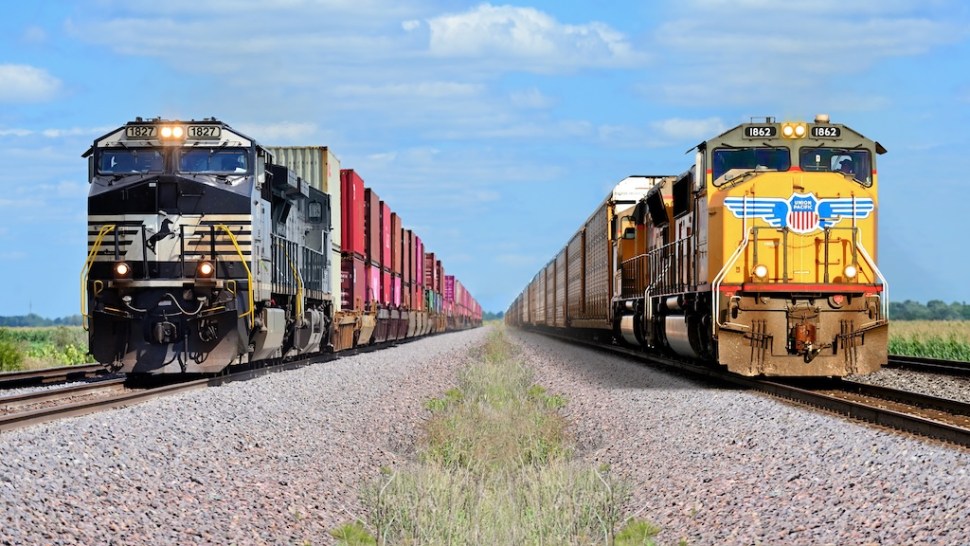
In an exclusive interview with FreightWaves, Union Pacific Chief Executive Jim Vena fired back at critics of his blockbuster merger with Norfolk Southern, insisting it won’t have the lasting price and service issues that have accompanied past transportation consolidations even as it reshapes the U.S. supply chain.
“People have to quit looking backwards and look at what’s possible,” Vena said by phone from UP’s Omaha headquarters.
Union Pacific (NYSE: UNP) has faced withering criticism from industry observers who declared the math supporting the $85-billion transaction with NS (NYSE: NSC) didn’t add up.

Bur Vena said it was a “mistaken view” to see it just through the numbers.“You have to look at the quality aspect, as well. The people and companies that manufacture and produce the goods we consume every day, we want to be able to give them a better rail system, one that allows them to compete against the world.”
At the same time, numbers are at the crux of the merger proposal: 1.4 million truckloads converted to intermodal in 36 months, and 2 million truckloads diverted to rail annually.
More numbers: The railroads say the merger will shave up to 2 days off a typical 5 to 7 day journey for railcars moving from coast to coast. That’s a radical game-changer making rail competitive with transcontinental freight moving by truck; some industry executives have said privately that the time savings could be even greater. The single-line route will also open up the Midwest watershed, where rail has long grappled with a tangle of competing lines and interchange issues.
The questions surrounding UP-NS only intensified after the Surface Transportation Board in December rejected the initial merger filing as incomplete, and made explicit requests for more information including forward-looking market data and agreement details.
The companies expect to file an updated application in April.
Vena defended not including some data for competitive reasons — “you have to be careful you don’t give everything away to your competitors” — and repeated assertions that the vast majority of growth in the long term will come from taking share away from trucks. But some analysts took issue with the railroads in the application categorizing dray-to-rail conversions and rail-to-rail market share shifts as growth, instead of just truck-to-rail and the opening of all-new markets.
Vena fairly bristles at the critiques, and questions some credentials.
“It’s always easy to be on the negative side if you’re not out to deliver,” said Vena, pointing out that UP is atop industry analytics for efficiency, revenue and safety. “Our people are comfortable with what’s there and the data we have calculated.”
The company also redacted Schedule 5.8, which specifies “Materially Burdensome Regulatory Conditions” that would allow UP to walk away from the deal.
“With a transaction as large as ours, there will always be protection for both sides,” says Vena, who compared it to the contract terms for the 17 homes he and his family have lived in during his railroad career. “At some point we have the right to walk away, we have an out. But, there’s no walking away without a penalty. If the STB had told us to put it [the terms] out, we would have. We asked them to keep it confidential; it’s up to them. Why would you ever tell your competitors the financial details? It’s ridiculous, it really is. They would love to see what we have.”
The STB recently proposed a reset of reciprocal switching rules, which if approved would give some shippers a choice of rail carriers. Vena says that’s not a condition to scrap the merger. “I’m all for reciprocal switching, it gives optionality. I’m glad the STB came out with that reset.”
Asked about UP’s recent history of dismal growth, Vena says a focus on service can help optimize what the railroad can do, and answer the STB’s ‘higher bar’ requirement that a merger not only preserves competition, but enhances it.
“We’re a strong and well-run company,” says Vena. “Today, we have a low double-digit share of freight that is is moved every day in America. That’s a of tonnage. At the end of the day, we have to ask, does it make movement of goods more competitive? It will be better for the customer, and better for the country. We have to deliver more optionality and be able to take trucks off the highway, and that’s what we’re doing. To make shippers more competitive in the markets they’re in, we need to understand that market, and we need to win with our customers.”
Long term, Vena says, “50% of UP’s business is intermodal, and the merger will bring that segment to a whole new level of capability, so you need to tackle that, that’s where the growth is. We continue to work with customers to open up new markets, and spend capital to give them optionality. We’ve developed a steel plant in Phoenix, new chemical plants in Louisiana, new facilities across the network for intermodal.”
Vena said UP will continue to be efficient with its outlay for motive power, continuing to rebuild older locomotives rather than buy new. Union Pacific and Wabtec in later 2025 signed an agreement worth about $1.2 billion to modernize UP’s AC4400-series locomotives, the fourth such rebuild program since 2018. That will bring the carrier’s total to 1,700 rebuilt units.
“We’re still spending a lot to modernize, from the frame up, like new,” says Vena, a former locomotive engineer. “That is way more cost- effective, delivers onboard components, fuel efficiency, and reliability, we’re very comfortable doing that. If there was a product that was substantially better we’d buy it. The plan is to continue to modernize.”
Vena pointed out that the railroad has 1,500 ‘excess’ locomotives.
Still, the recent history of transportation mergers among airlines and railroads isn’t a study in customer-facing benefits where fares, rates and choices are concerned. Vena points out that railroads have succeeded despite the structural limitations of a heavily-regulated, capital-intensive industry.
“The cost structure of railroads over the past 20 years is nowhere near inflation,” he says. “Our customers are very large and very sophisticated companies — Cargill, Exxon, ADM, Chevron, Walmart, Fedex, UPS — major internationals, and they push every year to help them be better in the marketplace. We always ask, ‘What service are we providing, and how can we make that better?’ My God, as a business, where do we go? Always look to be operationally efficient in how you use your assets, faster, with more fluidity, and less touch points [per railcar].”
As for service issues, Vena said that, sometimes, the railroad has to work with what it’s given.
“Railroads aren’t precision operations because customers aren’t always precise, and you don’t know what they’re going to give you on a daily basis. People need to get off of this ‘driven by OR [operating ratio]’ thinking, that’s not what drives us.”
Asked about Ancora, the activist investor that forced leadership changes at NS and CSX (NASDAQ: CSX), Vena says, “At the end of the day, companies that are well-operated that fulfill and look for the greatest opportunity to deliver for shareholders and customers, and be the best in the industry, no activist will ever be able to take that company on. The American system of capitalism makes people look at companies that aren’t performing in the marketplace. It keeps your feet to the fire, to deliver as a CEO, that’s your job.
As far as NS, “There are always going to be activists who are not being fair about what they’re doing. Shareholders vote and decide whether management has a good plan or not. The outcome of the [Ancora] campaign was that the management team proved to shareholders they had the right plan moving ahead.
“There is not another system that’s better.”
Subscribe to FreightWaves’ Rail e-newsletter and get the latest insights on rail freight right in your inbox.
Read more articles by Stuart Chirls here.
Related coverage:
Trucking jobs post slight decline in unexpected total payroll drop
Intermodal lags carloads in latest U.S. rail freight data
Brokerage Compliance Symposium
The day before F3. Every compliance issue you face - fraud exposure, carrier liability, FMCSA rules, cargo theft, insurance gaps - navigated by attorneys and operators defining best practices in a changing industry.
F3 Awards Dinner
The night before F3. FreightTech100 companies honored. FreightTech 25 and Shipper of Choice winners revealed live. Cocktail reception into dinner and live music - 300 industry leaders in one purpose-built room.
F3: Future of Freight Festival
Industry-defining keynotes, rapid-fire technology demos, and industry leaders networking in experiences across Chattanooga - plus the inaugural F3 Awards Dinner featuring the FreightTech and Shipper of Choice reveals.
The day before F3. Every compliance issue you face - fraud exposure, carrier liability, FMCSA rules, cargo theft, insurance gaps - navigated by attorneys and operators defining best practices in a changing industry.
The Signal at Chattanooga Choo Choo • Chattanooga, TN Register NowThe night before F3. FreightTech100 companies honored. FreightTech 25 and Shipper of Choice winners revealed live. Cocktail reception into dinner and live music - 300 industry leaders in one purpose-built room.
The Signal at Chattanooga Choo Choo • Chattanooga, TN Register NowIndustry-defining keynotes, rapid-fire technology demos, and industry leaders networking in experiences across Chattanooga - plus the inaugural F3 Awards Dinner featuring the FreightTech and Shipper of Choice reveals.
The Signal at Chattanooga Choo Choo • Chattanooga, TN Register Now