




FedEx Corp. lowered expectations for its less-than-truckload unit, FedEx Freight, Thursday after the market closed. A planned spin off of the LTL business, into a separate publicly traded company, is now scheduled for June 1.
During FedEx Freight’s fiscal second quarter ended Nov. 30, revenue fell 1.7% year over year to $2.14 billion. A 2.8% decline in tonnage was partially offset by a 1.1% increase in revenue per hundredweight, or yield.
Shipments were down 3.9% y/y and 2.9% lower than the quarter ended Aug. 31. Weight per shipment was up 1.2% y/y. (The increase in shipment weight was a modest headwind to the yield metric.)
Manufacturing data for November showed the industrial complex has been in a slump for 35 of the past 37 months. The Purchasing Managers’ Index registered a 48.2 reading in the latest month, 50 basis points worse than October. (A reading above 50 signals expansion while one below 50 indicates contraction.) The new orders index — an indicator of future activity — fell 200 bps to 47.4.
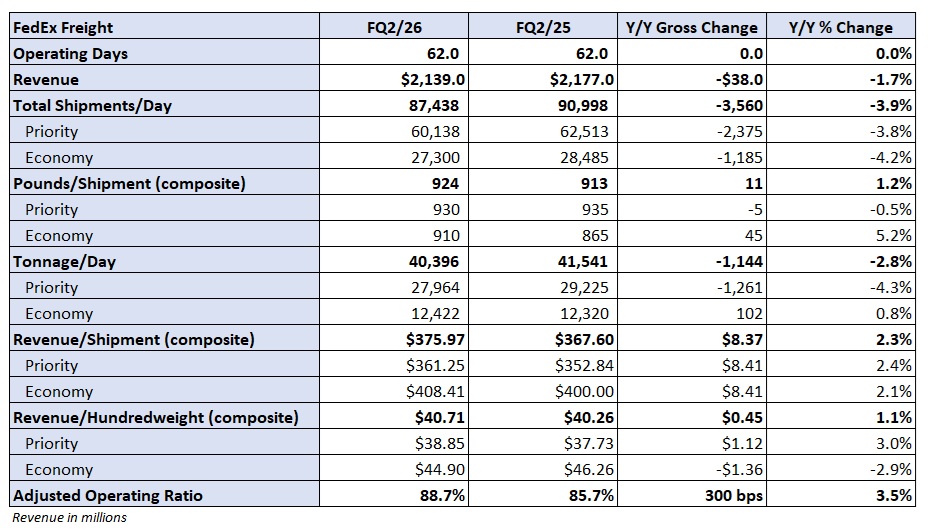
The LTL unit reported an adjusted operating ratio (inverse of operating margin) of 88.7%, which was 300 bps worse y/y. The adjusted OR excluded $152 million in one-time costs associated with the spinoff.
Top-line weakness and a 110-bp y/y increase in salaries, wages and benefits expenses (as a percentage of revenue) were the primary headwinds. FedEx Freight has completed over 85% of the hiring for what will become a 400-person LTL sales team. Hiring and other costs were a $25-million (120-bp) headwind in the period.
Revenue at FedEx Freight is now expected to decline slightly y/y in the fiscal year ending May 31. (The company was previously calling for a low-single-digit y/y increase in revenue.) Daily shipments are forecast to decline by a low-single-digit percentage, which should be partially offset by a modest increase in yields. Lower volumes are expected to continue to be a drag on margins. (Operating income is now expected to decline $300 million y/y versus the prior forecast for a $100 million increase.)
FedEx Freight’s previously announced general rate increase of 5.9% (on average) will take effect on Jan. 5.
FedEx Corp. raises guidance
FedEx (NYSE: FDX) reported consolidated adjusted earnings per share of $4.82 for its fiscal second quarter. The result was 71 cents higher than the consensus estimate and 77 cents higher y/y. Revenue of $23.5 billion was $700 million ahead of expectations.
The company raised guidance for its consolidated operations in fiscal year 2026.
It now expects consolidated revenue to increase by 5% to 6% y/y (prior outlook called for a 4% to 6% increase) and full-year adjusted EPS to range from $17.80 to $19 ($17.20 to $19 previously). The adjusted EPS number excludes several items, including retirement plan accounting adjustments, costs associated with the spinoff, and business optimization costs, among others.
Shares of FedEx Freight will be listed on the New York Stock Exchange under the ticker FDXF. The unit will hold an investor day on April 8 in New York City.
Brokerage Compliance Symposium
The day before F3. Every compliance issue you face - fraud exposure, carrier liability, FMCSA rules, cargo theft, insurance gaps - navigated by attorneys and operators defining best practices in a changing industry.
F3 Awards Dinner
The night before F3. FreightTech100 companies honored. FreightTech 25 and Shipper of Choice winners revealed live. Cocktail reception into dinner and live music - 300 industry leaders in one purpose-built room.
F3: Future of Freight Festival
Industry-defining keynotes, rapid-fire technology demos, and industry leaders networking in experiences across Chattanooga - plus the inaugural F3 Awards Dinner featuring the FreightTech and Shipper of Choice reveals.
The day before F3. Every compliance issue you face - fraud exposure, carrier liability, FMCSA rules, cargo theft, insurance gaps - navigated by attorneys and operators defining best practices in a changing industry.
The Signal at Chattanooga Choo Choo • Chattanooga, TN Register NowThe night before F3. FreightTech100 companies honored. FreightTech 25 and Shipper of Choice winners revealed live. Cocktail reception into dinner and live music - 300 industry leaders in one purpose-built room.
The Signal at Chattanooga Choo Choo • Chattanooga, TN Register NowIndustry-defining keynotes, rapid-fire technology demos, and industry leaders networking in experiences across Chattanooga - plus the inaugural F3 Awards Dinner featuring the FreightTech and Shipper of Choice reveals.
The Signal at Chattanooga Choo Choo • Chattanooga, TN Register Now