




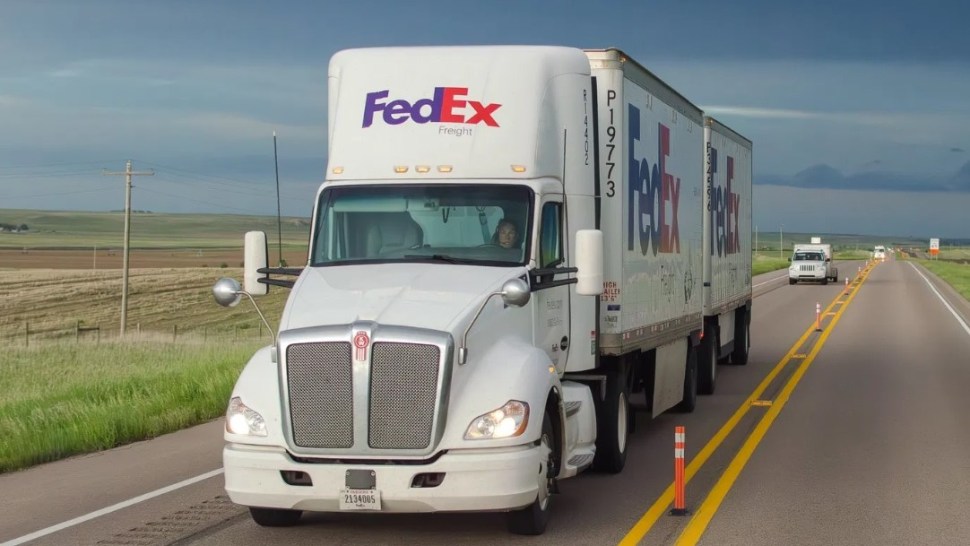
The nation’s largest less-than-truckload carrier, FedEx Freight, is on track to become a standalone public company by June of next year. Parent company FedEx said Thursday it plans to spend $600 million enhancing IT infrastructure and systems ahead of the spinoff.
Join the leaders shaping freight’s future at
F3: Future of Freight Festival, Oct 21-22.
Network with the industry’s best and discover what’s next.
Shares of FedEx Freight will be listed on the New York Stock Exchange under the ticker FDXF.
FedEx (NYSE: FDX) reported consolidated adjusted earnings per share of $3.83 for its fiscal first quarter ended Aug. 31 after the market closed on Thursday. That was 22 cents higher than the consensus estimate and 23 cents higher year over year. Revenue of $22.2 billion was $550 million ahead of expectations.
FedEx Freight reported revenue of $2.26 billion for the quarter, a 3.1% y/y decline. Tonnage per day was down 2.5% while revenue per hundredweight, or yield, was off 0.6%. (The tonnage decline was driven by a 2.2% decline in shipments and a 0.3% dip in weight per shipment.)

Management said the LTL market “remains rational” but topline trends continued to be constrained by a weak industrial economy and share loss to the truckload market where capacity is plentiful and rates are depressed.
The Purchasing Managers’ Index (PMI) registered a 48.7 reading for August (50 is neutral), placing it in negative territory for 32 of the past 34 months. (The dataset typically leads inflections in LTL volumes by approximately three months.)
The PMI new orders subindex – a signal for future activity – moved into expansion territory (51.4) after six consecutive months of decline. However, the dataset remained below 52.1, which the report identified as a required threshold for sustained increases in manufacturing orders.
FedEx Freight reported an 84% operating ratio (inverse of operating margin), which was 280 basis points worse y/y. The result included $9 million in separation costs (a nearly 40-bp y/y headwind) related to the spinoff.
Lower revenue and a 100-bp increase in salaries, wages and benefits expenses (as a percentage of revenue) were the culprits. Wage rates were higher than a year ago and the segment is also carrying the cost of 200 new dedicated sales associates. The sales staff is expected to double to 400 before the June separation.
For the fiscal year ending May 31, FedEx Freight’s revenue is forecast to increase y/y by a low-single-digit percentage, with yields improving modestly y/y in the back half. The unit’s full-year operating margin is expected to see modest y/y deterioration, but the declines have already started to narrow.
FedEx Freight recently announced a general rate increase of 5.9% on average that will take effect on Jan. 5.
Shares of FDX were up 5.4% in after-hours trading on Thursday.
Brokerage Compliance Symposium
The day before F3. Every compliance issue you face - fraud exposure, carrier liability, FMCSA rules, cargo theft, insurance gaps - navigated by attorneys and operators defining best practices in a changing industry.
F3 Awards Dinner
The night before F3. FreightTech100 companies honored. FreightTech 25 and Shipper of Choice winners revealed live. Cocktail reception into dinner and live music - 300 industry leaders in one purpose-built room.
F3: Future of Freight Festival
Industry-defining keynotes, rapid-fire technology demos, and industry leaders networking in experiences across Chattanooga - plus the inaugural F3 Awards Dinner featuring the FreightTech and Shipper of Choice reveals.
The day before F3. Every compliance issue you face - fraud exposure, carrier liability, FMCSA rules, cargo theft, insurance gaps - navigated by attorneys and operators defining best practices in a changing industry.
The Signal at Chattanooga Choo Choo • Chattanooga, TN Register NowThe night before F3. FreightTech100 companies honored. FreightTech 25 and Shipper of Choice winners revealed live. Cocktail reception into dinner and live music - 300 industry leaders in one purpose-built room.
The Signal at Chattanooga Choo Choo • Chattanooga, TN Register NowIndustry-defining keynotes, rapid-fire technology demos, and industry leaders networking in experiences across Chattanooga - plus the inaugural F3 Awards Dinner featuring the FreightTech and Shipper of Choice reveals.
The Signal at Chattanooga Choo Choo • Chattanooga, TN Register Now