
2025 is drawing to a busy close as the trucking industry rushes to move freight during America’s holiday peak retail season. For carriers, the year isn’t quite over yet, but the industry can still begin reviewing their performance this year.
New data highlights persistent safety challenges in the U.S. trucking industry. An analysis of Federal Motor Carrier Safety Administration (FMCSA) records reveals stark differences in crash rates among motor carriers, with midsize fleets showing significantly higher incident rates per driver compared to larger operators.
FreightWaves and a data partner have analyzed FMCSA crash data to discover the carriers with the highest number of crashes year-to-date (as of November 30) per driver.
The FMCSA maintains the Motor Carrier Management Information System (MCMIS), a comprehensive database that includes crash data uploaded by states based on police accident reports. States electronically transmit details from police reports on crashes involving commercial motor vehicles that result in fatalities, injuries, or towaways. This system has been in place for decades as part of FMCSA’s safety oversight, with public data access enhanced through tools like the Safety Measurement System (SMS) and Analysis & Information (A&I) online portals.
Crash information in MCMIS originates directly from state police reports. Law enforcement officers at the scene record details, which are then forwarded to state agencies and uploaded to FMCSA if they meet certain criteria (for example, a vehicle that required towing away).
However, data integrity remains a concern: national under-reporting rates can reach 30-40%, varying by state, and not all crashes are captured uniformly. Additionally, driver counts used for normalization come from carriers’ biennial MCS-150 updates. If a carrier reports an outdated or lower driver count than their actual fleet size, their crash rate—calculated as year-to-date crashes divided by number of drivers—can appear artificially inflated.
These lists also include fatalities attributed to the incidents the trucking carrier was involved in. It’s important to note that these fatalities, like the crashes themselves, do not represent information about culpability or preventability: all crashes and fatalities the motor carrier was involved in are included, regardless of whose fault they were.
Analyzing carriers crash rate metric provides us with frequency data: crashes YTD per driver, expressed as a percentage. The lists focus on carriers with at least 250 drivers, split into large (>500 drivers) and midsize (250-500 drivers) categories, using the top 10 from each provided dataset.

Among carriers with more than 500 drivers, the highest crash rates hover around 5-6%. Leading the list is mobility and personal transportation provider Transdev Services Inc. (DOT #505166), with 930 drivers and a 6.56% rate—61 crashes YTD, including 1 fatality. Close behind is Western Express Inc. (DOT #511412), an enterprise truckload carrier out of Nashville with 4,390 drivers, posting a 6.15% rate from 270 crashes and 4 fatalities. Other notable large carriers include West Side Transport Inc. (5.83%, 2 fatalities), Cadence Premier Cargo Inc. (5.56%), and waste hauler MR Bult’s Inc. (5.45%, 1 fatality). Crash rates taper off to around 4.9% for carriers like Paschall Truck Lines Inc. and Decker Truck Line Inc. (2 fatalities).
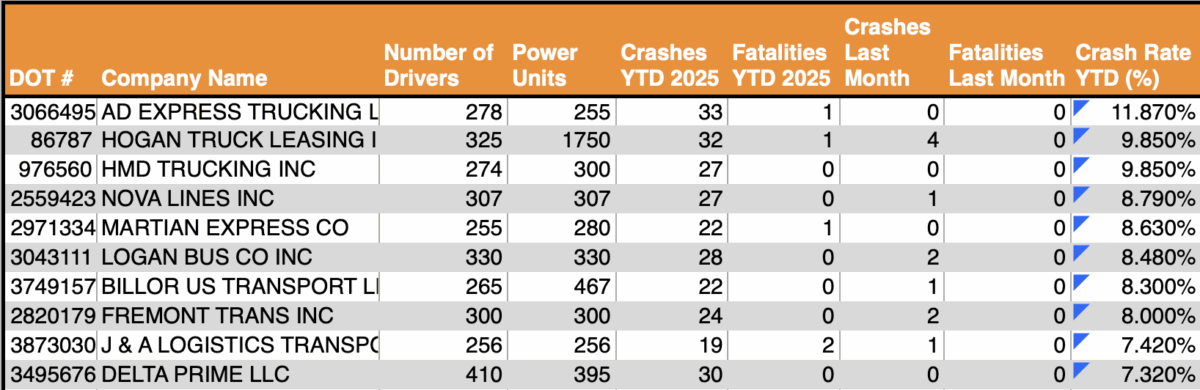
These figures, while concerning, pale in comparison to midsize carriers with 250-500 drivers. Here, crash rates soar above 7%, with some exceeding 11%. Topping this group is AD Express Trucking LLC (DOT #3066495), with 278 drivers and an alarming 11.87% rate—33 crashes YTD, including 1 fatality. Hogan Truck Leasing Inc. follows at 9.85% (32 crashes, 1 fatality), and HMD Trucking Inc. at 9.85% (27 crashes). Rates remain elevated for carriers like Nova Lines Inc. (8.79%), Martian Express Co. (8.63%, 1 fatality), and Logan Bus Co Inc. (8.48%).
This disparity underscores a clear trend: midsize carriers are far more like to be in a crash by this metric than their larger counterparts. Large fleets, often with more resources for safety programs, training, and compliance, not to mention safety technology on the tractor itself, exhibit significantly lower per-driver crash rates. Midsize operations may face greater challenges in scaling safety infrastructure, leading to higher incident rates.
The FMCSA’s Compliance, Safety, Accountability (CSA) program uses the Safety Measurement System (SMS) to prioritize carriers for intervention. CSA scores are calculated across seven Behavior Analysis and Safety Improvement Categories (BASICs), drawing from 24 months of roadside inspections, investigations, and state-reported crashes. Violations and crashes are weighted by severity, time, and normalized by exposure (e.g., vehicle miles traveled or power units).
The Crash Indicator BASIC specifically measures crash frequency and severity but is not publicly displayed—visible only to carriers and enforcement. Notably, through the Crash Preventability Determination Program, carriers can submit evidence to have non-preventable crashes excluded from this internal calculation.
We’ve written that the trucking industry desperately needs better crash data integration into the system. Current CSA reliance on inspection violations can be gamed, while objective crash outcomes like those in MCMIS are underutilized publicly. The piece calls for reinstating preventable crash rates in public-facing scores, using existing preventability reviews to provide transparent, outcome-based measures. This would help shippers and brokers better vet carriers amid rising liability concerns, supplementing often-unreliable inspection-based BASICs.
While raw crash counts have risen with industry growth, per-driver rates offer a normalized view into safety performance. Carriers should ensure accurate MCS-150 updates and challenge incorrect data via DataQs to maintain fair ratings. Ultimately, incorporating refined crash metrics publicly could drive broader accountability and safer highways.
This is the second story in a multi-story series on trucking carrier safety. Find the first story here.
F3: Future of Freight Festival
Industry-defining keynotes, rapid-fire technology demos, and industry leaders networking in experiences across Chattanooga - plus the inaugural F3 Awards Dinner featuring the FreightTech and Shipper of Choice reveals.
Industry-defining keynotes, rapid-fire technology demos, and industry leaders networking in experiences across Chattanooga - plus the inaugural F3 Awards Dinner featuring the FreightTech and Shipper of Choice reveals.
The Signal at Chattanooga Choo Choo • Chattanooga, TN Register Now