For the fourth week in a row, the benchmark price used to set most diesel surcharges has risen.
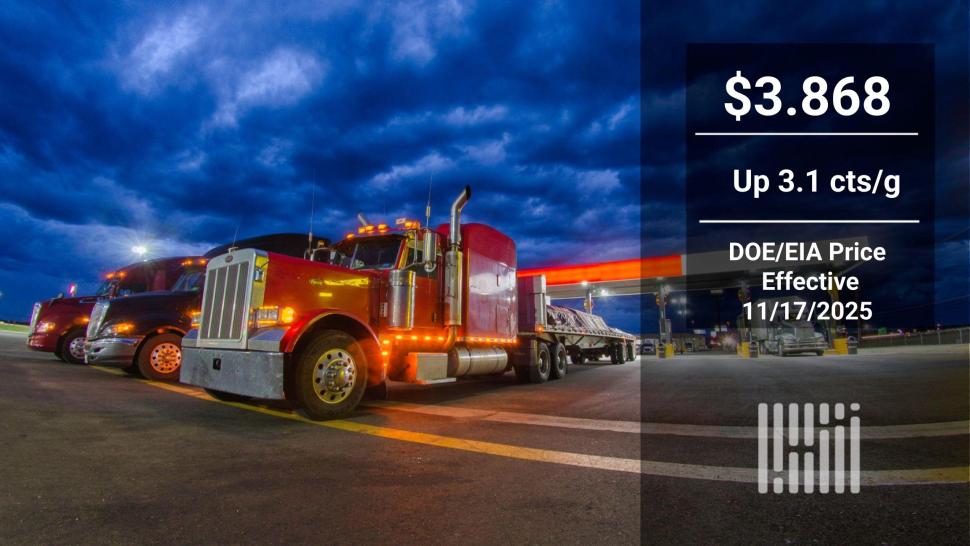
The weekly Department of Energy/Energy Information Administration average retail diesel price climbed 3.1 cents/gallon to $3.868/g, effective Monday but published Tuesday. With the increase, the price is now up 24.8 cts/g in the last four weeks and is at a level not seen since early July 2024.
Recent increases in the price of diesel are leading the market. While it is not as if truckers have a choice between gasoline and diesel, the growing spread between the two is a signal of just how strong diesel has been relative to other cuts from a barrel of crude.
The DOE/EIA average weekly gasoline price on August 4 was 76.4 cts/g less than the price of diesel. Since that time, the spread has blown out to 92.9 cts/g.
Overall oil prices have risen despite an International Energy Agency monthly report issued last week that doubled down on a supply/demand scenario that can’t be considered anything other than bearish.
The IEA, which is a group funded by mostly consuming countries, does not forecast prices. But its monthly review and outlook on global petroleum supply and demand are closely watched.
A bullish case could be made from one set of figures in the IEA report: its estimate that global petroleum supply in October dropped by 440,000 barrels/day, an enormous decline for one month. That led to global supply of 108.2 million b/d.
But the one-month decline can not mask the other numbers in the report. The 108.2 million b/d of production needs to be compared to estimates of demand in the coming year. (The IEA does not forecast total supply because it does not project what it believes OPEC will do with its production levels).
Total demand for 2025 is expected by IEA to average 103.9 million b/d, with a third quarter peak of 105 million b/d and a fourth quarter number of 104.8 million b/d.
Looking to next year, the IEA estimates a full-year average of 104.7 million b/d, with the peak number coming in at 105.7 million b/d for both the third and fourth quarters. The first quarter demand figure is projected to be 103.1 million b/d.
While this growing imbalance may not be showing up yet in the price, it is contributing to increasing inventories…but not in diesel.
According to the IEA report, what it described as global observed oil inventories were up 77.7 million b/d in September, which translates to 2.6 million b/d, the highest level since July 2021.
“Over the first nine months of the year, observable inventories have risen by 313 million barrels or 1.15 million b/d on average,” the IEA said. “Preliminary October data showed global stocks increased further, led by additional gains in oil on water.”
But not all inventories are equal. For example, U.S. gasoline inventories have been on a sharp decline in recent weeks, according to the weekly report of the Energy Information Administration. They were 220 million barrels in the week ending September 26. But in the most recent weekly report, for the week ended November 7, they had fallen to 205 million barrels.
Total non-jet distillate inventories, which are about 90% ultra low sulfur diesel, declined again in the week ended November 7. They were reported at 110 million barrels, having shed about 14 million barrels during a time of the year when they are expected to build.
The IEA said the difficulty turning all those crude inventories into finished products has been a global problem. “A slew of unplanned outages, scheduled maintenance and continued disruptions to Russia’s downstream operations, pushed refinery margins to a two-year peak in Europe and Asia in early November,” the agency said. “Global refinery runs slumped by 2.9 m b/d m-o-m to 81.5 mb/d in October but are set to increase sharply toward year-end.”
The impact of that can be seen in a simple comparison of the price of ULSD and global crude benchmark Brent on the CME commodity exchange. It continues to hang around the $1/gallon level. A month ago, it was about 72 cts/g, as crude is weighed down by those growing inventories and diesel is impacted by low inventory levels in the U.S. and the refinery issues the IEA spelled out.
Those tighter supplies of gasoline and diesel and the movement of their prices higher relative to crude appears to be pulling the price of crude with it but not on a 1:1 correlation. Still, that upward movement from diesel appears to be preventing the sort of collapse in oil prices that might otherwise be expected given the supply/demand imbalance that is the featured topic in the IEA report.
More articles by John Kingston
Beautiful women, open doors and drivers: trucking cybersecurity risks proliferate
Aifleet’s bold move: cutting its fleet size to survive in freight recession
Likely 1st AB5 trucking enforcement action in California snags 3 companies
Brokerage Compliance Symposium
The day before F3. Every compliance issue you face - fraud exposure, carrier liability, FMCSA rules, cargo theft, insurance gaps - navigated by attorneys and operators defining best practices in a changing industry.
F3 Awards Dinner
The night before F3. FreightTech100 companies honored. FreightTech 25 and Shipper of Choice winners revealed live. Cocktail reception into dinner and live music - 300 industry leaders in one purpose-built room.
F3: Future of Freight Festival
Industry-defining keynotes, rapid-fire technology demos, and industry leaders networking in experiences across Chattanooga - plus the inaugural F3 Awards Dinner featuring the FreightTech and Shipper of Choice reveals.
The day before F3. Every compliance issue you face - fraud exposure, carrier liability, FMCSA rules, cargo theft, insurance gaps - navigated by attorneys and operators defining best practices in a changing industry.
The Signal at Chattanooga Choo Choo • Chattanooga, TN Register NowThe night before F3. FreightTech100 companies honored. FreightTech 25 and Shipper of Choice winners revealed live. Cocktail reception into dinner and live music - 300 industry leaders in one purpose-built room.
The Signal at Chattanooga Choo Choo • Chattanooga, TN Register NowIndustry-defining keynotes, rapid-fire technology demos, and industry leaders networking in experiences across Chattanooga - plus the inaugural F3 Awards Dinner featuring the FreightTech and Shipper of Choice reveals.
The Signal at Chattanooga Choo Choo • Chattanooga, TN Register Now