




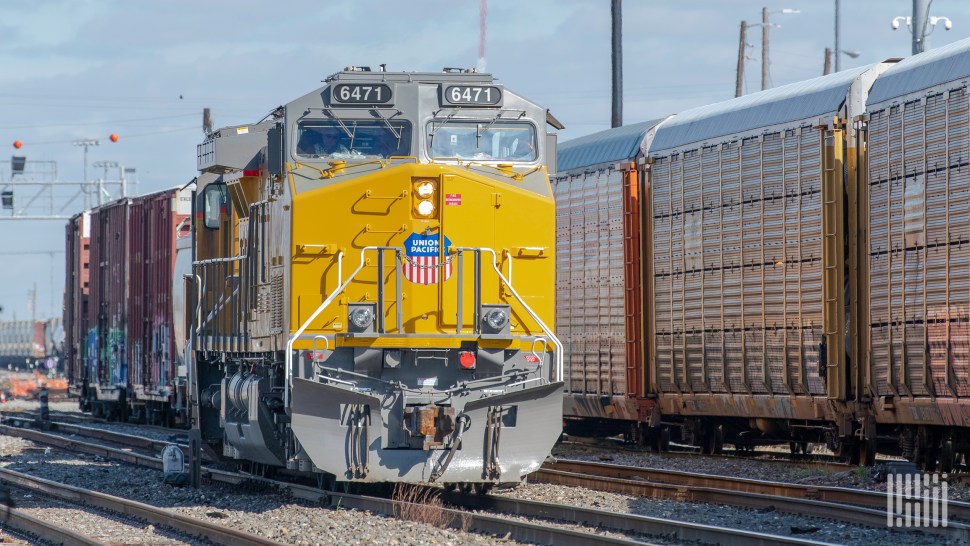
WASHINGTON — The Trump administration is extending from the highways to the railroads its clampdown on transportation workers who lack proficiency in English.
Transportation Secretary Sean P. Duffy announced on Friday that the Federal Railroad Administration will be limiting crews on cross-border trains from Mexico to not more than 10 miles into the U.S. from their point of entry as a result of a “focused inspection” of Union Pacific Railroad and Canadian Pacific Kansas City operations.
FRA inspectors discovered instances in which crew members operating trains inbound from Mexico had difficulty interpreting track bulletins and communicating safety requirements in English.
“Whether you’re operating an 80-ton big rig or a massive freight train, you need to be proficient in our national language – English,” Duffy warned in a press release. “If you aren’t, you create an unacceptable safety risk.”
FRA Administrator David Fink pointed out that train crews who can’t speak English “pose a significant safety risk that should not be ignored. Dispatchers and first responders need to know that they can communicate with train crews, especially during times of emergency.”
The agency noted that under current regulations, railroads may only certify locomotive engineers and conductors “who possess the knowledge, skills, and abilities necessary to operate safely. Due to important train documents and radio communications being in English, these potential language barriers that FRA observed raised severe safety concerns.”
FRA issued letters to both UP (NYSE: UNP) and CPKC (NYSE: CP) informing them of the findings and that the agency is clarifying how it approves the railroads’ locomotive engineer and conductor certification programs.
“Uncertified (and therefore potentially untrained) crews must stop at the customs inspection point and that any interpreters must be certified under safety regulations,” according to DOT.
“Any occurrences of crews operating in the U.S. without a sufficient understanding of the English language to perform their duties safely could result in the Trump Administration taking enforcement action.”
Prompted by Labor?
DOT’s latest English proficiency restrictions on the rail sector follows prodding earlier this year by the Brotherhood of Locomotive Engineers and Trainmen (BLET).
In response to DOT’s request for information on an updated national freight strategy, BLET president Mark Wallace urged the FRA to require that trains crossing the southern border conduct crew changes on an international bridge so that American train crews can take control at the border instead of at a rail yard located farther north in the U.S.
“Due to safety and security reasons, FRA should mandate that train operations return to using American train crews [in] America,” Wallace wrote in an August 14 letter to DOT.
“A requirement of a crew change at any international crossing would make certain that these train crews are proficient in the English language while operating trains. There can be no miscommunication when critical safety information is being conveyed. Requirements that train crews have legal work authority within the U.S. are vital to ensuring that the crews are fully subject to the FRA’s safety jurisdiction, including certification, qualification, and training requirements.”
The Association of American Railroads pushed back, asserting that non-U.S. railroad crews that conduct cross-border interchange are trained in U.S. operating rules, undergo pre-employment background checks, and comply with federal drug and alcohol testing requirements.
“This proven, limited operational practice has paid huge dividends for local communities and businesses across the nation,” an AAR spokesman told FreightWaves at the time.
FreightWaves has reached out to AAR for further comment.
Related articles:
Brokerage Compliance Symposium
The day before F3. Every compliance issue you face - fraud exposure, carrier liability, FMCSA rules, cargo theft, insurance gaps - navigated by attorneys and operators defining best practices in a changing industry.
F3 Awards Dinner
The night before F3. FreightTech100 companies honored. FreightTech 25 and Shipper of Choice winners revealed live. Cocktail reception into dinner and live music - 300 industry leaders in one purpose-built room.
F3: Future of Freight Festival
Industry-defining keynotes, rapid-fire technology demos, and industry leaders networking in experiences across Chattanooga - plus the inaugural F3 Awards Dinner featuring the FreightTech and Shipper of Choice reveals.
The day before F3. Every compliance issue you face - fraud exposure, carrier liability, FMCSA rules, cargo theft, insurance gaps - navigated by attorneys and operators defining best practices in a changing industry.
The Signal at Chattanooga Choo Choo • Chattanooga, TN Register NowThe night before F3. FreightTech100 companies honored. FreightTech 25 and Shipper of Choice winners revealed live. Cocktail reception into dinner and live music - 300 industry leaders in one purpose-built room.
The Signal at Chattanooga Choo Choo • Chattanooga, TN Register NowIndustry-defining keynotes, rapid-fire technology demos, and industry leaders networking in experiences across Chattanooga - plus the inaugural F3 Awards Dinner featuring the FreightTech and Shipper of Choice reveals.
The Signal at Chattanooga Choo Choo • Chattanooga, TN Register Now