




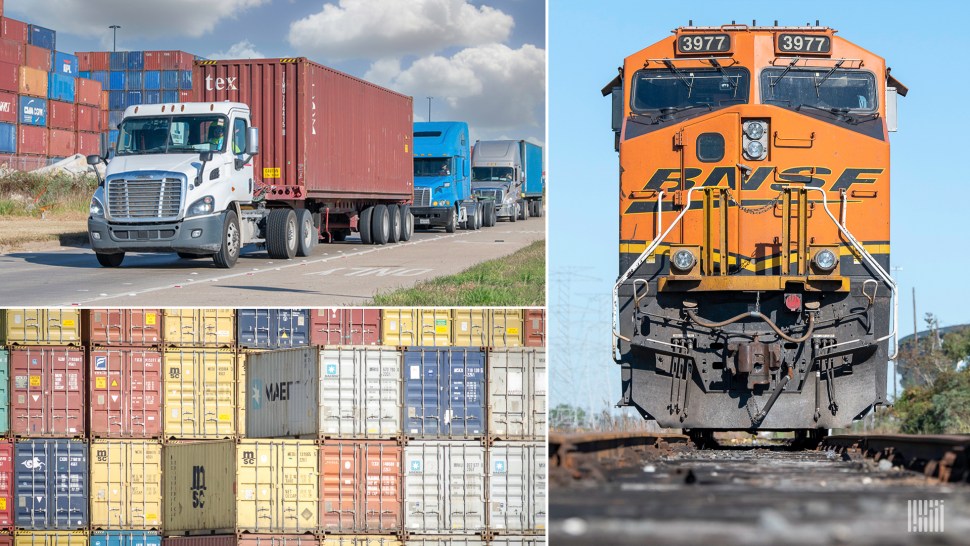
WASHINGTON — In the event the federal government shuts down at midnight Tuesday, freight supply chains, in the short term, should be largely unaffected.
Join the leaders shaping freight’s future at
F3: Future of Freight Festival, Oct 21-22.
Network with the industry’s best and discover what’s next.
In most cases, federal agencies that run the programs and services affecting goods movement are either funded by mechanisms like the Highway Trust Fund – which are separate from the annual appropriations process – or their employees are deemed essential and will therefore continue to work during a funding lapse.
This year, however, the Trump administration has threatened to use a shutdown as justification for additional federal workforce reductions, but it’s unclear how government employees will be affected, including those working at agencies within the U.S. Department of Transportation.
“DOT modal agencies are largely charged with safety functions, so anytime you cut from that you run the risk of decreasing safety,” Jameson Rice, a transportation lawyer and partner with the law firm Holland & Knight. “It may not be felt immediately, but you will in the long term.”
In the short term, however, safety functions related to domestic goods movement, such as roadside inspections carried out by the Federal Motor Carrier Safety Administration, and rail accident investigations and safety advisories under the Federal Railroad Administration, would continue, according to DOT’s most recent funding lapse shut-down plans.
At the U.S. Maritime Administration, where approximately 25% of its workforce is expected to be furloughed, vessel security and port infrastructure programs would continue using “carry forward balances” as would staff needed to oversee those programs and services.
Cargo inspection of imports through land borders and seaports would also continue, according to the U.S. Customs and Border Protection. Roughly 93% of the agency’s 68,000-person workforce are expected to be retained and continue to work during a funding lapse, the Department of Homeland Security’s latest contingency plan notes.
However, while most CBP employees are considered essential, that may not necessarily be the case at other agencies that have inspection oversight of cargo shipments, such as the Food and Drug Administration, the Environmental Protection Agency, the Department of Agriculture, and the Consumer Product Safety Commission.
For example, during a lapse in appropriations, activities at CPSC such as field investigations, product testing, and recalls could cease during a lapse, according to recent contingency plans, which potentially could disrupt cross-border trade and supply chains.
“What sometimes is not considered essential are additional reviews of cargo shipments that might be required and are conducted by government agencies other than CBP,” Cindy Allen, an international trade consultant and a former CBP executive director, told FreightWaves.
“So products subject to government oversight that may require additional review or testing might be impacted, which means potentially slowing freight flows.”
Other government agencies that affect freight markets, and the effect a shutdown could have on operations (based on their most recent contingency plans), include:
Federal Maritime Commission
Because most of the FMC’s employees are funded by annual appropriations, the commission, which regulates the U.S. international container trades, will be hit hard by a shutdown.
All work will cease “that furthers the agency’s mission to ensure a competitive and reliable international ocean transportation supply system that supports the U.S. economy and protects the public from unfair and deceptive practices,” according to the agency’s most recent shutdown plan.
Surface Transportation Board
Activities at the STB having to do with case processing, regulatory filings, and most litigation will likely be suspended in the case of funding lapse. That includes procedural schedules, oral arguments and voting conferences, data collection and analysis, and staff meetings with stakeholders will all be suspended.
Depending on how long the shutdown lasts, STB’s schedule for reviewing Union Pacific’s $85 billion acquisition of Norfolk Southern could be affected.
U.S. Coast Guard
Approximately 95% of the U.S. Coast Guard’s 52,377 active duty and civilian workforce will be retained in the case of a shutdown, according to DHS, which means inspections of U.S.- and foreign-flag vessels entering U.S. ports, waterfront facility security, and container inspection enforcement will continue.
Related articles:
Brokerage Compliance Symposium
The day before F3. Every compliance issue you face - fraud exposure, carrier liability, FMCSA rules, cargo theft, insurance gaps - navigated by attorneys and operators defining best practices in a changing industry.
F3 Awards Dinner
The night before F3. FreightTech100 companies honored. FreightTech 25 and Shipper of Choice winners revealed live. Cocktail reception into dinner and live music - 300 industry leaders in one purpose-built room.
F3: Future of Freight Festival
Industry-defining keynotes, rapid-fire technology demos, and industry leaders networking in experiences across Chattanooga - plus the inaugural F3 Awards Dinner featuring the FreightTech and Shipper of Choice reveals.
The day before F3. Every compliance issue you face - fraud exposure, carrier liability, FMCSA rules, cargo theft, insurance gaps - navigated by attorneys and operators defining best practices in a changing industry.
The Signal at Chattanooga Choo Choo • Chattanooga, TN Register NowThe night before F3. FreightTech100 companies honored. FreightTech 25 and Shipper of Choice winners revealed live. Cocktail reception into dinner and live music - 300 industry leaders in one purpose-built room.
The Signal at Chattanooga Choo Choo • Chattanooga, TN Register NowIndustry-defining keynotes, rapid-fire technology demos, and industry leaders networking in experiences across Chattanooga - plus the inaugural F3 Awards Dinner featuring the FreightTech and Shipper of Choice reveals.
The Signal at Chattanooga Choo Choo • Chattanooga, TN Register Now