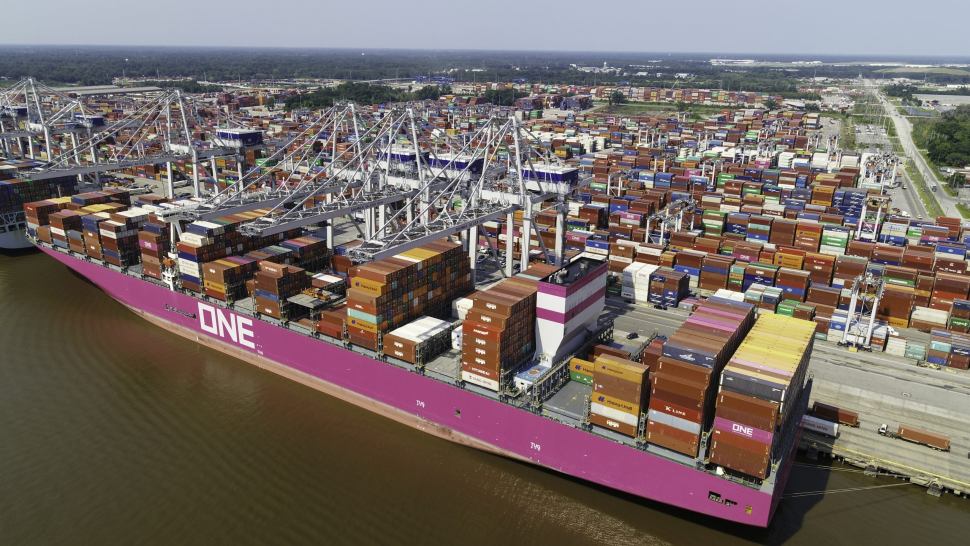
Customers, business partners, and industry leaders gathered for the Georgia Ports Authority’s 57th annual Georgia International Trade Conference to address critical developments in maritime logistics and the evolving supply chain landscape.
The meeting came as global trade faces persistent uncertainty and cost pressures, and highlighted the state’s strategic positioning as a gateway of choice for importers and exporters seeking reliability and economic efficiency.
“Innovation and port investments by the Georgia Ports Authority are helping to keep our state No. 1 for business while also positioning us as a true leader in global trade,” said Gov. Brian Kemp, in opening remarks at the event held in late April. “Our ports are an economic engine for the entire state, and we’ll continue to find ways to further their success and reach.”
Supply chain predictability a competitive advantage
In an environment where global disruptions have repeatedly tested supply chain resilience, Georgia Ports President and Chief Executive Griff Lynch framed the authority’s strategy around two core customer demands: Predictability and cost savings.
“In today’s current global business environment, our customers require greater supply chain predictability and cost savings opportunities,” Lynch said. “We have the capacity and connectivity to respond quickly to disruptions and market fluctuations around the world, enabling our customers to adjust supply chain speeds and routings to win and retain business.”
The Port of Savannah has positioned itself to capture this redirected cargo by emphasizing its operational efficiency and multimodal connectivity.
Researchers at Georgia Tech’s Supply Chain and Logistics Institute found that routing cargo through the Port of Savannah saves shippers more than $1,000 per container when delivering to Atlanta, Memphis, and Nashville compared to West Coast gateways. Beyond pure cost savings, the research documented more predictable transit times through Savannah.
East Coast ports have spent billions of dollars over the past decade building up infrastructure to establish direct connections to global markets that used to rely on landbridge service from the West Coast.
Chris Gaffney, managing director of the Supply Chain and Logistics Institute at Georgia Tech, elaborated on the findings. “Our research shows that when shippers evaluate total landed cost and end-to-end reliability, routing cargo through Savannah provides a clear economic advantage compared with West Coast routes. For Atlanta, Memphis and Nashville, routing cargo through Savannah reduces congestion exposure, saves shippers money and delivers more consistent, predictable transit performance.”
These findings carry significant implications for supply chain decision-making. As shippers increasingly adopt total landed cost methodologies that account for transit variability and congestion risk, Savannah’s advantages extend beyond simple freight rate comparisons to encompass the broader operational and financial benefits of consistent, reliable service.
Operational velocity and multimodal connectivity
Savannah’s operational statistics demonstrate the scale and efficiency that underpin its competitive claims. Currently, 80% of Savannah’s cargo moves inland by truck, while 20% travels by rail. This modal split reflects both the port’s proximity to major Southeastern markets and the economics of transportation modes at varying distances.
With diesel fuel costs remaining a persistent concern for trucking operations, rail becomes increasingly attractive for destinations beyond 250 miles from the port. Savannah’s intermodal infrastructure supports this optionality with 42 doublestack trains departing weekly to connect with inland markets. The port claims the lowest rail dwell time in the nation at 20 hours or less, meaning containers spend minimal time waiting for rail connections after discharge from vessels.
Vessel activity at the port reflects its status as a major gateway, with 40 container ships calling Savannah each week. On the truck side, the port handles between 14,000 and 16,000 truck gate moves daily. The efficiency of these movements is notable, with dual moves – transactions involving both a container drop-off and pickup – are completed in less than 50 minutes, while single moves take approximately 30 minutes. These processing times reduce driver detention and improve equipment utilization for trucking companies serving the port.
The Mason Mega Rail facility had a record year in 2025, handling 591,000 containers. This performance validates the authority’s strategic bet on rail capacity as a differentiator in serving inland consumer and manufacturing markets.
Gainesville Inland Port extends reach
The GPA opened the Gainesville Inland Port on May 4, adding another node to its distribution network with daily rail service provided by Norfolk Southern (NYSE: NSC). The facility represents a strategic expansion of the port’s reach into north Georgia’s manufacturing and distribution corridors.
In its first year of operation, Gainesville is expected to transition 26,000 truck moves from highways to rail. This shift will remove significant truck traffic from Atlanta-area highways, providing environmental and congestion relief while offering shippers a cost-effective alternative for moving containers to and from the port. For businesses located in the Gainesville region, the inland port will provide more convenient access to international shipping connections without requiring direct truck trips to Savannah.
The inland port concept has gained traction across major gateway ports as a strategy for extending market reach, reducing congestion at marine terminals, and providing value-added services closer to customer locations. Georgia Ports’ network of inland facilities positions the authority to serve a broader geographic footprint while maintaining operational efficiency at its Savannah terminals.
10-year investment plan
The authority outlined an ambitious 10-year investment plan that will fundamentally expand the port’s capacity to handle growing cargo volumes. The nearly $5 billion self-financed investment program will add five new big ship berths, the most of any U.S. container port, at Ocean Terminal and Savannah Container Terminal. This berth expansion supports a projected 54% growth in container throughput over the planning horizon.
Savannah harbor deepening study launched
Looking further into the future, GPA has initiated the process to study further deepening and widening of the Savannah Harbor shipping channel. On April 15, the authority submitted a Letter of Intent to Adam Telle, the Assistant Secretary of the Army for Civil Works, to formally begin the feasibility study process.
“We are excited to kick off this first step with the Army Corps of Engineers on the Savannah Harbor deepening and widening feasibility study,” Lynch said. “Our goal is to be the benchmark for deepening projects.”
Port officials explained that the shipping channel needs improvement to better serve the largest vessels currently calling Savannah and to prepare for even larger, more efficient ships expected to serve the U.S. East Coast in the future. The study will consider both deepening the channel and adding passing lanes to enable two-way ship traffic, which would significantly enhance the port’s vessel handling capacity.
State DOT infrastructure improvements
The Georgia Department of Transportation announced multiple infrastructure projects that will enhance access to the Port of Savannah and improve freight flows throughout the region.
The department will begin construction on a cable replacement project for the Talmadge Bridge over the Savannah River. While the bridge will remain operational during construction, the work will shorten the bridge’s cables, increasing air draft beneath the structure from 185 feet to approximately 205 feet. This modification will allow larger vessels to pass beneath the bridge, supporting the port’s ability to accommodate the growing vessel sizes calling Savannah. Completion of the bridge project is expected in 2029.
In August 2026, GDOT will open the $126 million Brampton Road Connector, a four-lane highway providing a direct link between the Port of Savannah’s Garden City Terminal and the interstate highway system. The new connector will eliminate at-grade rail crossings and remove truck traffic from local neighborhoods, improving both freight efficiency and community quality of life.
GDOT plans to widen I-95 by one lane in each direction along a 22-mile stretch from Exit 90 to the South Carolina state line, with the project currently in preliminary design. The department also plans to reconstruct and widen portions of Interstate 16 west of I-95 toward State Route 67 in Bulloch County. This $522 million project will expand I-16 to three lanes in both directions, with construction expected to begin in 2027.
Separately, the Port of Brunswick is now the top U.S. port by annual automobile volumes. A fourth ro-ro berth is planned to meet future growth.
Positioning for growth
“All the pieces are coming together in Savannah as the gateway of choice for the Southeast region,” Lynch said. “With five container berths in the pipeline, along with a new Gainesville Inland Port and multiple GDOT infrastructure improvements, Georgia Ports is ready for the next 10 years with its $5 billion investment plan as the fastest growing port in the Southeast, serving 70% of the nation’s population east of the Mississippi River.”
Brokerage Compliance Symposium
The day before F3. Every compliance issue you face - fraud exposure, carrier liability, FMCSA rules, cargo theft, insurance gaps - navigated by attorneys and operators defining best practices in a changing industry.
F3 Awards Dinner
The night before F3. FreightTech100 companies honored. FreightTech 25 and Shipper of Choice winners revealed live. Cocktail reception into dinner and live music - 300 industry leaders in one purpose-built room.
F3: Future of Freight Festival
Industry-defining keynotes, rapid-fire technology demos, and industry leaders networking in experiences across Chattanooga - plus the inaugural F3 Awards Dinner featuring the FreightTech and Shipper of Choice reveals.
The day before F3. Every compliance issue you face - fraud exposure, carrier liability, FMCSA rules, cargo theft, insurance gaps - navigated by attorneys and operators defining best practices in a changing industry.
The Signal at Chattanooga Choo Choo • Chattanooga, TN Register NowThe night before F3. FreightTech100 companies honored. FreightTech 25 and Shipper of Choice winners revealed live. Cocktail reception into dinner and live music - 300 industry leaders in one purpose-built room.
The Signal at Chattanooga Choo Choo • Chattanooga, TN Register NowIndustry-defining keynotes, rapid-fire technology demos, and industry leaders networking in experiences across Chattanooga - plus the inaugural F3 Awards Dinner featuring the FreightTech and Shipper of Choice reveals.
The Signal at Chattanooga Choo Choo • Chattanooga, TN Register Now