




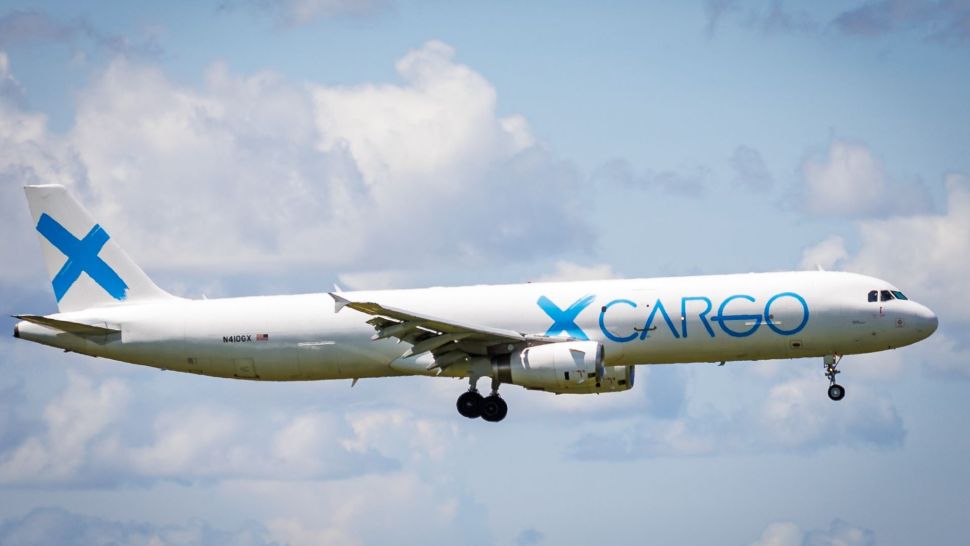
Startup Global Crossing Airlines is indefinitely parking two of its four Airbus A321 converted freighters to defer expensive safety upgrades because there is little interest for narrowbody airlift in an oversaturated market and flying them is unprofitable.
Weak domestic and regional cargo demand forced the company two years ago to deemphasize cargo and focus on its growing passenger charter business for sports teams, music acts, the U.S. government and other groups. The Miami-based company postponed plans to add more used A321 aircraft retrofitted to carry main-cabin cargo, treading water in hopes cargo business eventually picked up.
That hasn’t happened. Worse, some of its business dried up.
Global Crossing Airlines’ (OTCQB: JETMF) revenue increased 10% last year to $246.3 million, despite a flat fourth quarter, and the company recorded its first ever positive operating income ($8.9 million), according to financial results issued Thursday. Earnings before interest, taxes, depreciation, amortization and rent climbed 25%. EBITDAR is a common metric for measuring financial health in the airline industry because of the heavy rent costs for aircraft.
“These achievements came despite material delays in aircraft deliveries and significant headwinds from the continually depressed trough in cargo markets, which created a material drag on our earnings,” said Chris Jamroz, executive chairman, in the announcement.
During a briefing with stock analysts, management said the cargo segment recorded an operating loss of more than $10 million.
GlobalX faces a number of cargo challenges. It is the only airline in North America that operates the A321 passenger-to-freighter aircraft.
Breaking the market stranglehold of the Boeing 737-800 converted freighter has been difficult because cargo operators are more familiar with Boeing, which has a long history of cargo aircraft, than Airbus and there is a huge glut of the planes. Lessors, investors and freighter operators rushed to convert 737-800s when the pandemic disrupted supply chains, believing the surge in freight transportation and e-commerce shopping represented a structural change in demand. With supply chains rebalanced, Amazon and other merchants building hyper-local distribution centers and normalized shipping volumes there are more narrowbody freighters than express delivery companies, and other all-cargo operators, need.
In February, DHL Express ended a short-term transportation agreement under which GlobalX operated a couple of routes in DHL’s parcel network for several months, including Miami to DHL’s hub in Cincinnati. DHL recently shifted to the Boeing 757 converted freighter, a plane it has widely used before in Europe. The German express delivery giant recently loaned a 757-200 to contractor 21 Air to operate on its behalf on the routes previously flown by GlobalX.
The U.S. Postal Service’s decision in recent years to save money by shifting more mail to ground transportation also eliminated a potential customer.
Meanwhile, Miami-based startup 7 Air Cargo is overlapping GlobalX routes to Central America and the Caribbean, often undercutting competitors on rates.
The inability of A321 freighters to gain market traction prompted Air Transport Services Group, a large lessor of freighter aircraft, to exit a joint venture with an Oregon-based engineering company that specializes in developing passenger-to-freighter conversion kits.
Engine problems with new Airbus aircraft also pose a long-term problem for conversion houses. Airlines and lessors typically retire passenger aircraft after 15 to 20 years, but the supply pipeline is drying up as airlines hold onto aircraft longer than normal. That’s because a defect in Pratt & Whitney gear-turbofan engines has led to premature inspection and repair requirements, the grounding of hundreds of aircraft, and slower production rates for new aircraft. CFM International Leap engines are also facing production constraints.
Under the circumstances, GlobalX has opted to sideline two of its A321 freighters because aviation regulators have directed all A321 operators to install a fuel tank venting system to correct a flammability hazard. The fix costs $300,000 to $400,000. And one of the planes requires a $200,000 pylon inspection.The other two cargo aircraft were retrofitted with the fuel inerting system, said President and CFO Ryan Goepel, in a phone interview.
“If there’s no work, why mess around and spend the money?” he said. “I’m getting $4,000 an hour on freight, and I’m getting $7,000 an hour on passenger. I’d rather my pilots fly passenger flights.”
GlobalX has 12 A320 and A321 passenger aircraft in the fleet and plans to take seven additional aircraft from lessors this year.
The owners of the cargo aircraft have been unwilling to offer more flexible terms so far, in large part because the passenger market for A321s is red hot, Goepel lamented.
“It’s cheaper for us to park them because we can’t get out of our leases,” he said. The other freighters are flying, but “they’re not making any money still. They’re just not losing as much. But we just can’t justify four of them.”
Most of GlobalX’s current cargo business comes from IBC Airways, a South Florida-airline that serves Puerto Rico, Jamaica and other countries in, and around, the Caribbean.
Goepel stressed that the two idle freighters are not being sent to storage and can be quickly activated if customers interested in dedicated transport materialize. Another option is to cannibalize the engines, put them on passenger aircraft and return their engines to the lessor. A third option is to lease the engines to an airline in need because they are nearly as valuable as a whole aircraft.
Click here for more FreightWaves/American Shipper stories by Eric Kulisch.
Write to Eric Kulisch at ekulisch@freightwaves.com.
RELATED STORIES:
Lessor ATSG quits Airbus A321 cargo conversion joint venture
DHL extends short-term cargo contract with Global Crossing Airlines
Brokerage Compliance Symposium
The day before F3. Every compliance issue you face - fraud exposure, carrier liability, FMCSA rules, cargo theft, insurance gaps - navigated by attorneys and operators defining best practices in a changing industry.
F3 Awards Dinner
The night before F3. FreightTech100 companies honored. FreightTech 25 and Shipper of Choice winners revealed live. Cocktail reception into dinner and live music - 300 industry leaders in one purpose-built room.
F3: Future of Freight Festival
Industry-defining keynotes, rapid-fire technology demos, and industry leaders networking in experiences across Chattanooga - plus the inaugural F3 Awards Dinner featuring the FreightTech and Shipper of Choice reveals.
The day before F3. Every compliance issue you face - fraud exposure, carrier liability, FMCSA rules, cargo theft, insurance gaps - navigated by attorneys and operators defining best practices in a changing industry.
The Signal at Chattanooga Choo Choo • Chattanooga, TN Register NowThe night before F3. FreightTech100 companies honored. FreightTech 25 and Shipper of Choice winners revealed live. Cocktail reception into dinner and live music - 300 industry leaders in one purpose-built room.
The Signal at Chattanooga Choo Choo • Chattanooga, TN Register NowIndustry-defining keynotes, rapid-fire technology demos, and industry leaders networking in experiences across Chattanooga - plus the inaugural F3 Awards Dinner featuring the FreightTech and Shipper of Choice reveals.
The Signal at Chattanooga Choo Choo • Chattanooga, TN Register Now