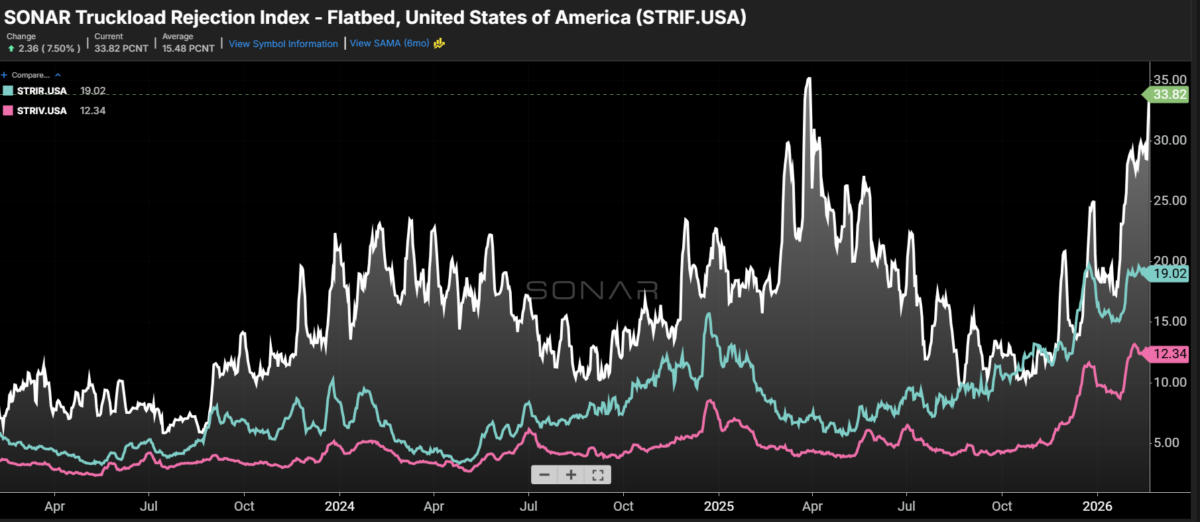
Chart of the Week: SONAR Truckload Rejection Index Flatbed, Reefer, Van – USA SONAR: STRIF.USA, STRIR.USA, STRIV.USA
Flatbed tender rejection rates (STRIF) in the newly enhanced SONAR tender dataset jumped above 32% this past week for only the second time in their eight-year history. The first occurrence was last March, when the surprise rollout of tariffs on the U.S.’ North American trading partners boosted cross-border flows as manufacturers rushed to stockpile parts and components. Is this an early sign of a manufacturing renaissance?
The flatbed market is heavily reliant on manufacturing, construction and energy. While it is difficult to isolate the impact of any single sector, there are signs of developing momentum worth monitoring over the coming year—for flatbed carriers and potentially for economists as well.
The manufacturing sector has been sluggish, posting only modest gains in recent years. The Institute for Supply Management’s Purchasing Managers’ Index (PMI)—a key gauge of U.S. manufacturing activity—has trended higher since June 2023 but has shown expansion in only four months since October 2022. January’s reading of 52.6 was the strongest of that stretch.
The SONAR Flatbed Truckload Volume Index has averaged roughly 18% higher year over year since the start of the year, while accepted tender volumes are up more than 10%. This suggests the rise in rejections is not purely a function of tightening truckload capacity, which has affected all trucking segments.
There appears to be a meaningful demand-side component that is absent in the much larger dry van market, which remains down year over year, though comparisons will become easier in the months ahead. Dry van activity is more closely tied to retail and CPG sectors and can shift to intermodal rail when capacity allows.
Flatbed tenders represent less than 5% of SONAR’s total tender dataset, but they tend to reflect steadier, manufacturing-related freight compared to the more volatile spot market, which includes a greater share of irregular or specialized moves. Tenders also do not measure inflation and are less influenced by freight mix.
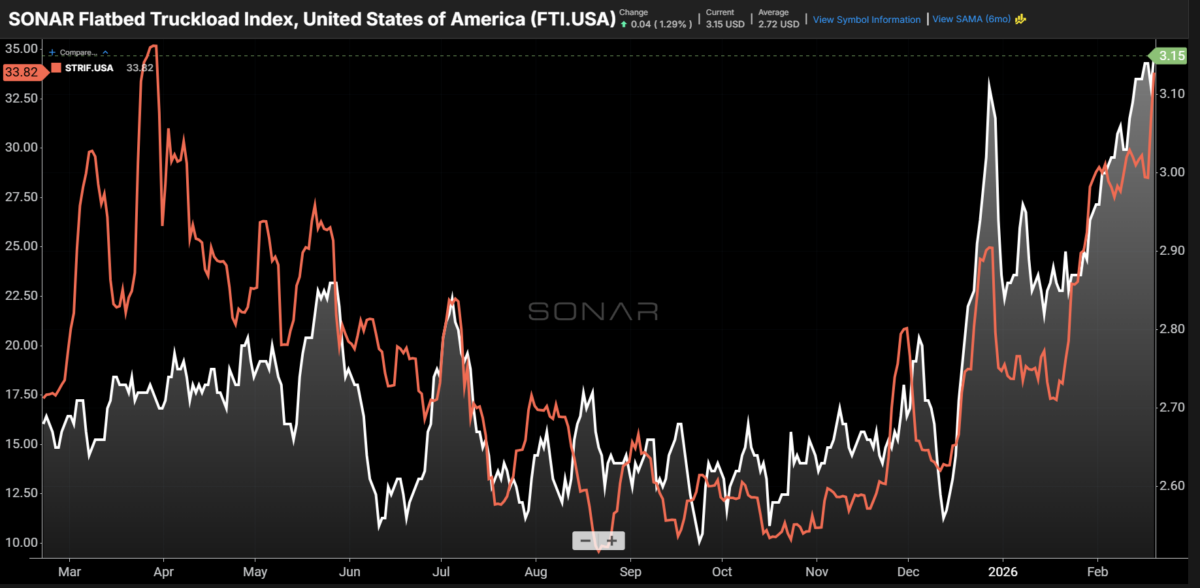
Regardless of these nuances, the upward trend in tenders is supported by recent spot rate data. The Flatbed Truckload Index (FTI), which measures aggregated spot rates, is up 18% year over year and is tracking closely with tender rejection rates.
Tariff ruling impact
The Supreme Court ruled against the Trump administration’s IEEPA tariffs, a decision that could boost demand across transportation modes. While the tariffs were intended to reduce the trade deficit and encourage domestic production over the long term, they clearly weighed on freight flows in the near term—especially in trucking.
Although the path forward remains somewhat uncertain in terms of refunds and implementation details, the ruling removes a key headwind for goods demand. Flatbed and dry van markets could benefit the most, as many manufacturers have struggled to source components. The auto sector, however, may be more influenced by the upcoming USMCA review scheduled for July.
At a minimum, there are several reasons to believe freight demand has positive momentum. Flatbed growth was evident even before the winter storms and the tariff ruling. Potential tax incentives under the OBBBA may also provide additional support.
Open deck rejection rates jump above 30% in February.
SONAR aggregates data from hundreds of sources, presenting the data in charts and maps and providing commentary on what freight market experts want to know about the industry in real time.
Brokerage Compliance Symposium
The day before F3. Every compliance issue you face - fraud exposure, carrier liability, FMCSA rules, cargo theft, insurance gaps - navigated by attorneys and operators defining best practices in a changing industry.
F3 Awards Dinner
The night before F3. FreightTech100 companies honored. FreightTech 25 and Shipper of Choice winners revealed live. Cocktail reception into dinner and live music - 300 industry leaders in one purpose-built room.
F3: Future of Freight Festival
Industry-defining keynotes, rapid-fire technology demos, and industry leaders networking in experiences across Chattanooga - plus the inaugural F3 Awards Dinner featuring the FreightTech and Shipper of Choice reveals.
The day before F3. Every compliance issue you face - fraud exposure, carrier liability, FMCSA rules, cargo theft, insurance gaps - navigated by attorneys and operators defining best practices in a changing industry.
The Signal at Chattanooga Choo Choo • Chattanooga, TN Register NowThe night before F3. FreightTech100 companies honored. FreightTech 25 and Shipper of Choice winners revealed live. Cocktail reception into dinner and live music - 300 industry leaders in one purpose-built room.
The Signal at Chattanooga Choo Choo • Chattanooga, TN Register NowIndustry-defining keynotes, rapid-fire technology demos, and industry leaders networking in experiences across Chattanooga - plus the inaugural F3 Awards Dinner featuring the FreightTech and Shipper of Choice reveals.
The Signal at Chattanooga Choo Choo • Chattanooga, TN Register Now