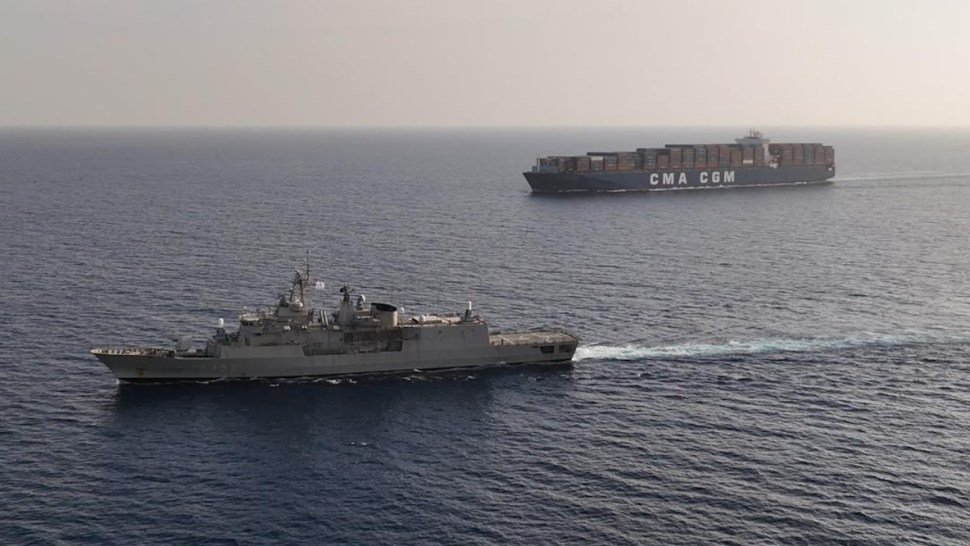
One of the world’s biggest ocean container carriers has changed course, again diverting vessels away from the Red Sea just weeks after making a highly-publicized return to the troubled Middle East trade route.
French carrier CMA CGM this week said its FAL 1, FAL 3 and MEX services will again operate via the Cape of Good Hope around the southern tip of Africa. The route adds as much as two weeks to a typical service from Asia.
“In light of the complex and uncertain international context, the CMA CGM Group is constantly and closely monitoring all potential impacts on its operations,” the company said in an advisory. “As a result, the CMA CGM Group has decided for time being to reroute vessels deployed on our FAL 1, FAL 3 and MEX services via the Cape of Good Hope.”
The company offered no explanation for its decision. FreightWaves has reached out to CMA CGM for comment.
FAL 1 (French Asia Line) links France, England, Sweden and Poland with China; FAL 2 connects Belgium, the Netherlands and Germany with China. MEX dedicated service calls seven China ports to France and Spain.
CMA CGM added that it will regularly review the situation regarding the Suez route.
Global container and tanker operators have diverted away from the Red Sea since early 2024, when Yemen-based Houthi militia Yemen attacked shipping in solidarity with the Palestinians in Gaza.
CMA CGM was the only known major carrier to maintain some scheduled commercial services on the Red Sea throughout the Houthi terror campaign. Since December CMA CGM and Maersk (MAERSK-B.CO) made high-profile voyages testing a return to the Red Sea, which serves as a critical link between Asia, Europe, the Mediterranean and North America.
“Shippers crave predictability in supply chains,” said Destine Ozuygur, senior market analyst at Xeneta. “Carriers taking the decision to return to the Red Sea then reversing that decision – even if it is done for important safety reasons – still risks undermining confidence in schedule reliability and eroding trust in partnerships.”
Full loop transit times on FAL1 decreased from 105 days to 98 when ships returned to the Suez Canal, according to Xeneta data, which included the removal of one vessel slot.
Ozuygur warned the unpredictability could spread across services and carriers. This includes CMA CGM INDAMEX service, which is currently still scheduled to transit the Suez Canal on fronthaul and backhaul legs.
Find more articles by Stuart Chirls here.
Related coverage:
Long Beach volume to double to 20M containers by 2050
Florida harbor pilot dies after fall from vessel
Brokerage Compliance Symposium
The day before F3. Every compliance issue you face - fraud exposure, carrier liability, FMCSA rules, cargo theft, insurance gaps - navigated by attorneys and operators defining best practices in a changing industry.
F3 Awards Dinner
The night before F3. FreightTech100 companies honored. FreightTech 25 and Shipper of Choice winners revealed live. Cocktail reception into dinner and live music - 300 industry leaders in one purpose-built room.
F3: Future of Freight Festival
Industry-defining keynotes, rapid-fire technology demos, and industry leaders networking in experiences across Chattanooga - plus the inaugural F3 Awards Dinner featuring the FreightTech and Shipper of Choice reveals.
The day before F3. Every compliance issue you face - fraud exposure, carrier liability, FMCSA rules, cargo theft, insurance gaps - navigated by attorneys and operators defining best practices in a changing industry.
The Signal at Chattanooga Choo Choo • Chattanooga, TN Register NowThe night before F3. FreightTech100 companies honored. FreightTech 25 and Shipper of Choice winners revealed live. Cocktail reception into dinner and live music - 300 industry leaders in one purpose-built room.
The Signal at Chattanooga Choo Choo • Chattanooga, TN Register NowIndustry-defining keynotes, rapid-fire technology demos, and industry leaders networking in experiences across Chattanooga - plus the inaugural F3 Awards Dinner featuring the FreightTech and Shipper of Choice reveals.
The Signal at Chattanooga Choo Choo • Chattanooga, TN Register Now