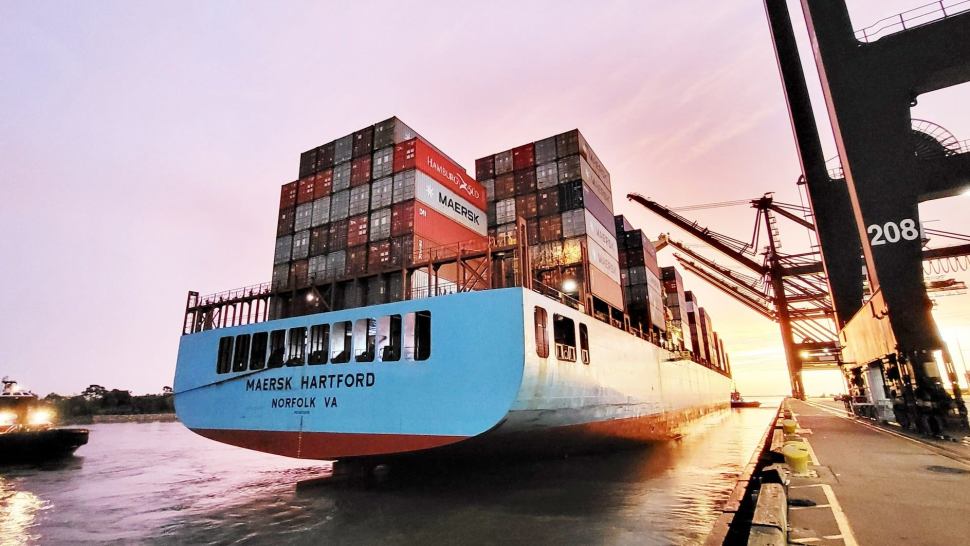
Major ocean carriers, after two years of sectarian violence that reconfigured regional shipping and the broader global supply chain, reopened services on a key Mideast route that could mean lower rates for shippers from Asia to the United States.
The announcement Thursday by Maersk (MAERSK–B.CO) that it is restarting scheduled services via the Red Sea and Suez Canal was a welcome sign of normalization amid years of violence and political turmoil across the region.
Maersk’s reconfiguring of its MECL service connecting Asia and the U.S. was by all appearances a conservative approach and one likely to be emulated by other container carriers as they reintroduce significant capacity into an uneven environment that could further undercut weakened ocean rates.
One major carrier, CMA CGM of France, mostly continued scheduled services throughout the Houthi offensive.
“Maersk has generally been the most risk averse out of the major carriers regarding a return to the Red Sea, so this is a turning point,” said Xeneta analyst Peter Sand. “The services announced by Maersk as returning to the Suez Canal are smaller ships operating outside an alliance, but the fact it is Maersk making this move is highly significant.”
Maersk over the past week revealed it had operated at least two vessels in the Red Sea. Sand implied that the carrier turned off satellite location equipment in order to conceal the ships’ exact locations – similar to that of the ‘dark fleet’ of sketchy ships with questionable provenance carrying sanctioned cargoes.
Houthi rebels based in Yemen since late 2023 have attacked Red Sea shipping in a show of support for Gaza.
“Xeneta data has shown Maersk testing the water in recent weeks with ships scheduled to sail around the Cape of Good Hope ‘going dark’ and instead sailing through the Red Sea,” said Sand. “Clearly these sailings were deemed successful and the risk now low enough to announce services through the region on official schedules.”
Sand said that while Maersk has re-opened the door to the Suez route, it’s unlikely other carriers will rush in.
“This does not mean an immediate large-scale return of container shipping to the Red Sea region. Depending on how quickly carriers want to move, it could take three to five months for schedules via the Suez Canal to be fully reinstated. We could also see significant disruption and port congestion during that time as services adjust to new routes and transit times.”
The timing of the return is critical and carries with it a host of factors that are certain to weigh on contract negotiations now underway between carriers and shippers. Diverting ships on longer voyages away from the Red Sea and around the tip of Africa effectively removed substantial capacity from the global market.
“A large-scale return to shorter sailing distances via the Suez Canal would effectively free up 6-8% of global container shipping capacity,” Sand said. “The implications of this are clear for both carriers and shippers, with overcapacity placing significant downward pressure on freight rates.”
Global container traffic totaled 183 million twenty foot equivalent units (TEUs) in 2024, so that could mean close to 2 million TEUs of capacity back in circulation.
“Average spot rates from the Far East are down 43% into the U.S. East Coast and 30% into North Europe compared to a year ago,” said Sand, “while long term rates are expected to fall back to pre-Red Sea crisis levels in December 2023 even without a large-scale return to Red Sea.”
Find more articles by Stuart Chirls here.
Related coverage:
Maersk returns to Red Sea with India-US service
Flat volumes a win for Port of Oakland in unstable year
Brokerage Compliance Symposium
The day before F3. Every compliance issue you face - fraud exposure, carrier liability, FMCSA rules, cargo theft, insurance gaps - navigated by attorneys and operators defining best practices in a changing industry.
F3 Awards Dinner
The night before F3. FreightTech100 companies honored. FreightTech 25 and Shipper of Choice winners revealed live. Cocktail reception into dinner and live music - 300 industry leaders in one purpose-built room.
F3: Future of Freight Festival
Industry-defining keynotes, rapid-fire technology demos, and industry leaders networking in experiences across Chattanooga - plus the inaugural F3 Awards Dinner featuring the FreightTech and Shipper of Choice reveals.
The day before F3. Every compliance issue you face - fraud exposure, carrier liability, FMCSA rules, cargo theft, insurance gaps - navigated by attorneys and operators defining best practices in a changing industry.
The Signal at Chattanooga Choo Choo • Chattanooga, TN Register NowThe night before F3. FreightTech100 companies honored. FreightTech 25 and Shipper of Choice winners revealed live. Cocktail reception into dinner and live music - 300 industry leaders in one purpose-built room.
The Signal at Chattanooga Choo Choo • Chattanooga, TN Register NowIndustry-defining keynotes, rapid-fire technology demos, and industry leaders networking in experiences across Chattanooga - plus the inaugural F3 Awards Dinner featuring the FreightTech and Shipper of Choice reveals.
The Signal at Chattanooga Choo Choo • Chattanooga, TN Register Now