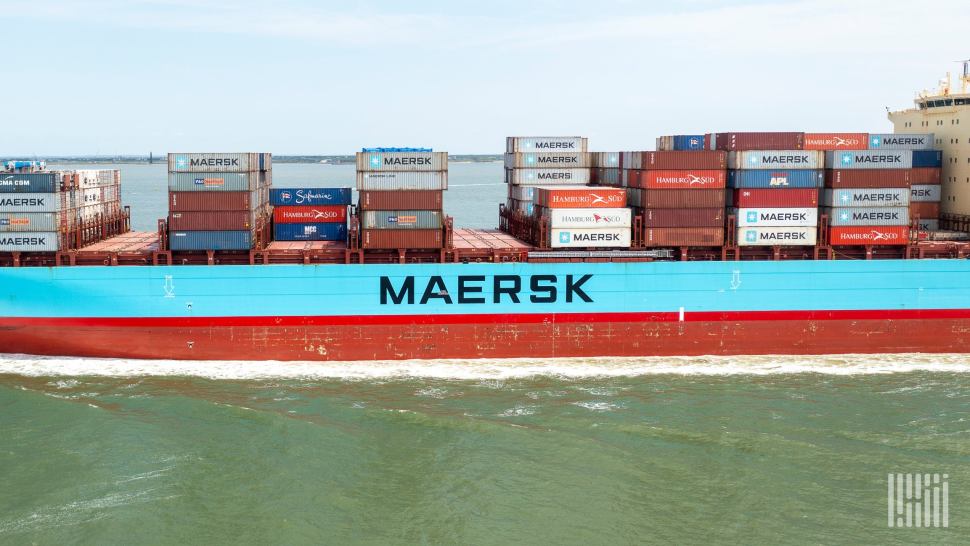
Maersk on Thursday said it is resuming scheduled service through the Red Sea-Suez Canal route for the first time in two years.
The announcement follows what the world’s second-largest container carrier called a successful test when the U.S.-flagged Maersk Denver transited the Suez Canal route Jan. 11-12 on the westbound MECL service connecting India and the United States.
Maersk and other major global carriers diverted vessels away from the Red Sea in early 2024, when Houthi rebels in Yemen began attacking merchant shipping in support of Hamas following the outbreak of the war in Gaza.
Maersk (MAERSK-B.CO) in a customer advisory said the move is a “structural return” of the MECL service to the trans-Suez route. The company earlier characterized this as a stepwise approach to gradually re-introduce capacity at a time when carriers have been struggling with depressed rates amid uneven demand and an influx of new vessels.
Analysts have said a full restart could return as much as 2 million containers’ worth of traffic to the Suez.
The Maersk announcement is clouded by tensions in Iran, after President Donald Trump promised a military response to the crackdown by the Islamic government on protests that have reportedly killed thousands of civilians. Nehru in India is 1,200 nautical miles east of Iran on the Arabian Sea, and it is unknown how a large-scale military operation could effect shipping in the region.
“This decision follows a continued stabilization of conditions in and around the Red Sea, including the Suez corridor, as well as improved stability and reliability in the region, allowing us to return to the service pattern originally designed to provide our customers with the most efficient transit times,” the company said. The MECL service is solely operated by Maersk.
The service calls Newark, Norfolk, Savannah and Charleston on the East Coast, and Houston on the Gulf Coast. It originates at Jawaharlal Nehru, India’s largest port, calls Pipavav and Mundra, also in India, and stops at Jebel Ali in Saudi Arabia, Oman’s Salalah as well as Port Tangier in Morocco.
The Houthi attacks killed nine seamen, sank four vessels and damaged dozens more.
Carriers had diverted away from the Red Sea through the Cape of Good Hope around the tip of Africa, a more costly route that added as much as two weeks’; sailing time to an Asia-U.S. voyage.
Maersk said Red Sea service will depend on stability in the area, “and the absence of any escalation in regional conflict. The safety of crew, assets, and customers’ cargo remains the highest priority.”
The company said it has contingency plans in place to shift individual sailings or the entire MECL service back to the Africa route should the situation deteriorate.
The change started with the westbound sailing of the Cornelia Maersk from Jebel Ali on Jan. 15. The Maersk Detroit marked the first eastbound sailing, having departed North Charleston on Jan 10.
Maersk said the return to Suez routing will shave one week off sailing times in both directions; the diverted eastbound transit time is currently listed on the Maersk site at 62 days.
Maersk said there would be some temporary impacts to imports to the U.S. via MECL but did not expect any noticeable congestion.
Find more articles by Stuart Chirls here.
Related coverage:
Flat volumes a win for Port of Oakland in unstable year
Canada port, DP World complete $178M modernization
Retail optimism boosting trans-Pacific container rates
Why Charleston drayage drivers should care about Iran protests
Brokerage Compliance Symposium
The day before F3. Every compliance issue you face - fraud exposure, carrier liability, FMCSA rules, cargo theft, insurance gaps - navigated by attorneys and operators defining best practices in a changing industry.
F3 Awards Dinner
The night before F3. FreightTech100 companies honored. FreightTech 25 and Shipper of Choice winners revealed live. Cocktail reception into dinner and live music - 300 industry leaders in one purpose-built room.
F3: Future of Freight Festival
Industry-defining keynotes, rapid-fire technology demos, and industry leaders networking in experiences across Chattanooga - plus the inaugural F3 Awards Dinner featuring the FreightTech and Shipper of Choice reveals.
The day before F3. Every compliance issue you face - fraud exposure, carrier liability, FMCSA rules, cargo theft, insurance gaps - navigated by attorneys and operators defining best practices in a changing industry.
The Signal at Chattanooga Choo Choo • Chattanooga, TN Register NowThe night before F3. FreightTech100 companies honored. FreightTech 25 and Shipper of Choice winners revealed live. Cocktail reception into dinner and live music - 300 industry leaders in one purpose-built room.
The Signal at Chattanooga Choo Choo • Chattanooga, TN Register NowIndustry-defining keynotes, rapid-fire technology demos, and industry leaders networking in experiences across Chattanooga - plus the inaugural F3 Awards Dinner featuring the FreightTech and Shipper of Choice reveals.
The Signal at Chattanooga Choo Choo • Chattanooga, TN Register Now