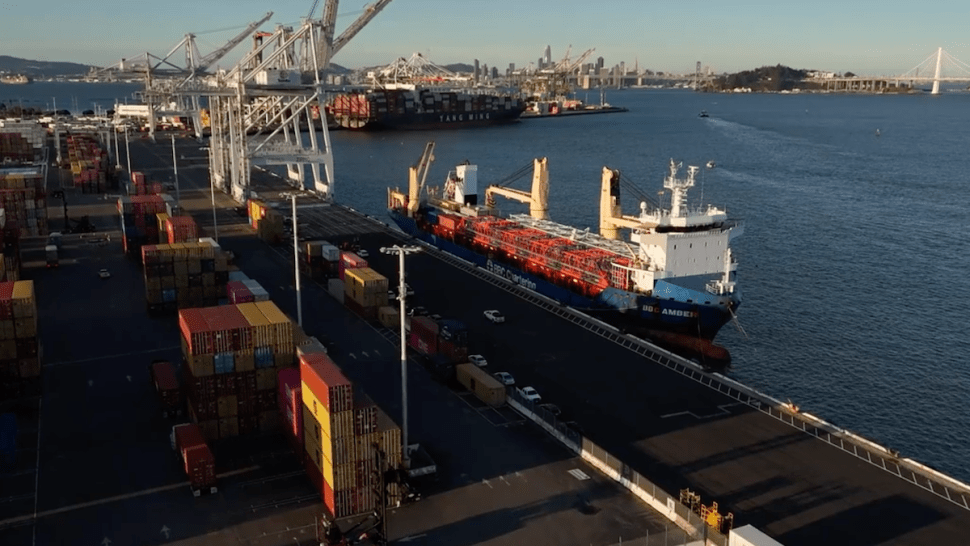
The Port of Oakland handled 179,580 twenty foot equivalent units (TEUs) in December, down 1.7% year-on-year as cargo volumes stabilized in the face of uneven global trade conditions.
Loaded containers totaled 140,050 TEUs, a decline of 3% compared to December 2024. Loaded imports fell 12.8%, while loaded exports were 10.9% higher.
Oakland and other West Coast ports outside of southern California faced an array of challenges in 2025, from President Donald Trump’s chaotic tariff war on China to a shifting of trade patterns and reconfiguring of services on the part of ocean carriers. The hubs have also seen aggressive growth by the western Canadian ports of Vancouver and Prince Rupert, which have leveraged crossborder rail services to attract U.S.-bound intermodal shipments headed for the Midwest.
Oakland’s empty container volumes totaled 39,530 TEUs in December, an increase of 3.4% y/y, which the port ascribed to end-of-year repositioning. On a month-to-month basis, December volumes rose slightly compared to November, consistent with normal year-end shipping patterns.
“December reflected the kind of uneven performance we’ve seen across the industry, with softer imports and strong export activity,” said Port of Oakland Maritime Director Bryan Brandes, in a release. “That difference is more about timing and adjustment than any fundamental change in demand.”
For all of 2025, total container volume was essentially flat at 0.4% off previous-year levels at 2,253,976 TEUs, which the port termed a “notable outcome” given policy and economic uncertainty.
Total import TEUs were weaker by 0.9%, while exports TEUs increased slightly by 0.1%, for a near-50/50 mix. Loaded containers accounted for approximately 77% of total volume, on a par with recent years.
“In an environment defined by uncertainty, maintaining stability matters,” Brandes said. “Our focus throughout the year was on keeping cargo moving reliably and predictably, ensuring customers could continue to move goods efficiently as trade conditions shifted.”
The port this week said it received two new container cranes, for the TraPac terminal. It said the delivery from Liebherr marks the first time European-built ship-to-shore cranes that have been deployed on the U.S. West Coast.
Find more articles by Stuart Chirls here.
Related coverage:
Canada port, DP World complete $178M modernization
Retail optimism boosting trans-Pacific container rates
Why Charleston drayage drivers should care about Iran protests
Brokerage Compliance Symposium
The day before F3. Every compliance issue you face - fraud exposure, carrier liability, FMCSA rules, cargo theft, insurance gaps - navigated by attorneys and operators defining best practices in a changing industry.
F3 Awards Dinner
The night before F3. FreightTech100 companies honored. FreightTech 25 and Shipper of Choice winners revealed live. Cocktail reception into dinner and live music - 300 industry leaders in one purpose-built room.
F3: Future of Freight Festival
Industry-defining keynotes, rapid-fire technology demos, and industry leaders networking in experiences across Chattanooga - plus the inaugural F3 Awards Dinner featuring the FreightTech and Shipper of Choice reveals.
The day before F3. Every compliance issue you face - fraud exposure, carrier liability, FMCSA rules, cargo theft, insurance gaps - navigated by attorneys and operators defining best practices in a changing industry.
The Signal at Chattanooga Choo Choo • Chattanooga, TN Register NowThe night before F3. FreightTech100 companies honored. FreightTech 25 and Shipper of Choice winners revealed live. Cocktail reception into dinner and live music - 300 industry leaders in one purpose-built room.
The Signal at Chattanooga Choo Choo • Chattanooga, TN Register NowIndustry-defining keynotes, rapid-fire technology demos, and industry leaders networking in experiences across Chattanooga - plus the inaugural F3 Awards Dinner featuring the FreightTech and Shipper of Choice reveals.
The Signal at Chattanooga Choo Choo • Chattanooga, TN Register Now