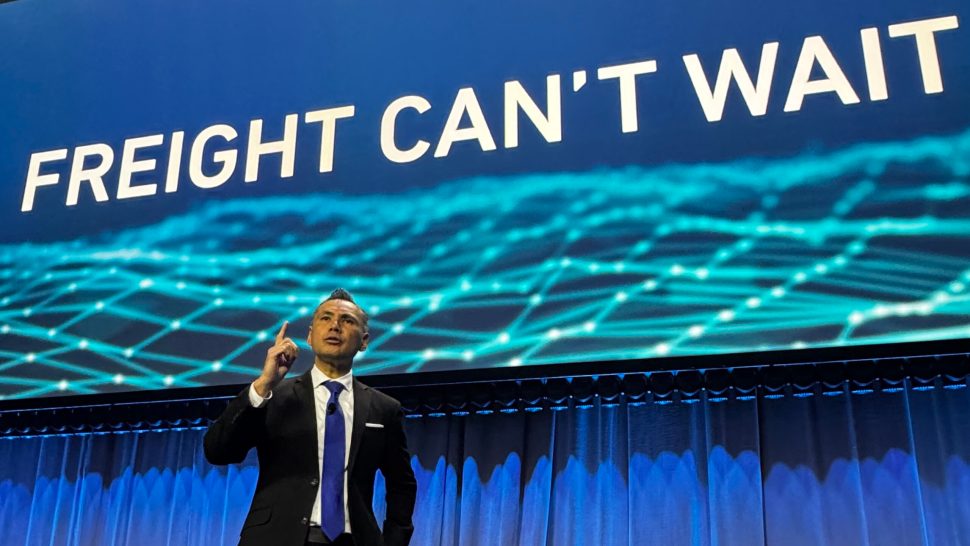
On the strength of another record year for container volume, the Port of Long Beach is making wide-ranging plans to double its cargo throughput by 2050.
The hub, which along with the Port of Los Angeles comprises the busiest U.S. import gateway, handled about 9.9 million containers in 2025, Chief Executive Noel Hacegaba said at his first State of the Port address. A new forecast projects Long Beach will move 20 million containers annually by 2050.
“We have 24 years to prepare to double our container throughput and figure out how we’re going to handle all that additional cargo quickly, safely, efficiently and sustainably,” said Hacegaba, who succeeded retired CEO Mario Cordero. “We have set our sights on 2050 because thinking big and planning ahead are critical to our collective success.
“Speed to market is the key to our success and rail connectivity is the key to our future.”
The San Pedro port complex is served by BNSF (NYSE: BRK-B)and Union Pacific, and short line Alameda Belt Railway. The proposed merger of UP (NYSE: UNP) and eastern carrier Norfolk Southern (NYSE: NSC) would extend the ports’ reach into the Midwest as well as to eastern seaboard markets.
The $1.8-billion Pier B On-Dock Rail Support Facility, designed to move containers from ship to train in less than 24 hours for improved connectivity to inland destinations, is scheduled for completion in 2032. Hacegaba said that that will triple on-dock rail to 4.7 million twenty foot equivalent units (TEUs).
The port continues to prioritize environmental goals, he said, with the proposed development of the world’s first conventional, zero-emissions container terminal.
The Metro Express Terminal at Pier S, if approved, would handle up to 1.8 million TEUs annually for express vessel services, with human-operated cargo handling equipment powered by renewable energy.
Long Beach is predicting trade flows via CargoNav, Hacegaba said, a digital visibility tool that originated in the port’s Supply Chain Information Highway project, to track shipments, plan operations and maximize efficiency. The tool will soon add a Universal Trucking Appointment System partially funded by the state, and will enable motor carriers to schedule pickup and drop-off of containers at any of the port’s six marine terminals, eventually extending to Los Angeles, as well.
Long Beach processed 48.9% of all cargo moving through the San Pedro Bay in 2025, with that share anticipated to continue growing over the next several years.
The port ended 2025 with 9,881,595 TEUs processed, up 2.4% from the previous record of more than 9.6 million TEUs moved in 2024. Imports rose 1.1% to 4,779,559 TEUs and exports declined 5.5% to 1,141,113 TEUs compared to 2024, amid President Donald Trump’s on-again off-again trade war with China. Empty containers increased 6.7% to 3,960,925 TEUs.
For the first time in 2025, five of the port’s six container terminals handled more than 1 million TEUs each in 2025, with two processing more than 2 million TEUs each. It also marked the third time the port moved more than 9 million containers, coming within an estimated six to seven vessels of reaching 10 million.
Hacegaba expects 2026 to be another busy year shaped by changes in trade policies, tariff normalization and shifts in manufacturing sourcing. Volume is projected at more than 9 million TEUs, which would make it one of the five busiest years on record.
Find more articles by Stuart Chirls here.
Related coverage:
Florida harbor pilot dies after fall from vessel
Asia-US shippers could see lower rates from Red Sea return
Brokerage Compliance Symposium
The day before F3. Every compliance issue you face - fraud exposure, carrier liability, FMCSA rules, cargo theft, insurance gaps - navigated by attorneys and operators defining best practices in a changing industry.
F3 Awards Dinner
The night before F3. FreightTech100 companies honored. FreightTech 25 and Shipper of Choice winners revealed live. Cocktail reception into dinner and live music - 300 industry leaders in one purpose-built room.
F3: Future of Freight Festival
Industry-defining keynotes, rapid-fire technology demos, and industry leaders networking in experiences across Chattanooga - plus the inaugural F3 Awards Dinner featuring the FreightTech and Shipper of Choice reveals.
The day before F3. Every compliance issue you face - fraud exposure, carrier liability, FMCSA rules, cargo theft, insurance gaps - navigated by attorneys and operators defining best practices in a changing industry.
The Signal at Chattanooga Choo Choo • Chattanooga, TN Register NowThe night before F3. FreightTech100 companies honored. FreightTech 25 and Shipper of Choice winners revealed live. Cocktail reception into dinner and live music - 300 industry leaders in one purpose-built room.
The Signal at Chattanooga Choo Choo • Chattanooga, TN Register NowIndustry-defining keynotes, rapid-fire technology demos, and industry leaders networking in experiences across Chattanooga - plus the inaugural F3 Awards Dinner featuring the FreightTech and Shipper of Choice reveals.
The Signal at Chattanooga Choo Choo • Chattanooga, TN Register Now