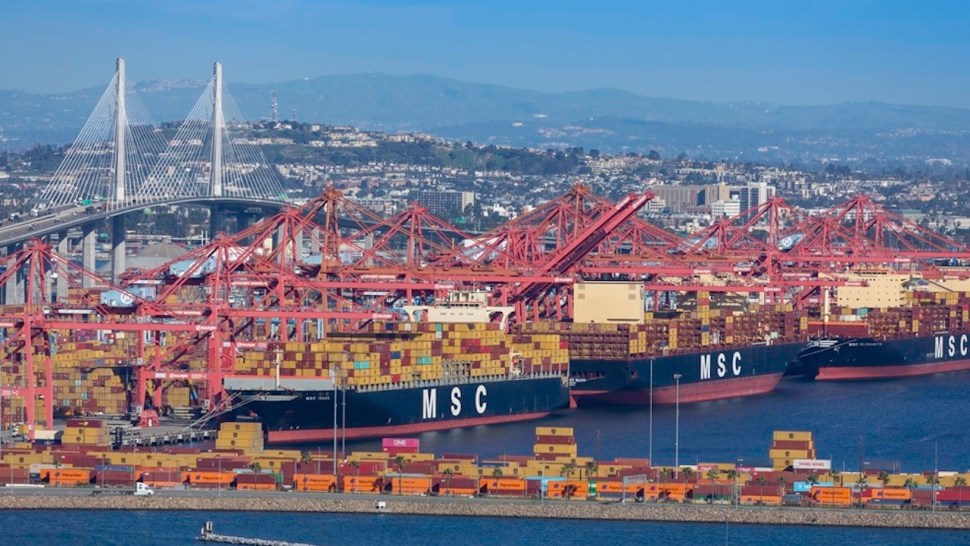
The Port of Long Beach delivered its third busiest June on record, moving 779,000 twenty foot equivalent units (TEUs), a 10.6% increase compared with the same period a year ago.
The strong performance marks the second consecutive month of year-over-year gains, bringing year-to-date volume to more than 4.8 million TEUs, nearly 2% ahead of the first half of 2025’s record-setting pace.
Dr. Noel Hacegaba, wrapping up the first half of his inaugural year as chief executive, in an online briefing framed the results as a testament to supply chain resilience amid tariffs and geopolitical uncertainty.
Imports rose 11% to over 387,000 TEUs, while exports dipped 1% to more than 86,000 TEUs. Empty containers increased 14% to nearly 306,000 TEUs as ocean carriers work to clear docks and create terminal capacity for incoming cargo.
Sourcing shifts and peak season front-loading
The traditional peak shipping season has become obsolete. According to Hacegaba, what once characterized a concentrated holiday rush has been replaced by year-round waves of cargo arriving in different spurts.
“Flexibility has become the supply chain’s greatest competitive advantage,” he said, “but it now signals peak season is no longer a season. It’s a year-round strategy.”
Shippers are front-loading goods to get ahead of the July 24 tariff deadline, when temporary 10% tariffs are set to automatically expire without clarity from the Trump administration on what policy may follow. Fall and holiday merchandise that typically arrives in October, November, and December began appearing at the port as early as spring. The National Retail Federation announced that import volumes are projected to hit an all-time record at major container ports.
Ocean carriers have responded by adding services and deploying extra loaders – unscheduled ships – to import more cargo and remove empty containers.
“It may be July, but for the supply chain, the holiday shipping season has already started,” Hacegaba said. “Retailers are intent on restocking shelves while keeping prices as low as possible.”
Beyond seasonal consumer goods, the port is seeing strong imports of AI data center hardware and infrastructure materials, reflecting sustained year-round demand for technology investments.
Intermodal activity has surged, with approximately 28% of containers now leaving port terminals by train, requiring intensive daily coordination with Class I railroad partners. Data shows that the increase has slowed intermodal transportation by rail.
Rail struggles with intermodal surge
Intermodal activity has surged, with approximately 28% of containers now leaving port terminals by train, requiring intensive daily coordination with Class I railroad partners. Data shows that the increase has slowed intermodal transportation by rail.
“We’re handling more cargo than ever before, but we’re not seeing anywhere close to the congestion, the delays, the backlogs that characterized the supply chain crisis just a few years ago,” Hacegaba said in response to a question from FreightWaves about rail flows. “That requires a lot of coordination and communication with our Class I [railroad] partners. We are in touch with them almost daily, making sure that we have adequate equipment, making sure that there’s coordination when it comes to pick-up and drop-offs, making sure that the terminals are communicating directly with the Class Is. Speed to market is a key to our success. Rail connectivity is a key to our future. And currently, it’s a key to our success even today.”
Geopolitical fractures and trade policy vulnerabilities
Multiple external pressures are testing supply chain resilience. The Trump administration announced earlier this month that it will not renew the U.S.-Mexico-Canada Agreement (USMCA) in its current form – a pact valued at $2 trillion in annual trade, with U.S. exports to both countries exceeding $670 billion. Negotiations may continue through the summer or longer, with the possibility of separate bilateral agreements with Mexico and Canada.
The end of the ceasefire affecting the Strait of Hormuz has added urgency to energy concerns, Hacegaba said. U.S. oil reserves remain low, and when inventories are tight, markets have less cushion to absorb disruption. This can put upward pressure on oil prices, increase fuel and transportation costs, and create ripple effects throughout the global supply chain.
“Businesses across the shipping and logistics industry continue planning for a range of scenarios as they work to build more resilient and diversified supply chains,” Hacegaba said. “Businesses are preparing for volatility, not certainty.”
Halftime Report: Digital and capital infrastructure victories
The first six months of 2026 have delivered significant infrastructure wins for the port. California’s $1.2 billion Port and Freight Infrastructure Program awarded Long Beach a record $383 million, funding that is supporting 22,000 jobs, reducing emissions, and modernizing operations.
Key achievements include the launch of CargoNAV, a digital platform offering real-time cargo visibility to supply chain partners. The port also opened its Cyber Defense Operations Center (SeaDOC) in partnership with the Coast Guard, Customs and Border Protection, and the California Governor’s Office of Emergency Services, strengthening defenses against cyber threats targeting the digital systems powering $300 billion in annual trade.
Hacegaba said that construction continues on the Pier B on-dock rail support facility to enhance rail efficiency across San Pedro Bay. The port has prioritized green truck corridor initiatives, launching the world’s first port-powered corridor between the port and the state’s Central Valley agricultural center, followed by a corridor extending to Mexico. Commercial methanol bunkering has advanced alongside continued investments in cleaner equipment.
Outlook for the second half of the year
The port is preparing for decades of growth, Hacegaba said, with Total Terminals International’s proposal to redevelop its Pier T Marine Terminal using zero-emissions technologies and expanded on-dock rail capacity. The years-long environmental review process has begun, with public scoping meetings scheduled for July and August. The redevelopment aims to densify, electrify, and modernize operations as the port prepares to double throughput to 20 million container units annually by 2050.
Despite the front-loading activity in the first half, the port expects continued robust growth through year-end.
“Uncertainty has become the new normal,” Hacegaba acknowledged. “But what customers and our supply chain partners have come to expect from our port is steady, reliable, resilient operations, and we will continue to deliver on that.”
Read more articles by Stuart Chirls here.
Read more:
Jaxport adds new Asia-LatAm-Med container service
DP World plans UAE port, container terminal to bypass Strait of Hormuz: Report
Iran conflict drives up Asia-US container rate by 276%
New chief at busy East Coast box gateway
Container ship attacked in Strait of Hormuz as Iran widens war
Brokerage Compliance Symposium
The day before F3. Every compliance issue you face - fraud exposure, carrier liability, FMCSA rules, cargo theft, insurance gaps - navigated by attorneys and operators defining best practices in a changing industry.
F3 Awards Dinner
The night before F3. FreightTech100 companies honored. FreightTech 25 and Shipper of Choice winners revealed live. Cocktail reception into dinner and live music - 300 industry leaders in one purpose-built room.
F3: Future of Freight Festival
Industry-defining keynotes, rapid-fire technology demos, and industry leaders networking in experiences across Chattanooga - plus the inaugural F3 Awards Dinner featuring the FreightTech and Shipper of Choice reveals.
The day before F3. Every compliance issue you face - fraud exposure, carrier liability, FMCSA rules, cargo theft, insurance gaps - navigated by attorneys and operators defining best practices in a changing industry.
The Signal at Chattanooga Choo Choo • Chattanooga, TN Register NowThe night before F3. FreightTech100 companies honored. FreightTech 25 and Shipper of Choice winners revealed live. Cocktail reception into dinner and live music - 300 industry leaders in one purpose-built room.
The Signal at Chattanooga Choo Choo • Chattanooga, TN Register NowIndustry-defining keynotes, rapid-fire technology demos, and industry leaders networking in experiences across Chattanooga - plus the inaugural F3 Awards Dinner featuring the FreightTech and Shipper of Choice reveals.
The Signal at Chattanooga Choo Choo • Chattanooga, TN Register Now