California Trucking Association sues to block Advanced Clean Fleets rule
With the first requirements of California’s Advanced Clean Fleets (ACF) rule set to go in effect in just a few weeks, the California Trucking Association (CTA) has asked a federal court to block the regulation’s implementation.
The lawsuit, filed Monday in the U.S. District Court for the Eastern District of California, requests both a preliminary and permanent injunction to stop the California Air Resources Board (CARB) from enforcing the rule.
CTA officials hinted in recent months that such a suit might be coming.
The CTA argues that California exceeded its authority in creating the ACF. The rule mandates a phase-out of internal combustion engines (ICE) in trucks by 2040. But on a more pressing timeline, no ICE-powered trucks could be added to the state’s drayage registry after Jan. 1, 2024; they must be zero-emission vehicles (ZEVs).
The ACF violates the Federal Aviation Administration Authorization Act (F4A), which coincidentally is a key argument used by the CTA in its lawsuit to block the implementation of the state’s independent contractor law, AB5, in California’s trucking sector. F4A, a law that dates back to the early 1990s, blocks a state from passing a regulation that impacts a “price, route or service” offered by a trucking company.
The other claims in the lawsuit are generally linked in one way or another to these two critiques and essentially argue that California wildly exceeded its authority in passing ACF.
“Instead of providing an assurance of clear and compliant regulations, the California Air Resources Board has promulgated the ACF regulations, which expands California’s regulatory authority well beyond its borders and establishes such untenable mandates that CARB itself has already been compelled to informally promise certain provisions will not be enforced,” the CTA suit states. CARB’s actions “represent a vast overreach that threatens the security and predictability of the nation’s goods movement industry.”
The suit notes that ACF may have had a pathway to legal federal approval. But as it notes, “EPA may, but has not, granted a waiver for CARB to adopt and enforce a regulation like ACF. While CARB may claim otherwise, ACF cannot be enforced until such waiver is granted.”
As far as CTA’s charge that ACF violates F4A, the CTA says ACF “creates precisely the type of patchwork the F4A was designed to avoid, as motor carriers must modify their services and routes to support ZEVs both inside and outside California. The impact on the nation’s logistics industry of ACF’s requirements would be nothing short of disastrous.”
CTA says in the suit that a state can implement its own requirements on the sale of vehicles in its borders, “but only when those mandates strictly comply with federal requirements.” It cites a provision of the Clean Air Act: the Clean Fuel Fleet Program (CFFP). But CTA says there are stricter guidelines under the CFFP on what a state can do than CARB has adopted in the ACF, in violation of what it says was “Congress’ carefullycalibrated balance between federal and state authority over fleet vehicle emissions.”
CTA’s arguments regarding federal supremacy take several forms.
“In no form has the legislature granted to CARB, or Congress granted to EPA, the authority to adopt a regulation with such sweeping power over the California economy and by virtue of the interstate nature of California’s trucking industry, the national economy,” CTA argues.
That passage is under a request for relief because of the CTA’s view that the Clean Air Act preempts the ACF rule. But the question of federal supremacy shows up throughout the lawsuit.
CTA rips CARB for confusion under its claim that the ACF violates due process. “ACF presents no clear regulatory scheme that can be understood by regulated parties, nor even by CARB itself,” the suit says. “The voluminous record during ACF rulemaking demonstrates the clear confusion regulated parties have in understanding their obligations under the rule.”
Logistics real estate operator Prologis beat third-quarter estimates Tuesday before the market opened but noted softened demand.
The San Francisco-based company reported core funds from operations (FFO) of $1.30, 5 cents ahead of analysts’ expectations but 43 cents lower year over year (y/y).
“Our results reflect strong execution by our team and the quality of our global portfolio,” said co-founder and CEO Hamid Moghadam. “That said, until there is more stability in the economy, negative customer sentiment will weigh on demand. We remain focused on capturing our embedded lease mark-to-market, building out our land bank into a favorable future supply environment, and partnering with our customers to address their most critical pain points.”
Occupancy across Prologis’ (NYSE: PLD) portfolio was 97.1% in the quarter, 60 basis points lower y/y. It commenced leases on 46.4 million square feet of space, which was a 9% reduction compared to the year-ago period.
Net effective rent change (over the entire lease term) was up more than 24 percentage points to 84%.
Prologis raised the front end of its guidance range by 2 cents to reflect the beat. The new range is $5.58 to $5.60, which brackets the current consensus estimate.
The company will host a call Tuesday at 12 p.m. EDT to discuss third-quarter results.
To view more FreightWaves infographics, click here
Roadrunner’s new service waives shipment costs on late deliveries
Asset-light less-than-truckload provider Roadrunner announced Tuesday a new program that waives the total shipment cost when freight is not delivered on time.
Smart Guarantee gives customers the option to pay a 25% fee, subject to a $75 minimum, for day-specific guaranteed delivery. The fee is calculated on net freight costs, which excludes fuel expense and accessorial charges. Customers will now have an option on some lanes to select “guaranteed” when booking shipments. If Roadrunner fails to meet the delivery date, it will waive 100% of the freight bill.
Unpalletized and overlength freight is excluded from the program as are shipments handled by its agents and interline partners.
Lori Blaney, Roadrunner’s senior vice president of sales, said the option is an alternative to “expensive expedited or air service” as customers can now “use Roadrunner’s direct metro to metro long haul network and guarantee it.”
Roadrunner (OTC: RRTS) is currently operating its long-haul network at an on-time rate of more than 93%.
Other LTL carriers offer versions of speed service guarantees. However, most typically only refund the fee itself — not the entire cost of the shipment — when a service failure occurs.
“Compared to other offerings in the industry, our Roadrunner Smart Guarantee is simple, transparent, and very shipper friendly,” Blaney said in a statement to FreightWaves. “While other carriers have multiple offerings with varying levels of fee reimbursement and complex rules, we opted to keep ours as straightforward as possible — if it doesn’t arrive on the day we say it will, it’s 100% free.
“We are highly confident in the New Roadrunner after several years of significant service investments, and the shipper-friendly terms of this guarantee reflect that.”
The company also said it will soon add new services in Kansas City, Missouri, and Portland, Oregon.
Roadrunner specializes in long-haul LTL transportation across a network that has national capabilities and terminals in 39 major markets. It completed a financial restructuring two years ago and has improved delivery times on 279 freight lanes since.
“Our strategic improvements to our Smart Network build upon one another,” stated CFO Jack Korslin. “After several years of investment in technology, automation, data analytics and personnel, we’re excited to put our money where our mouth is.”
How Middle East war could impact global LNG, LPG shipping
War in the Middle East changes the geopolitical calculus for ocean shipping, compounding existing threats from Russia’s invasion of Ukraine. Two of the top energy cargoes at risk in the Middle East are liquefied petroleum gas (LPG) — propane and butane — and liquefied natural gas (LNG).
What happens next in the Middle East will have major trade consequences for the U.S., the world’s largest exporter of both LNG and LPG.
Oystein Kalleklev is the CEO of LNG shipping company Flex LNG (NYSE: FLNG) and LPG shipping company Avance Gas (Oslo: AGAS). The two companies he oversees have a combined market cap of $2.56 billion.
FreightWaves conducted an in-depth interview with Kalleklev on Monday, covering the latest geopolitical issues faced by his fleets, his outlook on global LPG and LNG shipping fundamentals, and his views on shipping stocks.
This question-and-answer interview was edited for clarity and length.
Geopolitical risks escalate
FREIGHTWAVES: Both LNG and LPG shipping markets are heavily exposed to war in the Middle East. There are two very different geopolitical scenarios here: one where fighting is contained in Israel and one where it escalates into a regional conflict that affects shipping via the Strait of Hormuz.
How do you see the “contained” scenario affecting markets for LNG cargoes transported by Flex LNG and LPG cargoes transported by the very large gas carriers (VLGCs) of Avance?
KALLEKLEV: The global LNG market is already so tight that just a minor ripple creates a lot of consequences. We saw prices for TTF [the Netherlands gas hub price] go up 40% to 50% last week. I think that’s a general risk premium. People are more worried.
The question on the VLGC side is whether the U.S. will crack down on Iran. That would disrupt volumes of Iranian LPG to China. China would need more LPG from places like the U.S. There hasn’t been any sign of the U.S. wanting to escalate this situation yet. That could be because Iran has been quite aggressive in the past by suddenly arresting crude tankers [when shipping conflicts escalate]. It’s kind of like putting your hand in a hornets’ nest.
FREIGHTWAVES: Then there’s the geopolitical escalation disaster scenario. This is not a black swan. It seems entirely possible that Israel will go after Hamas in Gaza, Iran will in some way retaliate and Israel will take some action against Iran. It seems entirely possible that this could close the Strait of Hormuz. Almost a third of the world’s LNG and more than a third of the world’s LPG transits this strait.
KALLEKLEV: I agree. It’s certainly not implausible that if Hezbollah attacks from the north, there might be some type of retaliation by Israel against Iran. In such a situation you might have a closure of the Strait of Hormuz. All of the Qatari LNG volumes would be at risk, which would certainly be negative for the LNG market because a lot of volume would disappear.
Flex LNG doesn’t really take many cargoes from Qatar and it has all of its ships on “hell or high water” charters. There would be a bigger risk for Avance, which is a spot shipping company, because it would affect the LPG volumes coming out of the Middle East.
But I just don’t think you could have that kind of situation in the Strait of Hormuz for very long. These countries in the Middle East depend on these flows. Saudi Arabia needs $80 or $90 per barrel to balance its budget. Iran needs to export both oil and LPG to let its priests and military control the country. I believe there would be revolutions in the Middle East if the flows stopped for too long.
LPG shipping demand on the rise
FREIGHTWAVES: Even before the Israel-Hamas war, VLGC spot rates hit an all-time high of $150,000 per day in September. They’re now down to around $100,000 per day — still very strong. Why have rates been historically high, unrelated to geopolitics?
KALLEKLEV: The U.S. is producing more LPG. LPG inventories in the U.S. are basically at an all-time high. That is depressing the U.S. price [compared to prices in Asia], making the arbitrage to Asia super-strong. We’ve also seen an increase in LPG exports from the Middle East, despite OPEC cuts. And you have a good oil price environment so you have a good LPG arbitrage versus naphtha. [LPG competes with naphtha as a feedstock for Asian steam crackers. Higher oil prices lead to higher naphtha prices, making LGP more competitive, increasing VLGC demand to Asia]. At the same time, LPG has a good arbitrage versus other energy sources like LNG. And then, when you put Panama Canal congestion on top of all that, you get a really tight freight market.
FREIGHTWAVES: Panama Canal delays are making it harder for VLGCs to return to the U.S. Gulf from Asia within their appointed loading windows — their laycans — so VLGCs are taking the longer but more reliable route via the Suez Canal or Cape of Good Hope on their ballast (empty) legs. That is reducing available ship capacity and pushing up rates. Are more VLGCs taking the longer route on their laden (full) legs to Asia, as well? That would make the market even tighter.
KALLEKLEV: With our VLGCs, we have more or less discontinued routing our ships through the Panama Canal on the ballast leg. Even if it looks like it will work on paper, and you expect waiting time at the canal of five days and you add in another three days as an extra cushion, you may get to the canal and end up waiting 14 days. You are not able to meet your laycan. You can ask the charterer for a new laycan, but if they don’t agree, you’ve lost your cargo and you have to start all over again, and you end up waiting even more days when you arrive in the U.S. Gulf.
We do see more charterers [who control the route on the laden leg] routing around the Cape of Good Hope and avoiding the Panama Canal. They also need predictability. If they’re sending a cargo to Asia, typically the price is good for a month. If they are not able to get to China before the end of the [scheduled] month, the price they get for the cargo could be lower.
LNG shipping rates normalize
FREIGHTWAVES: LNG shipping spot rates topped $400,000 per day last winter — the highest spot rates ever recorded by any ocean transport ships in history — as a result of surging European demand following Russia’s invasion of Ukraine and the sabotage of the Nord Stream pipelines. European gas inventories are now very high. What do you see for LNG shipping rates this winter?
KALLEKLEV: Last winter was of course crazy because of the war. Europe had to just buy anything it could in the spot market.
Flex LNG and Avance Gas CEO Oystein Kalleklev. (Photo: Marine Money)
This winter is a much more benign market. The demand reduction for gas in Europe has been astonishing. Even after prices have come down, demand hasn’t really bounced back. We’ve seen a lot less demand from both the European household and industrial sectors.
But even though storage is very high, Europe is still buying every spot cargo it can today so it does not entirely deplete its inventories coming out of this winter. I think the market will still be tight this winter, but I don’t think you’ll see the rate levels we saw last year.
Remember, cargo economics affect what people pay [for spot freight]. There are headlines today that gas is more expensive than oil. But in August 2022, gas was six times more expensive than oil. The cargo economics now are nowhere close to what they were last season.
I think the $200,000 [per day] we’ve seen on spot for modern tonnage this year is about the level we will be at. I don’t think we’ll see anything much more than that [current headline rates are around $140,000 per day, according to Clarksons]. And if you told somebody spot rates would be $200,000, everybody would be bullish about that in any year except 2022. When we fixed a ship at about $200,000 in 2018, we went straight to the pub. When we fixed at about $300,000 in 2022, we just went to a restaurant.
FREIGHTWAVES: LNG shipping is so different from other markets like crude tankers, product tankers, dry bulk and LPG. Those segments are heavily focused on spot rates. LNG shipping is almost entirely about long-term contracts. The $400,000-plus-per-day LNG spot rates in late 2022 made for juicy headlines, but almost no one actually got them. Almost all LNG ships are on long-term contracts. Do you think this is a permanent market dynamic, given how expensive LNG ships are versus other vessels, thus the need for long-term charters to cover cash breakeven?
KALLEKLEV: Usually, when you get a spot market in LNG shipping, it’s because markets are soft and people have no place to put their ships and they’d rather gamble in the spot market. As you mentioned, it’s also about the price of the ships now. Cash breakeven on an LNG carrier can be $50,000-$60,000 per day, versus the low $20,000s for a VLGC. It’s much harder to trade an LNG carrier in the spot market when you have such a high cash breakeven because if you’re in the spot market making zero because you’re idling, you have some big bills to pay. Much bigger bills than in any other shipping segment.
Listing shares in New York vs. Oslo
FREIGHTWAVES: You’re the CEO of two listed companies: Avance in Oslo and Flex LNG, listed in both the U.S. and Oslo. Flex LNG was originally listed only in Oslo. Why did you add a U.S. listing in 2019?
KALLEKLEV: I joined Flex in 2017 and we were already starting to think about the U.S. listing then. We changed our accounting from IFRS [International Financial Reporting Standards] to U.S. GAAP [generally accepted accounting principles] in January 2018 because most U.S. investors are more accustomed to U.S. GAAP than IFRS.
There were a couple of reasons we looked at listing in the U.S. One was that, back then, most of the big LNG shipping companies were in the U.S., not Oslo, so we thought we could get better pricing if we listed in the U.S.
Another was that we could see that the U.S. was growing to be on par with Australia and Qatar in LNG exports, so we thought: If we list in 2019, we’re not allowed to raise equity in the U.S. for 12 months after we list, but 2020 would be good timing because there would be a lot of new U.S. volumes in the market, which would create more interest around the sector, and we could start fixing ships on long-term charters in 2020 and start paying good dividends.
Then COVID happened, which derailed our plans, although only for a year or so. The market came back in late 2020 and into 2021. We started fixing our ships on long-term charters and reorienting the company from being more asset-based to being a more dividend-paying company, which of course did wonders for our stock price.
We listed at $11 per share. It went all the way down to $4 during COVID and it has now gone to $31, plus we’ve paid around $8.20 in dividends. So, it’s been a good voyage, even though it was a bit difficult in the beginning.
And today, more than 90% of Flex LNG’s trading is in the U.S. So, if anything, the question is whether it makes sense to still be listed in Oslo.
FREIGHTWAVES: You mentioned that before Flex LNG listed in the U.S., most LNG shipping companies were listed here. But most of those companies have since gone private: Teekay LNG, GasLog LNG Ltd., GasLog Partners, Hoegh LNG Partners. They all decided they were worth more private than public. Would Flex LNG be open to a take-private offer?
KALLEKLEV: Of course. Our work is to create as much possible value for our shareholders. If there is some private equity fund or infrastructure fund knocking on our door and willing to pay a price we think is attractive, we are not going to be putting in poison pills. Everything is for sale for the right price, although we are happy just being long-term shareholders and performing and paying out dividends.
FREIGHTWAVES: Oslo-listed shares of Avance Gas have performed incredibly well. They’ve more than doubled year to date. But the Norwegian kroner has been very volatile and has depreciated against the U.S. dollar, a negative for U.S. investors. Given your success with Flex LNG, why not seek a dual listing for Avance in the U.S., particularly given that one of your competitors, BW LPG (Oslo: BWLPG), is now going for a U.S. listing?
KALLEKLEV: I do get quite a lot of investors asking about a U.S. listing. But John [shipping tycoon John Fredriksen] owns 77% of Avance, compared to 43% to 44% of Flex LNG. The float [shares available to the public] in Avance is limited, not only in percentage but in dollar value. If we dual-list, there are a lot of costs involved. If we had a normal float and John owned a similar shareholding as he has in Flex, it could make sense. But it’s really about the costs compared to the benefits and I’m not convinced, given the shareholding situation today, that it makes sense.
Retail investors and related parties
FREIGHTWAVES: In the 2000s, there was the hope that shipping would evolve to become a major sector for institutional investors. That all died out in the mid-2010s. And in the last few years, there’s been a huge increase in retail investor interest. What do you think of the institutional-versus-retail investor split and how do you adjust your messaging as a result of that?
KALLEKLEV: Institutional shareholders have never really come back to shipping. The interest from institutional investors is actually surprisingly low. If you look at our shareholders, we do have institutional investors, but they’re mostly index funds like Vanguard. They’re index buyers, not some big institution taking a 5% bet on our stock.
Retail is becoming even more important. Last week, some lady on CNBC was shouting that she was very bullish on Flex LNG stock and we got a retail alert from our designated market maker that our retail volumes were 10 times normal. So, we can see that retail is now very important for shipping.
Retail investors typically follows the sector on platforms like Seeking Alpha or investor blogs or even just Twitter. We try to reach out to them more now with podcasts and investor presentations on YouTube. We’re also more active on social media.
KALLEKLEV: There are several problems out there with related parties. One is selling ships at inflated values [to the public entity by the private sponsor]. Another is skimming, by using fees, whether for management services or commissions. We have always been very focused on not having any of this.
At the same time, we are dependent on running our companies efficiently. We have five publicly listed companies in the group in Oslo running about 250 ships [Flex LNG, Avance Gas, Frontline (NYSE: FRO), Golden Ocean (NASDAQ: GOGL) and Ship Finance International (NYSE: SFL)]. What we don’t want to do is duplicate administrative tasks.
So, we have very lean management teams and a shared services company, Front Ocean, that all five participating companies jointly own, which provides shared services such as legal, IT and insurance. Rather than hiring a lot of different people who are idle half the day, we pool those resources and get economies of scale.
The easiest way to look at this is to benchmark our costs versus our listed peers. For Avance, our average operating expenses are the lowest and our average general and administrative costs are by far the lowest.
It gets more complicated when you have related party transactions [for vessels]. When we do so, there is a very detailed overview so investors can drill down into that.
FREIGHTWAVES: The proof is that there are numerous shipping companies out there suffering from a “management discount.” Their shares trade at a discount due to the reputation of their founders. But some of the Fredriksen companies, like Frontline, trade at a management premium.
KALLEKLEV: Yeah, it’s called the “JF Premium.” People know that if we do a transaction, it will be favorable to shareholders. It’s a bit like Berkshire Hathaway — people know Warren Buffett will treat his shareholders in a friendly way. In our system, if you do anything to jeopardize that reputation, you are done for. You will not be able to work here.
Diesel at pump still sliding as futures, wholesale mostly trending higher
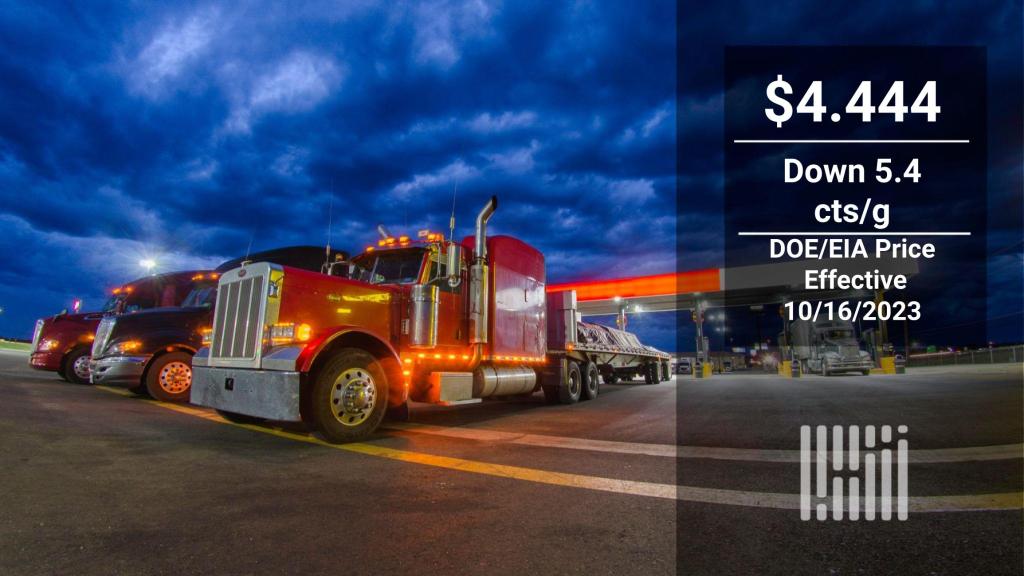
Retail diesel prices continued to slide last week, per the Department of Energy/Energy Information Administration retail weekly diesel benchmark, with the broader market still trying to figure out whether tensions in the Middle East are going to lead to tighter oil supplies.
The DOE/EIA price fell 5.4 cents per gallon to $4.444 per gallon Monday. With recent declines, it’s the lowest price since Aug. 21, when the number was posted at $4.389/g.
Most fuel surcharges are based on the weekly DOE/EIA diesel price.
There have been six trading days since the Hamas-led attack on Israel on Oct. 6. The overall trend has been higher; ultra low sulfur diesel on the CME settled Oct. 6 at $2.9008/g and settled Monday at $3.1492/g.
But it has been an up-and-down road to get there, with four days of increases (including a 16.68 cents-per-gallon gain Friday) and two days of declines, including Monday’s 6.25 cents-per-gallon fall. The big move on Friday wasn’t even attributed by most market analysts to the presumption of a wider war in the Middle East; instead, it was mostly because the U.S. took action against two shipping companies for violating the price cap on Russian oil shipments.
S&P Global Commodities Insights (SPGCI), in one of its online “Factboxes,” recently spelled out the actual disruptions to energy supplies so far — minimal — and what may lie ahead. Most of its findings were on natural gas, as shipments from an offshore Israeli oil field to Egypt have been disrupted and rerouted.
But SPGCI also quoted Jim Burkhard, its vice president and head of research for oil markets, energy and mobility, as warning that “500,000 b/d of Iranian exports could be at risk if the US tightens sanctions.”
According to the Factbox, Burkhard said in a note last Wednesday, “Biden will be under pressure to enforce sanctions and curtail Iranian export revenue.”
Rising Iranian production has been a key factor in slowing the march of crude oil to $100 per barrel, which seemed destined to occur just a few weeks ago. Brent crude, the international benchmark, settled Monday at $89.65. Its recent high was Sept. 27, when it settled at $96.55/b.
SPGCI estimated that Iranian production in April was 2.62 million barrels per day. In its most recent report, the group estimated Iranian output in September at 3.1 million b/d, up from 2.95 million b/d a month earlier.
One notable development in markets in the past weeks that could impact diesel, with acceleration in recent days, is that the margin for producing gasoline from crude has fallen, by some measures, to less than zero.
And the spread between the futures price of RBOB gasoline, the unfinished gasoline product used to establish the futures price of gasoline, and ultra low sulfur diesel on the CME has blown wide open. It recently has been at about 90 cents per gallon, with ULSD priced that much above RBOB, while that spread averaged 47 cents per gallon between the start of August and the end of September.
How that could impact diesel is that refiners will look to maximize their diesel output going forward, as the margins to make diesel remain healthy. That could provide the opportunity to build inventories that have been below historic norms in all the key markets of the world.
The possible negative impact for diesel consumers from that trend of weak gasoline is that diesel margins can’t overcome the lack of profitability for making gasoline and that could lead to run cuts. The 3:2:1 spread — a basic indicator for refining profitability by comparing the price of three barrels of crude to two barrels of gasoline plus one barrel of diesel — was above $35/b from roughly mid-June to the end of August. On Monday, it stood at about $18/b at the close of trading.
Stock-battered e2open now has activist investor Elliott as big shareholder
Activist investor Elliott Investment Management has taken a large stake in e2open, the supply chain software provider that last week ousted its CEO and saw its stock plunge when its earnings were released.
In a 13D filing with the Securities and Exchange Commission submitted Friday, Elliott Management said it has either outright ownership or indirect ownership through cash settled swaps that together amount to approximately 13.8% of the outstanding class A shares of the company, which total about 303.2 million.
Shares of e2open (NYSE: ETWO) actually owned outright, net of the swaps position, total about 9% of the outstanding shares.
In its filing, Elliott Management said it “believes the securities of [e2open] are undervalued and represent an attractive investment opportunity.” It said Elliott “will seek to engage in a dialogue” with the e2open directors to “maximize shareholder value.”
Possibilities that might come out of those discussions are “potential changes in [e2open’s] operations, management, organizational documents, composition of the Board, capital or corporate structure, sale transactions, dividend policy, strategy and plans.” The reference to dividends is for a company that does not pay them.
Based on the 13D filing, it appears that Elliott Management swooped in quickly after the disastrous one-two punch last week: weak earnings and the exit of CEO Michael Farlekas after the close of trading Tuesday, followed by an earnings call with analysts.
The late Tuesday events sent the shares of e2open down somewhat less than 20% before the market opening Wednesday. But by the time trading got into full swing Wednesday, the rout was on, with e2open stock dropping from a Tuesday close near $4.38 per share to a bottom Wednesday near $2.20.
That is when Elliott Management made its move. In the 13D, it says it bought about 8.3 million shares that day at prices ranging from $2.20 to $2.40. It made an additional purchase Thursday at $2.52.
Ironically, Elliott just sold 1.75 million shares of e2open stock on Sept. 15 at an average price of $4.90 per share.
The news of the Elliott Management stake Monday sent e2open’s stock price back up. At approximately 2:15 p.m. Monday, e2open’s stock price was $3.02, up 57 cents for a gain of about 23.4%. That was just under its high for the day. Volume at 2:15 p.m. was more than double the average daily volume, according to Barchart. Its 52-week high was $7.20 on Feb. 2.
E2open responded with a short statement late Tuesday.
.$ETWO on Elliott Management stake: “E2open encourages and maintains an open dialogue with all of our shareholders. Our Board of Directors and management team remain committed to creating long-term shareholder value and continue to take actions to achieve that objective.” pic.twitter.com/cyw3vB9P7N
E2open carries a B rating on its debt from S&P Global Ratings, which is well down in the non-investment grade scale. Paying a dividend could trigger a downgrade, given leverage levels at e2open that in its spring 2022 review from S&P were in the 7X to 8X EBITDA level, which is high by almost any standard.
E2open declined comment on the Elliott Management filing.
WASHINGTON — New-entrant out-of-service (OOS) orders issued to carriers will surge to an all-time high in 2023, according to the latest government data, a trend that has mirrored the dramatic increase in new-carrier operating authorities issued since 2020.
The Federal Motor Carrier Safety Administration began keeping track of new-entrant OOS orders in 2012. Since then, after climbing to a record 24,363 in FY2022, such orders already topped that number as of June 30 in FY2023, with 25,955, according to FMCSA’s Motor Carrier Management Information System (MCMIS).
Data for the full fiscal year, which ended Sept. 30, will not be available until December. But OOS orders occurring in FY2023 likely surpassed 35,000, based on trends over the past eight quarters (see chart).
New-carrier entrants are defined by FMCSA as “a motor carrier not domiciled in Mexico that applies for a U.S. Department of Transportation identification number in order to initiate operations in interstate commerce.”
FMCSA initiates a safety audit within the first 18 months of a new-entrant carrier going into business. If the carrier fails or refuses the audit or cannot be reached to perform the audit, the agency issues an OOS order.
“A new entrant may not operate in interstate commerce on or after the effective date of the OOS order,” according to FMCSA regulations. In addition, “a new entrant that operates a [commercial motor vehicle] in violation of an OOS order is subject to federal fines and penalties.”
FMCSA was not immediately available to comment on the surge and its implications.
One explanation is that, because operating authorities increased to record levels over the past few years (made up mostly of single trucks or small fleets), new-entrant OOS orders would parallel the trend because the pool of potential OOS recipients has gone up as well.
Daniel Koors, an owner-operator and council member for CDL Drivers Unlimited, an advocacy group aimed at helping improve working conditions and lifestyles for commercial drivers, is not surprised that OOS orders are at a record high. He believes current economic conditions in the trucking sector are accelerating the trend.
“It’s simple — there’s not enough money in the market right now to maintain these new drivers,” Koors told FreightWaves. “Many are barely able to maintain their homes let alone their trucks.”
Koors said that in addition to maintenance costs, fuel costs and freight rates are working against new entrants.
“I would say a majority of the new entrants that have fallen out are the ones that started during the pandemic,” he said. “They don’t have the back-office support, they don’t have the capital, they jumped in when things were hot, and they didn’t set up the relationships needed to get them through this downturn.”
To the extent that the record new-entrant OOS orders might represent an overall decline in trucking capacity, it adds to evidence that a bursting “capacity bubble” looms, which could result in higher freight rates as the market attempts to readjust.
How well are you using technology to reduce operating costs?
The logistics industry has been reshaped by a veritable technological revolution in recent years. Many fleets, however, are not taking advantage of the modern solutions designed to help them improve their safety and profitability.
New technologies are hitting the market daily, and these tools are capable of improving everything from driver selection to litigation outcomes. To experience these improved operational efficiencies, fleets — and their partners — just need to embrace the technology.
PCF Transportation is dedicated to helping its clients do just that. The company works with fleets to improve their operations — and mitigate their exposure to litigation — in a myriad of modern, tech-driven ways.
For example, PCF Transportation utilizes technology to analyze clients’ complete U.S. Department of Transportation violation history over the past two years. This allows them to quickly pinpoint vulnerabilities and spot drivers with repeat offenses.
“There is so much opportunity for our customers to use new technologies to help them manage their fleets,” PCF Transportation Practice Leader Todd Lykke said. “Just a few years ago, it would have been almost impossible to identify every violation and break down which trucks and drivers are having trouble.”
Once these issues are uncovered, fleets can work quickly to fix them. Often, that means having conversations with repeat offenders and offering customized training to fix identified problems.
In instances where drivers are unresponsive to training efforts, these technologies give fleets the evidence they need to terminate drivers who consistently create problems for the company. By identifying these drivers before a tragic accident occurs, fleets can protect themselves from nuclear verdicts.
“About 20% of drivers are creating 80% of the problems,” Lykke said. “If you’re a litigator and you can identify that the driver in an accident case has a poor record, it’s a slam dunk. Let’s not give the farm away. Let’s make it as difficult as possible.”
PCF Transportation’s tech-driven solutions are not just about identifying individual problem drivers, however. The company is also adept at helping fleets pinpoint — and resolve — systematic issues that may leave them vulnerable to increased litigation and unfavorable outcomes.
“We help identify the weak areas that a plaintiff attorney will identify and expose in court,” Lykke said. “Once we understand where the client is vulnerable from a litigation standpoint, we work on that issue.”
These weak areas could include poor driver selection and compliance practices, inadequate training programs, or outdated maintenance records. Fleets tend to fall into these negative habits in an effort to cut costs. In the end, this kind of neglect can end up costing companies a whole lot more than it saves them. PCF Transportation can help these fleets clean up their acts without breaking the bank.
In the spirit of keeping clients safe and up to date, PCF Transportation offers an annual safety and DOT compliance seminar. This event allows the company’s clients to have productive conversations with compliance experts at no cost to them.
The company also has a blog aimed at keeping clients informed about what is happening in the transportation industry — from nuclear verdicts to regulation updates — along with many other of their core industries.
These offerings align with PCF Transportation’s dedication to keeping its clients safe on the road and protecting them from nuclear verdicts. For the company’s efforts to be effective, however, fleet owners must also demonstrate a strong commitment to building — and improving — their safety programs.
“When companies buy into a safety program, it makes all the difference in the world,” Lykke said.
Despite the fact that companies often avoid creating robust safety programs on the basis of financial strain, fleet owners who dedicate their time, effort and resources to cultivating a culture of safety actually save more money in the long run.
Safe companies consistently benefit from competitive insurance rates, a benefit that cannot be overstated in an industry where sky-high insurance premiums have been known to drive fleets out of business.
Mack Trucks and striking UAW resume talks Thursday
A strike by the United Auto Workers at Mack Trucks entered its second week Monday. Bargainers plan to resume talks Thursday.
It is not unusual for a strike following rejection of a tentative agreement to release built-up worker pressure. Mack has said nothing publicly since exressing surprise and dismay that 73% of the workers turned down the tentative five-year agreement on Oct. 8.
That agreement would have increased wages 19% over five years with a 10% raise front-loaded. It did not address cost-of-living adjustments (COLA) that workers say are critical to wages keeping up with inflation.
The UAW International agreed to forgo COLAs during the Great Recession in 2009. Restoring them is a major issue in an ongoing strike against the Detroit Three automakers General Motors, Ford and Stellantis that began Sept. 15.
Currently, 34,000 of 146,000 UAW-represented autoworkers are on strikes at UAW-targeted Detroit Three plants. The union said it may strike any or all remaining plants depending on bargaining progress.
Mack Trucks strike affects plants in 3 states
The Mack strike coincides with but is separate from the Detroit Three strike. It affects six Mack and Volvo Group facilities in Pennsylvania, Maryland and Florida. Workers at sibling Volvo Trucks North America in New River Valley, Virginia, work under a separate four-year agreement. VTNA imposed terms of that agreement after a split vote on the third of three tentative agreements reached in 2021.
Mack’s medium-duty truck plant in Roanoke, Virginia, is also unaffected because it began operation after the last UAW agreement was reached following a 12-day strike in 2019. Workers there are not included in the master labor agreement.
It is unknown whether the UAW is seeking to bring Mack’s Roanoke operations under the master agreement and represent the 250 workers there. Mack Trucks North America President Jonathan Randall declined to discuss the strike Monday at the American Trucking Associations Management Conference and Exhibition in Austin, Texas.
The company begins regular production of Class 6 and 7 battery-powered medium-duty trucks in Roanoke in the fourth quarter in addition to diesel-powered models. Mack has about a 5% share of the medium-duty truck market. That’s ahead of internal projections for the 3-year-old plant.
Mack expects to end the year with a 5.5% share of the medium-duty market, in line with its 2022 share, Randall said.