Asia Pacific Airlines on notice for $2.9 million FAA fine
The Federal Aviation Administration has issued a preliminary fine of $2.9 million against Aeromicronesia Inc., a cargo airline based in Guam that does business as Asia Pacific Airlines, for safety violations related to pilot training and equipment.
Asia Pacific Airlines provides scheduled and ad hoc charter service between Guam, the Marshall Islands, Micronesia, the Northern Mariana Islands, American Samoa, Palau and Honolulu. It has five Boeing 757-200 converted freighters on its registry, but two of them have been parked for more than three months, according to aircraft tracking sites.
The FAA last week alleged the airline used unqualified pilots on 163 flights between late December 2022 and Feb. 1, 2023, and operated 121 flights without oversight by an authorized person. The airline also operated 30 flights that didn’t comply with conditions and limitations when certain equipment was out of order. The agency also faulted Asia Pacific Airlines for failing to document engine monitoring and continually assess engine reliability used in extended-range operations over water.
Asia Pacific Airlines was grounded for three months early last year after the FAA revoked its operating authority. The company disputed allegations its pilots were not properly trained.
Asia Pacific Airlines has 30 days to respond to the proposed fine. The company could not be reached for comment by time of publication. President Adam Ferguson told trade journal ch-aviation that the airline complies with all safety requirements and that the fine was a surprise after the company thought it had resolved all concerns.
Gather AI launches new features, sees promise in indoor drone tech
Shortly after announcing its $17 million raise in March, Gather AI, an inventory management solutions provider that uses drone technology, launched two new offerings on Tuesday to elevate its ability to help warehouse operators find underutilized space.
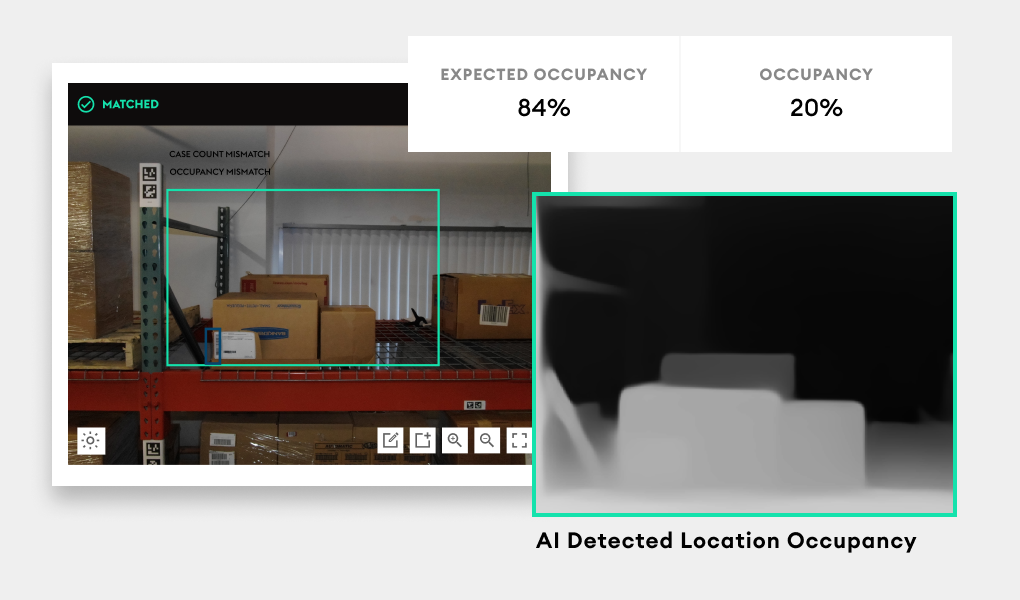
The initial solution, location occupancy, harnesses computer vision data collected by Gather AI drones. It accurately gauges available space and promptly notifies managers when products can be consolidated, optimizing space utilization.
The location occupancy feature is finding space for more storage. (Photo: Gather AI)
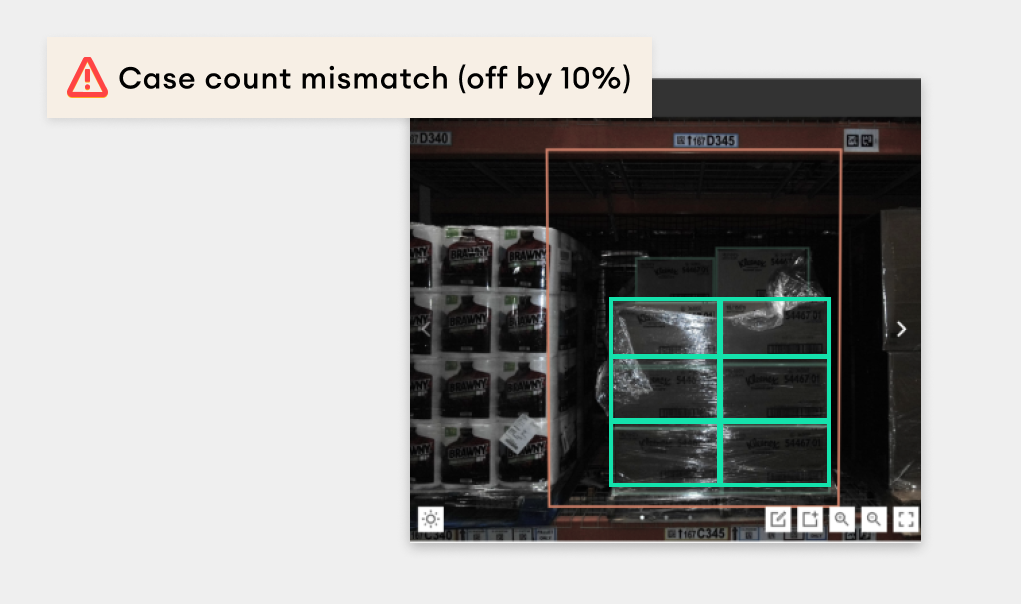
The second addition is the inferred case count feature, leveraging computer vision and AI algorithms on historical data to estimate the number of units on a pallet. This tool not only assists in identifying potential shortages but also streamlines managerial oversight by reducing the necessity for manual error detection, optimizing resource deployment.
“Several customers require us to count cases as part of our cycle counting program. … Using Gather AI’s drone inventory monitoring and the inferred case count feature is 87% more efficient than having our team do physical cycle counting. The efficiency gain enables our team to prioritize revenue-generating direct labor activities,” AJ Raaker, director of warehouse development at Taylor Logistics Inc., said in the release.
Computer vision counting cases for accuracy. (Photo: Gather AI)
Inventory drones
Drone applications in logistics have a bright future and according to studies, have an annual growth rate of 20% up to 2027.
While many applications center around delivery, indoor drone uses have a high potential to solve several warehouse management problems while avoiding technological challenges with outdoor drones, including flying regulations and weather conditions.
Drones offer various inventory management solutions, including audits, cycle counting and stock taking.
While stock-taking verifies warehouse item quantities annually, cycle counting happens more frequently. Typically, small teams conduct cycle counts manually, which can be slow, labor-intensive and error-prone. Drones can enhance this process by increasing accuracy, reducing costs and minimizing risks associated with manual labor at heights.
Drones play a crucial role in intralogistics by transporting goods within warehouses and facilitating on-site express deliveries. Drones also mitigate risks associated with manual inspections, especially in hazardous or elevated areas, and can enhance surveillance to deter theft.
“Our computer vision and AI analyze inventory images, offering warehouse operators access to a richer source of information than barcodes. Our new inferred case counting and location occupancy capabilities push the art of what’s possible while solving for error-prone, labor-intensive tasks for our customers,” said Sankalp Arora, co-founder and CEO of Gather AI.
Prologis sees market tightening again once interest rate cuts begin
Management from logistics real estate investment trust Prologis said Wednesday that uncertainty around the timing of interest rate cuts has slowed leasing demand in the near term but that its favorable longer-term outlook remains unchanged.
Prologis (NYSE: PLD) reported first-quarter core funds from operations (FFO) of $1.28 per share, in line with the consensus estimate. However, it lowered its full-year guidance by 1% to a new range of $5.37 to $5.47 compared to analysts’ expectations of $5.50 at the time of the print.
The slight pullback in outlook represents some hesitancy in the market, which management believes will last for the next two to three quarters. Looking two and three years out, it said it’s potentially more bullish than before as deferred demand continues to build.
“If you are sensing any acute change in our outlook, you are not reading our call correctly, said Hamid Moghadam, co-founder and CEO, on a Wednesday call with analysts.
He said lease signings have been pushed out somewhat due to geopolitical concerns and higher interest rates. However, he expects that to change once rates start moving lower.
“People are just scared of pulling the trigger until the Fed gives the all-clear sign with the first rate cut,” Moghadam said.
Table: Prologis’ key performance indicators
Rental revenue increased 12% year over year (y/y) to $1.83 billion in the first quarter. Consolidated revenue was 11% higher at $1.96 billion.
Occupancy across its portfolio was 96.8%, which was 30 basis points lower than the fourth quarter and 120 bps lower y/y. The company said occupancy rates have fallen 310 bps across the broader industry since the peak two years ago, but only by 80 bps across Prologis’ portfolio.
Prologis now expects average occupancy in 2024 to be between 95.75% and 96.75%, which is a 75-bp reduction from the midpoint of the prior range. It said available supply is down 80% from the peak and one-third lower than pre-pandemic levels. It expects vacancy rates to reach the mid-6% range, quickly moving quickly lower later this year.
It views a 6% vacancy rate as market equilibrium for rent negotiations.
Net effective rent change (over the entire lease term) was 67.6% in the quarter, 120 bps lower y/y.
Global market rents were down 1% in the period, with most markets in the U.S. seeing little change. Prologis noted weakness in Southern California (rents down 6% in the first quarter) and the Inland Empire of California due to general demand softness. But Moghadam believes some of that sluggishness is tied to protracted labor negotiations at the West Coast ports over the past two years.
However, rent changes on multiyear leases rolling over were 120% higher across the U.S. and 156% higher in the Inland Empire. The company said marking its whole lease portfolio to current market conditions would produce $2.2 billion in additional rents, or about a 50% increase to the current lease rates.
“The worst that we are projecting in this period is almost as good as the best we’ve seen in other cycles,” Moghadam said. “We’ve just been spoiled by a market … where vacancies have been lower than they’ve ever been.”
Shares of PLD were down 6.9% at 2:40 p.m. EDT on Wednesday compared to the S&P 500, which was off 0.2%.
TrueLifeCare: An angel on your shoulder – Taking the Hire Road
Kay Pfeiffer, senior vice president of TrueLifeCare joined Jeremy Reymer on a recent episode of Taking the Hire Road. Pfeiffer and Reymer chatted about the importance of awareness, education and action in addressing the diabetes epidemic plaguing the trucking industry today.
The average lifespan of a truck driver is just 61 years old. That doesn’t sit right with Pfeiffer.
A trio of diseases — sleep apnea, diabetes and hypertension — is largely responsible for shortening the lifespan of drivers across the nation. One of these diseases, diabetes, is particularly insidious because it can also come with a slew of disabling complications.
About 39 million American adults have been diagnosed with diabetes, and that number is expected to grow exponentially over the next five years. In the truck driving population, about 500,000 people — or 15%-17% of all drivers — live with diabetes, according to Pfeiffer.
On a daily basis, unmanaged diabetes causes about 50 people to go blind, leads to 220 amputations and pushes 240 patients into end-stage kidney failure. Fortunately, the disease does not have to end this way. The U.S. health care system, however, is not set up to help patients — especially busy patients like truck drivers — proactively manage their health.
“It is manageable if you get the right help. The current health care system, unfortunately, does not provide the right help,” Pfeiffer said.
TrueLifeCare steps in where the mainstream health care industry steps out. The organization partners with carriers to help their drivers manage chronic conditions, including diabetes.
TrueLifeCare provides program participants with direct access to a nurse for consistent support in making healthier choices — from deciding what to eat at a truck stop to fitting movement into their schedules. Pfeiffer called these nurses “angels on their shoulders,” pointing out the necessity of compassionate support for people making difficult lifestyle changes.
The organization also provides participants with free testing supplies and other practical resources to reduce the barrier to proactive diabetes management.
By keeping drivers healthier and happier, participating in a program like TrueLifeCare keeps them driving longer. When drivers experience diabetes complications like blindness or amputations, they are prematurely taken out of the workforce. Pfeiffer noted that, in an industry that is already struggling with a driver shortage, this is a serious challenge for carriers.
“If we don’t do all we can to help drivers manage their diabetes, they’re going to fall into the shortage,” Pfeiffer said.
Carriers experience other benefits from participating in the program as well. Most participants — including TrueLifeCare partner Heartland Express — see medical spend decrease by as much as 50% for program participants. Additionally, issues like absenteeism, productivity lags and frequent worker’s compensation claims are reduced.
At the end of the day, drivers want to work for carriers that care about them. And carriers want to keep their drivers happier and healthier on the road. A strong commitment to health — and a partnership with a company like TrueLifeCare — is a great way to accomplish those goals.
On Episode 707 of WHAT THE TRUCK?!?, Dooner is talking to Dominick Angelo Tullo of T&R Oil Co. about fuel fraud, scams and skimming. Tullo has firsthand experience with all the black hat tricks of the trade and shares a story about a scam that cost his company a few thousand gallons of fuel.
It’s been three weeks since the Francis Scott Key Bridge collapse in Baltimore. How has cargo been disrupted? Overhaul’s Ronald Greene talks about impacts to auto and other commodities. He also warns shippers of risks to watch for and shares cargo theft trends.
Daylight Transportation is opening a first-of-its-kind building in Texas. Greg Steele tells us all about the company’s road to sustainability and how it helps with employee retention. We’ll also see what’s trending in expedited LTL.
Plus, anti-Zim protesters hit Maher Terminals; J.B. Hunt posts big earnings miss; broker revenues fall over 15%; and who has the right of way?
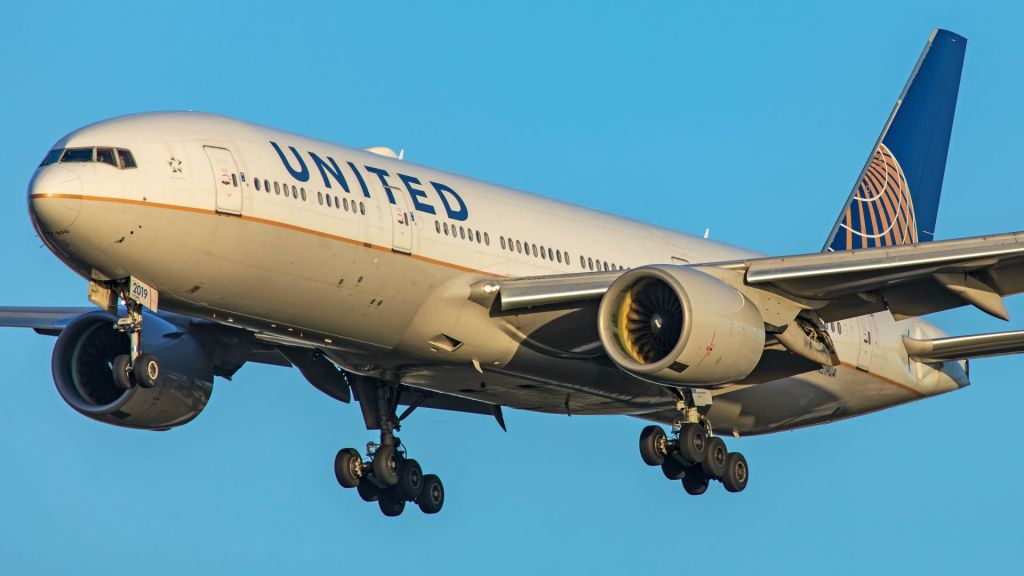
United Airlines, buoyed by a significant recovery in market conditions, delivered surprisingly strong cargo results in the first quarter that likely will be the benchmark for comparing the performance of other airlines.
United (NASDAQ: UAL) reported after Tuesday’s market close that sales for freight and mail were $391 million, a notably small dip of 1.8% from the same three-month period in 2023 considering the air logistics sector’s 16-month slump that lasted into the second half of 2023 and the revenue hit taken by airlines. CEO Scott Kelly said on a conference call he anticipates it will be the last year-over-year decline in cargo during the near term.
Last week, Delta Air Lines reported cargo revenue declined 15% during the first quarter to $178 million.
Last year, United Airlines’ cargo revenue slid 31% to $1.5 billion as supply and demand in the airfreight sector normalized from the go-go days of the pandemic. Cargo’s relative strength during the quarter is underscored by the fact that revenues were only slightly below $402 million in the fourth quarter of 2023, which is generally the strongest freight season of the year. United’s revenues were down 14.8% year over year in the fourth quarter.
The Chicago-based carrier said cargo revenue ton miles — a measure of revenue generation based on how much cargo is carried and how far it is carried — increased 16.6% to 852 million in the quarter ended March 31.
The cargo division benefited from the upturn in the air cargo market, which grew about 12% year over year during the first quarter. Price reporting agencies show volumes are still 8% ahead of last year at this time as the market heads into the slower summer months. Rates have recovered to where they were a year ago and are 25% higher than they were in July.
United’s cargo results shouldn’t be attributed only to good luck. The airline consistently outperforms its U.S. peers and many international competitors because of its large widebody fleet and ability to maintain deep relationships with freight forwarders that tender most shipments and its large widebody fleet.
Overall, United Airlines posted earnings that exceeded analysts’ expectations with operating revenue of $12.5 billion, up 10% year over year. It had an adjusted pretax loss of $79 million, but would have have been profitable were it not for a $200 million impact related to the grounding of Boeing MAX 9 aircraft after a door panel blew out on an Alaska Airlines flight in January.
It was the first time United generated an adjusted operating profit in the first quarter since 2019. “The fact that the MAX 9 grounding caused a $200 million headwind makes it even more impressive,” said TD Cowen analyst Helane Becker in a client note.
The earnings report said travel demand remains strong, with business travel finally making large post-pandemic strides.
United expects to take delivery of 61 narrowbody aircraft and five widebodies in 2024, compared to contractual commitments for 183 narrowbody aircraft, due to Boeing delivery delays. The fleet changes will reduce full-year capital expenditures to about $6.5 billion from $9 billion. United also has a modified fleet plan for the following three years to get more near-term capacity, including the conversion of MAX 10 orders to MAX 9s, and signed letters of intent to lease 35 Airbus A321 neos. Management said it anticipates bringing in about 100 narrowbody aircraft in each of the three years under the new plan.
United’s stock was up 11% in early Wednesday trading to $46.34 per share.
WASHINGTON — Federal regulators are not convinced that the potential for lost wages for prospective truck drivers outweighs the safety benefits of current rules on how states must administer CDL skills tests.
In a notice scheduled to be published in the Federal Register on Thursday, the Federal Motor Carrier Safety Administration denied a petition by Florida Department of Highway Safety and Motor Vehicles asking that the state be exempted from a federal regulation requiring that the three-part CDL skills test be completed by test-takers in the following order: pre-trip inspection, basic vehicle control skills and on-road skills.
Under the regulation, if an applicant fails one part of the test, he or she may not start the next part but instead must return on a different day to take all three parts. Florida wanted applicants to be allowed to continue with subsequent segments of the skills test if they fail the pre-trip inspection or the basic vehicle control skills segments and return at a later date to retest only the failed segments.
In supporting Florida’s petition, the Commercial Vehicle Training Association (CVTA), which represents truck driver training schools, said added delays caused by having to reschedule and retake tests has put truck driver jobs on hold, which translates into millions of dollars in lost wages and less income tax revenue for state coffers.
The National Tank Truck Carriers, which represents cargo-tank haulers, sided with CVTA. “Given the well documented commercial driver shortage, it is imperative that we reduce barriers to individuals attaining the proper credentials for operating commercial vehicles,” the group stated in support of an exemption.
FMCSA acknowledged those assertions but also highlighted a statement submitted by commenter Tim Kordula, who in opposing Florida’s petition said allowing an applicant who fails the pre-trip inspection to immediately continue the test “is not only unsafe but irresponsible.”
In denying Florida’s petition, FMCSA Acting Deputy Administrator Sue Lawless said conducting the elements of the skills test in the required order “is the best practice for the safety of the CDL applicant, the examiner, and any motorists who must share the public roadway with the CDL applicant during the on-road portion of the CDL skills test.”
She also pointed out that current regulations do provide some flexibility: Leeway is given in some cases that allows applicants to not have to retake portions of the test that they have passed previously.
“Moreover,” Lawless stated, “with the implementation of the Federal Entry-Level Driver Training requirements, the agency believes [state driver’s license agencies] should see a reduction in the percentage of applicants who fail portions of the CDL skills test.”
Prologis reports in-line Q1, slightly trims 2024 outlook
Logistics warehouse operator Prologis slightly lowered its 2024 guidance on Wednesday as it expects leasing activity to “stay competitive” in some markets. It’s calling for occupancy and net operating income to step lower.
Prologis (NYSE: PLD) reported core funds from operations (FFO) of $1.28 in the first quarter of 2024, which was in line with the consensus estimate. It lowered FFO guidance by 1% to a new range of $5.37 to $5.47, which was slightly below analysts’ expectations of $5.50 at the time of the print.
“While operating conditions are healthy in the majority of our markets, customers remain focused on controlling costs, which is weighing on decision making and the pace of leasing,” said Hamid Moghadam, co-founder and CEO.
Rental revenue increased 12% year over year (y/y) to $1.83 billion, pushing consolidated revenue 11% higher to $1.96 billion.
Occupancy across Prologis’ portfolio was 96.8% in the period, which was 30 basis points lower than the fourth quarter and 120 bps lower y/y. Management’s new 2024 outlook calls for average occupancy to be between 95.75% and 96.75%, a 75-bp reduction at the midpoint of the range.
Net effective rent change (over the entire lease term) was 67.6%, 120 bps lower y/y.
“A volatile and persistently high interest rate environment, together with mounting geopolitical concerns, contribute to this indecision and its short-term effect on net absorption,” Moghadam said. “We remain optimistic about the fundamentals of our business, while being prepared for a slower environment in the next quarter or two.”
Shares of PLD were down 5.6% at 11:44 a.m. EDT on Wednesday compared to the S&P 500, which was off 0.3%.
The company will host a call Wednesday at noon EDT to discuss first-quarter results.
Port of LA opens promenade to connect community to waterfront
The Port of Los Angeles recently opened a waterfront promenade on its property, giving the nearby community unprecedented access to the water and sweeping views of the port’s activities.
The $77 million Wilmington Waterfront Promenade is the second phase of connecting the Wilmington community, located adjacent to the port, to the waterfront. The 9-acre promenade opened in February after more than three years of construction. Until this project, which port officials have deemed “transformational for the Wilmington community,” the industrial space wasn’t accessible to the public.
The port in 2011 opened a 30-acre park, previously a brownfield site, providing a buffer between the port and neighborhood. The next phase of the project includes constructing a pedestrian bridge and developing 12 acres of green space at the nation’s busiest container port. The port in February processed more than 780,000 containers, a 60% increase over last year.
The project’s goal was to maximize the views of the water “to embrace that it is a working port,” Dina Aryan-Zahlan, the port’s deputy executive director of development, told FreightWaves.
The promenade, hailed by port officials “as the window to the waterfront” of the working port, includes amenities such as picnic space, a floating dock and green space. Previously, the land contained empty buildings and a parking lot, Aryan-Zahlan said.
“The idea was to open that whole space up for the community to have access to what is our waterfront,” said port Community Relations Director Cecilia Moreno. “I think we’re the only community that doesn’t have a beach that’s right up against the water.”
Moreno, a Wilmington native, previously served as the Wilmington community affairs advocate for the port. She said she was mesmerized during her tour of the promenade.
“We just froze,” she said, adding that since the grand opening in February, many visitors have had the same awestruck and joyous reaction.
Philip Dugdale, who has worked on the project since 2016 and is the co-director of Sasaki’s New York design firm, said architects wanted to provide spaces for the community to engage with the water, with the human experience forefront in design choices. In contrast to the industrial aspects of the port, he said designers created a lush, green space.
“It’s reconnecting the community with the water,” he said.
The Great Freight Recession has now lasted longer than the COVID bull market
On March 31, 2022, FreightWaves declared that a freight recession was imminent. More than two years later, the freight market remains in one of its deepest and longest recessions in history.
Our original conclusion was derived from signals from FreightWaves SONAR. Its high-frequency datasets, which track freight supply and demand in real-time, indicated an imminent collapse. When FreightWaves first published the article, many were not only skeptical of the conclusion, they derided FreightWaves for the call. Even after the recession took hold, few would have guessed that the freight downturn would be as deep or as long as it has been.
As we enter the third year of the Great Freight Recession, the trucking industry asks, “How much longer is the market going to remain in a recession?”
We believe that we are now at the bottom of the market.
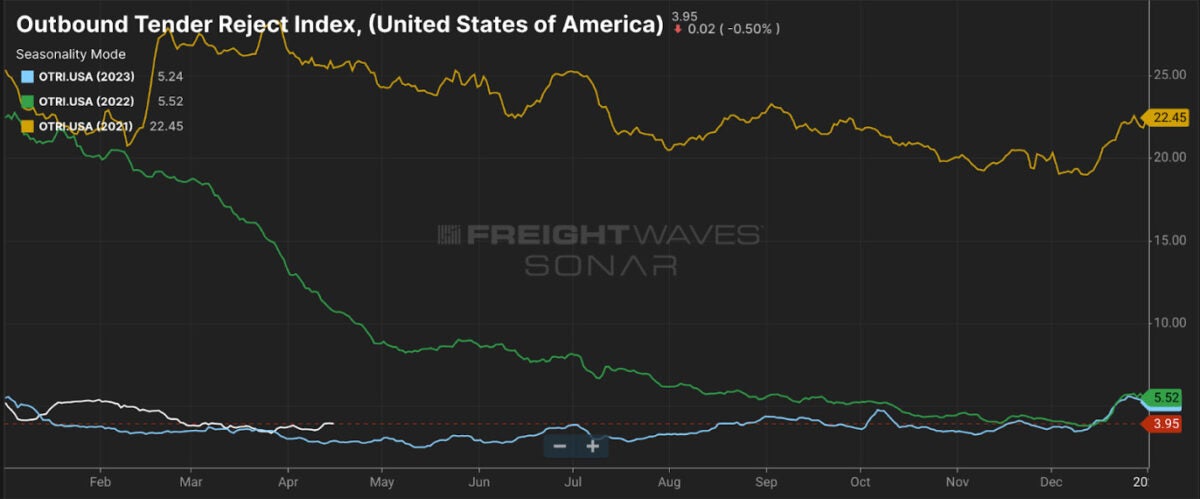
SONAR’s Outbound Tender Rejection Index, or OTRI, measures the percentage of truckload transactions rejected by carriers. OTRI indicates that conditions are better than they were a year ago, albeit not by much.
Tender rejections are a highly reliable indicator of the balance of supply and demand. The higher the rejection rate, the more load options a carrier has. The lower the rate, the fewer load options a carrier has. While some will look at the absolute value of tender rejections, we also look at them in the context of where they have been.
Tender rejections are currently at 3.95%, up from the 2024 low of 3.39 on March 26 and up substantially from 2.88% a year ago.
The Outbound Tender Rejection Index. To learn more about FreightWaves SONAR, click here.
We believe that tender rejections bottomed out in late March and have steadily increased throughout April, which is historically a soft month in freight. This indicates that the 2024 low is in the rearview mirror.
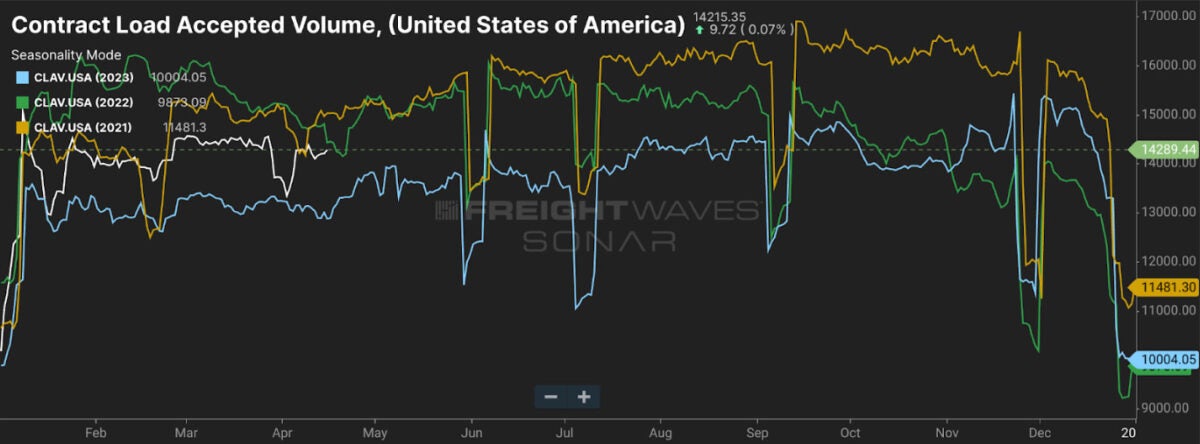
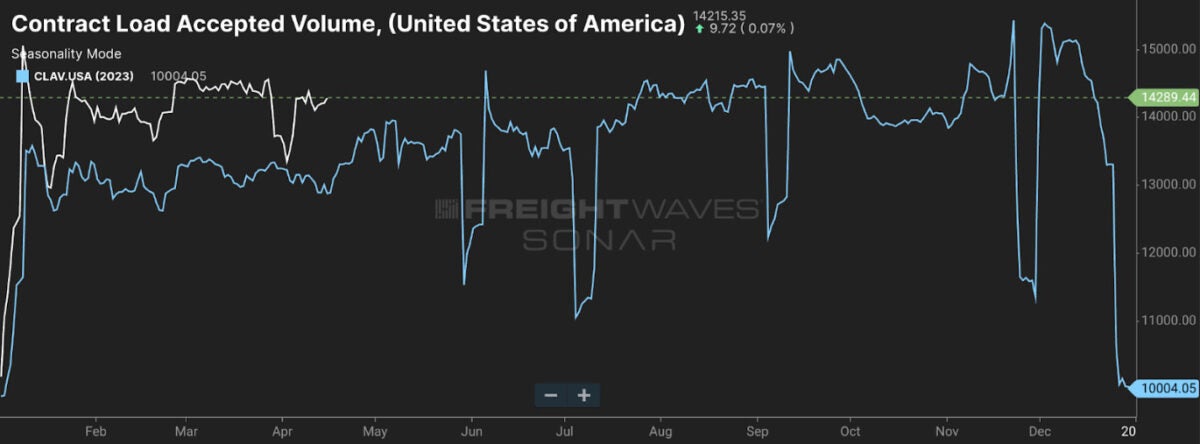
Contracted load accepted volumes, another SONAR index measuring contracted load demand, tell us that the market has grown since January 2023.
As of April 15, 2024, year-over-year contracted volumes are up 9%.
Contract accepted volumes are currently down 6% compared to April 2021, the peak of the COVID bull run.
Contract Load Accepted Volume. To learn more about FreightWaves SONAR, click here.
While a gap certainly exists between peak volumes and current volumes, the gap is narrowing. In the past year, contracted load accepted volumes have increased by 9%.
Contract Load Accepted Volume. To learn more about FreightWaves SONAR, click here.
The Atlanta Federal Reserve now forecasts that year-over-year GDP growth is up by 3%. In a normal growing economy, freight demand grows faster than economic growth. If the economy grows above 2% for the year, we expect that contracted load accepted volumes in 2025 will surpass the 2021 peaks.
Capacity will continue to decline
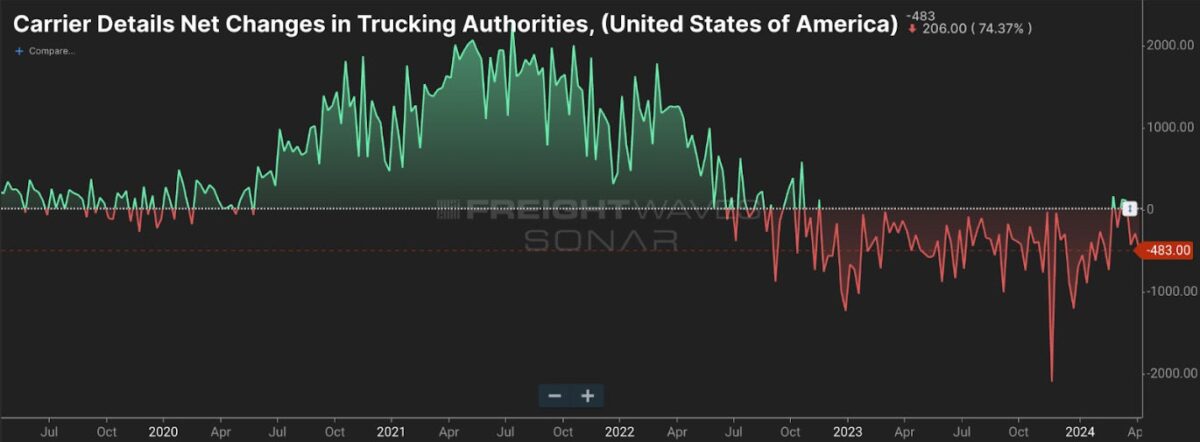
The growth in contracted load accepted volumes will occur at the same time that capacity continues to bleed out of the market.
Another of the many indices in the SONAR platform is the Carrier Details Net Revocation Data, which shows the increase or decline in the number of trucking companies in the market. In the chart below, anything above zero (green) shows an expansion in the number of trucking authorities, while anything below zero (red) shows a decline.
To learn more about FreightWaves SONAR, click here.
The index has been in negative territory since the fourth quarter of 2022. Capacity continues to leave the market, allowing the market to return to balance.
During the two years of the freight market’s COVID bull run, fleets built up substantial operating surpluses and were able to build strong balance sheets. This has enabled them to hang on for a long time.
For much of the Great Freight Recession, trucking fleets have been running many of their miles at losses. This has forced them to tap into the financial reserves they built up during the COVID bull run.
The Great Freight Recession has gone on longer than the COVID bull run, meaning that since the first days of the COVID lockdowns, truckers have operated primarily in recessionary territory. For those who remain in the market, their reserves are likely exhausted, as is their stamina.
However, for those who can continue, the tough times may be ending. The data suggests that a recovery in the balance of supply and demand will come as soon as fall 2024, but almost certainly by spring 2025.