FreightWaves’ Baltimore coverage spans segments

O little town of Baltimore

I lived in Baltimore City for 12 years so it’s impossible for me to not have a lot of mixed thoughts about the town. It has a vibrant financial community and I loved the local running groups. It’s also the only place where I was ever punched in the head on my way home from work.

I toured the container and ro-ro terminals and the coal export terminals at Baltimore on separate occasions. What was memorable to me is that the Lamborghinis and luxury European imports are not considered the “expensive cargo” — that would be the helicopters, tanks and construction equipment that come off the ro-ro vessels.

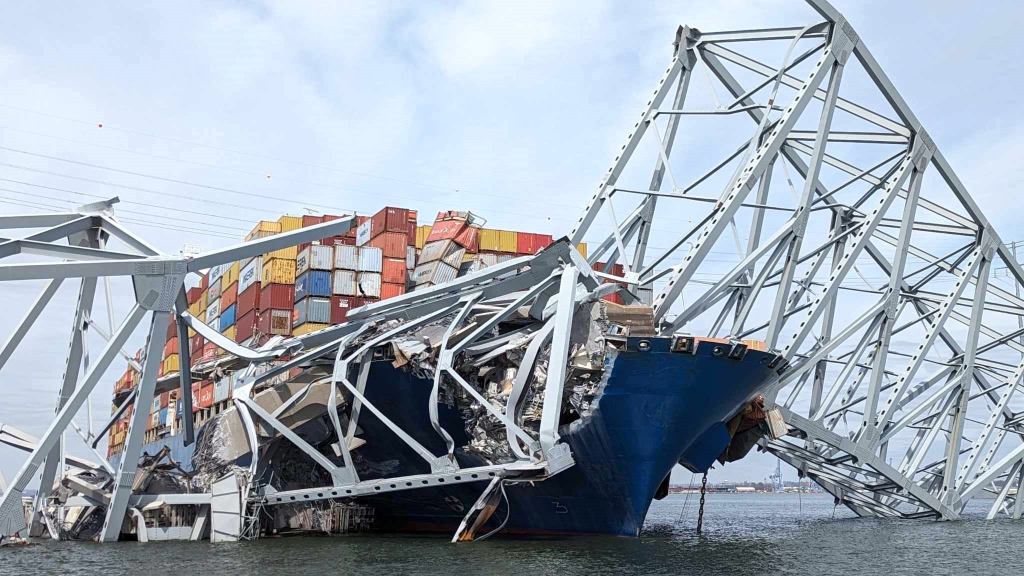
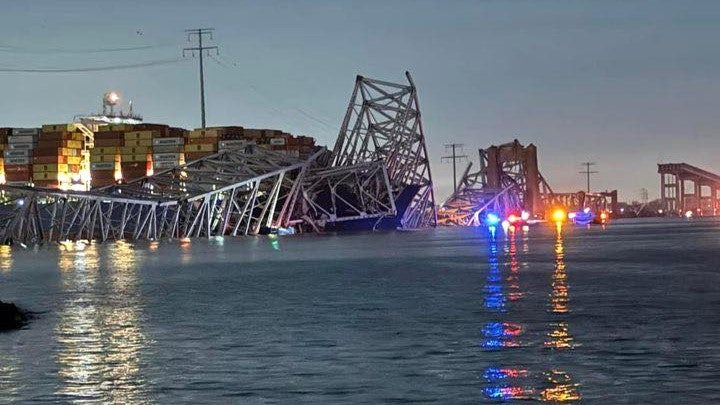
I still can’t believe that the Francis Scott Key Bridge is no more. To get and stay caught up, there are plenty of FreightWaves articles here

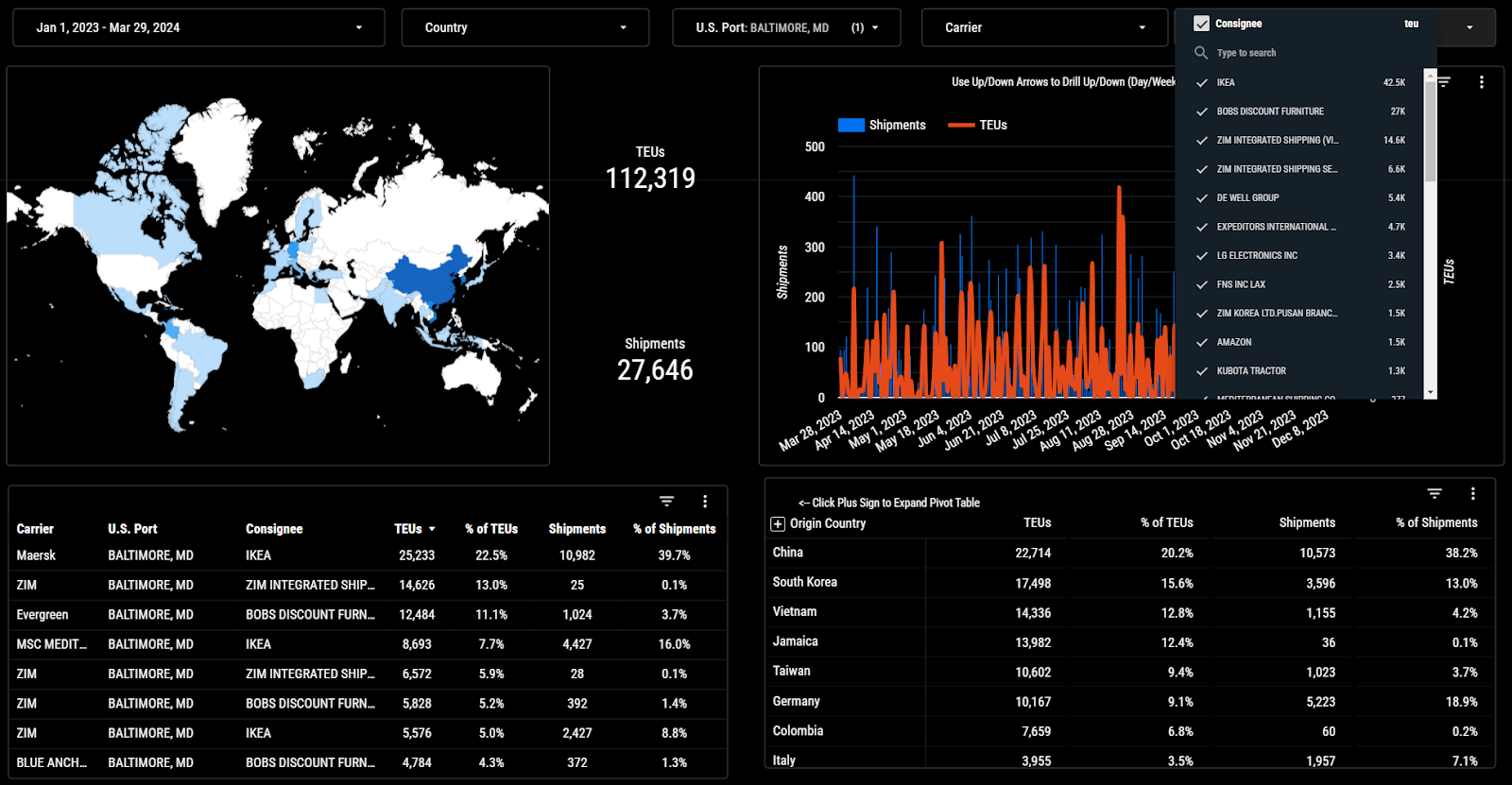
SONAR data shows that a lot of cheap furniture comes through the Port of Baltimore. (Chart: SONAR)

Here are a few stats about Baltimore from the SONAR data product, according to Zach Strickland, SONAR head of freight market intelligence:

  • Some 31,000 people per day crossed the Francis Scott Key Bridge — that’s not huge for trucking traffic but will be a bigger deal for maritime and subsequently drayage due to reduced port activity.
  • The Port of Baltimore handles about a fourth of the volume of Savannah, Georgia, according to the SONAR IOTI (inbound ocean bookings at point of origin) and ICSTM (maritime import shipments clearing U.S. customs) data sets.
  • The port is roughly the 12th-largest by volume of twenty-foot equivalent units in the U.S. over the past year (2.4% of TEUs in the SONAR Container Atlas app).
  • Baltimore is the 24th-largest outbound trucking market in the U.S., as the metro areas are segmented in SONAR (1.24% Outbound Tender Market Share).
  • Thirty-six percent of the tender volume stays in Maryland; 22% goes to Pennsylvania and 15% to Virginia, to round out the top three. I.e., Most of the freight is regional.

Fast fashion supply chain becomes profit center

On next week’s The Stockout show, which airs Monday at 10 a.m. Eastern time, Grace Sharkey and I plan to talk about Shein, the polarizing fast fashion company. Depending on one’s perspective, it’s a hero for bringing affordable accessories to the masses or an environmental demon for bringing tremendous material and packaging waste into style.

Setting that debate aside, Shein is clearly a supply chain innovator that creatively addresses the unpredictable nature of fashion industry trends. That includes this week’s news that the company is launching a “supply chain as a service,” which will make its supply chain infrastructure and technology available to outside brands and designers. The idea is to enable other brands to test new designs in small batches via Shein’s on-demand manufacturing model, which includes using real-time data to adjust production schedules. Unusual for clothing, Shein uses airfreight as a way to provide fast delivery to offset the typical slowness that would result from an on-demand and low-inventory manufacturing model.

If and when Shein releases a public prospectus, ripping it apart will make for great fodder for Grace and me to discuss.

Unilever cuts tail to move head

(Image: FWTV)

On Monday’s episode of The Stockout, FreightWaves’ show that focuses on CPG and retail logistics, I went through a few topics including last week’s announcements that Unilever plans to divest its ice cream business and cut 7,500 jobs. In some ways, the layoff announcement was the bigger news since Unilever telegraphed the ice cream divestiture when it restructured its financials in 2022. It’s also a strategy that is consistent with other publicly traded CPG companies, such as Nestle with its “cut the tail to move the head” strategy.

Other topics discussed on Monday’s show include General Mills’ cost inflation, record cocoa prices and a SONAR breakdown of the high-traffic Chicago-to-Atlanta lane. In addition, Baudendistel highlights why international intermodal volume is outperforming domestic intermodal volume and why that matters for investors, carriers and shippers.

Monday’s episode can be seen here, and the full playlist is available here.

Are unhealthy foods being unfairly targeted?
I found this article from Just Food to be timely in light of the intense investor and corporate focus on shifting resources in favor of food segments perceived to be healthy.

To subscribe to The Stockout, FreightWaves’ CPG and retail newsletter, click here.
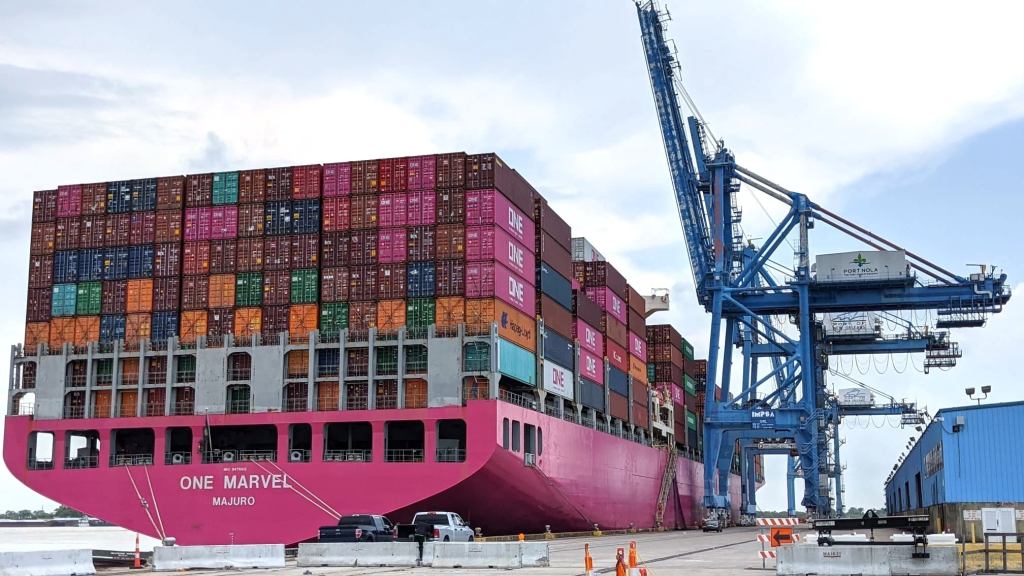
Gulf Coast ports record gains in cargo, crude oil shipments in February

Corpus Christi, Texas, and the Port of New Orleans saw increased cargo volumes in February, led by container exports of plastic resins and chemicals, along with shipments of crude oil.

Port of New Orleans reports 11% increase in container volumes 

Boosted by shipments of coffee, chemicals and plastic resins, the Port of New Orleans saw an 11% year-over-year (y/y) rise in container volumes at 42,760 twenty-foot equivalent units during February.

“Plastic resins and miscellaneous chemicals were the port’s top containerized exports,” port spokeswoman Kimberly Curth told FreightWaves. “Coffee, furniture and wood products were the top containerized imports.”

Breakbulk cargo totaled 104,249 short tons in February, a 17% y/y decline from the same month in 2023.

While breakbulk was down year over year during the month, it was up 36% compared to January 2024.

“For breakbulk, steel, natural rubber and lumber continue to be the top imports,” Curth said. “Breakbulk volumes in February were mainly driven by steel imports from Asia, natural rubber from Southeast Asia, as well as project cargo.”

The port handled 9,176 Class I rail car switches in February, a 28% y/y decrease. The port handles switching operations for the six Class I railroads that operate in New Orleans: BNSF Railway, CN, CSX, CPKC, Norfolk Southern and Union Pacific.

“Fiscal year to date, overall container volumes are up 13% compared to fiscal year 2023, underscoring our overall expectations for a double-digit growth this fiscal year,” Curth said. “It is also important to highlight that we saw a significant vessel schedule reliability improvement in our two East Coast South America services.”

Curth also said movements of empty containers into the port were up 19% y/y in February, helping shippers that need containers to ship goods out of New Orleans.

Crude oil shipments continue to maintain Port of Corpus Christi 

The Port of Corpus Christi posted a 1% y/y increase in total shipments during February, handling 15.7 million tons of cargo compared to 15.6 million tons in 2023.

Shipments of crude oil totaled 9.83 million tons for the month. Exports of crude oil totaled 8.97 million, a 1% y/y increase compared to the same year-ago period. Imports totaled 855,282 tons, a 38% y/y increase compared to 2023.

Petroleum shipments decreased 6% y/y in February to 4.65 million tons. Exports of petroleum totaled 3.6 million tons during the month, a 12% y/y decrease.

Shipments of bulk grain increased 329% y/y to 408,765 tons, while dry bulk cargo decreased 39% y/y to 408,495 tons.

Breakbulk shipments increased 532% y/y to 20,994 tons in February, while chemical cargo volumes totaled 297,100 tons, a 5% y/y increase from 2023.

Liquid bulk shipments decreased 16% y/y to 69,960 tons.

The Port of Corpus Christi had 388 barge calls during the month, an 11% y/y decline. Ship calls duringFebruary totaled 187, a 1% y/y decline compared to 2023.

More articles by Noi Mahoney

Port of Baltimore’s indefinite closure deals blow to city, state economy

Baltimore bridge collapse may cost billions, dramatically disrupt supply chains

State of Freight: Reasons to be bullish on second half of 2024

Will natural gas payback beat EV adoption?

The confluence of a new, bigger engine, net-zero carbon emissions from renewable natural gas (RNG) and pressure from shippers for their carriers to operate sustainably add up to a bright picture for natural gas adoption.

But a new study from the North American Council for Freight Efficiency (NACFE) points to a couple of cautions. First is methane leakage from the source of the RNG. Methane escaping into the atmosphere is a huge contributor to planet-warming greenhouse gas.

Second, and most important to fleet managers, is whether adopting natural gas and installing behind-the-fence fueling infrastructure will pay for itself before the tipping point to zero-emission electric vehicles arrives.

Timing and incentive availability raise caution flags

“When electric trucks become more viable … you may not have enough time to really execute and implement a decision to go to natural gas and then have enough years to really get that payback,” Mike Roeth, NACFE executive director, said in a virtual news conference on Monday.

And in lining up for incentives, will natural gas get its share of financial help to offset its higher-than-diesel costs?

“Incentives are available, but with all of the public and private needs for all of these solutions — support for battery-electric trucks, support for biodiesel and other things — we wonder what the lifeline of incentives will be for these various different solutions,” Roeth said.

Still, even with the challenges proponents don’t mention, NACFE is confident in a greater take rate for natural gas as an alternative to diesel.

Cummins X15N a key development

A new, more powerful Cummins X15N engine now in production addresses driver complaints of insufficient power and torque from its industry-standard X12N engine. The X12N is soon to be retired.

Cummins already has sold 40,000 of the X15N engines in China where they debuted in 2020. It expects to sell 3,000 stateside this year, and its top on-highway executive predicts penetration could eventually reach 10% of the approximately 300,000 engines sold annually. Whether that fivefold increase materializes is unknown.

But Roeth and his fellow researchers are sure natural gas-powered engines are destined to claim more than their 1%-2% historic market share. RNG is a big component of that projection. RNG accounts for about 69% of all natural gas nationwide and 97% in California.

“All those things pile up for us to see that natural gas and particularly the RNG portion being a bigger part of the solution than we thought just a few years ago,” Roeth said.


SEC fines Lordstown Motors’ founder

Steve Burns’ name was conspicuously absent when the Securities and Exchange Commission fined Lordstown Motors $25.5 million for faking pre-orders for its  Eudurance electric pickup truck.

Now the agency has called out Burns in a separate $175,000 penalty for his role in artificially pumping up expectations for the now-bankrupt startup.

On March 22, the SEC said it had settled fraud charges against Burns, Lordstown’s former chairman and CEO, for misleading investors about pre-orders for the Endurance. Short seller Hindenburg Research blew the whistle on Burns and Lordstown in a March 2021 report titled “The Lordstown Motors Mirage: Fake Orders, Undisclosed Production Hurdles and a Prototype Inferno.”

Lordstown Motors founder and former Chairman and CEO Steve Burns (Photo: Lordstown Motors)

Burns at one time held more than 25% of the startup’s stock. Lordstown went public in October 2020 in a reverse merger with special purpose acquisition company DiamondPeak Holdings Corp. Burns sold massive amounts of his shares up until the week of Lordstown’s Chapter 11 bankruptcy reorganization filing in August, collecting more than $60 million.

In October, he purchased the Endurance assets in bankruptcy for $10 million, and he has started a company called LandX, of which he is the principal owner.

Burns neither admitted nor denied the SEC’s allegations, He consented to a permanent injunction, the civil penalty and a prohibition from serving as an officer or director of a publicly traded company for two years. Burns could not be reached for additional comment on the SEC settlement.


REE Automotive gets greenlight on incentives, grows order book

Ree Automotive is reporting strong progress toward production of the first fully by-wire — no mechanical connections — commercial truck, although its cash is pretty short.

The company is pausing production tooling purchases until it can raise more money, probably in the second half of the year. 

Ree is burning 25% less cash than a year ago. Its cash and short-term investments stood at $86 million at the end of 2023. It raised about $15 million in a straight sale of shares at $6.50 each.

The Israel-based startup this week gained California Air Resources Board approval for incentives of more than $100,000 per truck. Meanwhile, the order book now stands at $50 million, up 900% year over year as Ree is running field tests with customers.

Ree now has 66 dealer and service locations in the U.S. and Canada. Founder and CEO Daniel Barel talked with me about the Class 4 P7-C chassis during the recent Work Truck Show in Indianapolis.


Briefly noted …

Kodiak Robotics tapped Werner Enterprises, Walmart and Loadsmith as part of an industry advisory council to help shape the company’s product development, deployment, and public engagement ahead of commercial launch targeted for late this year.

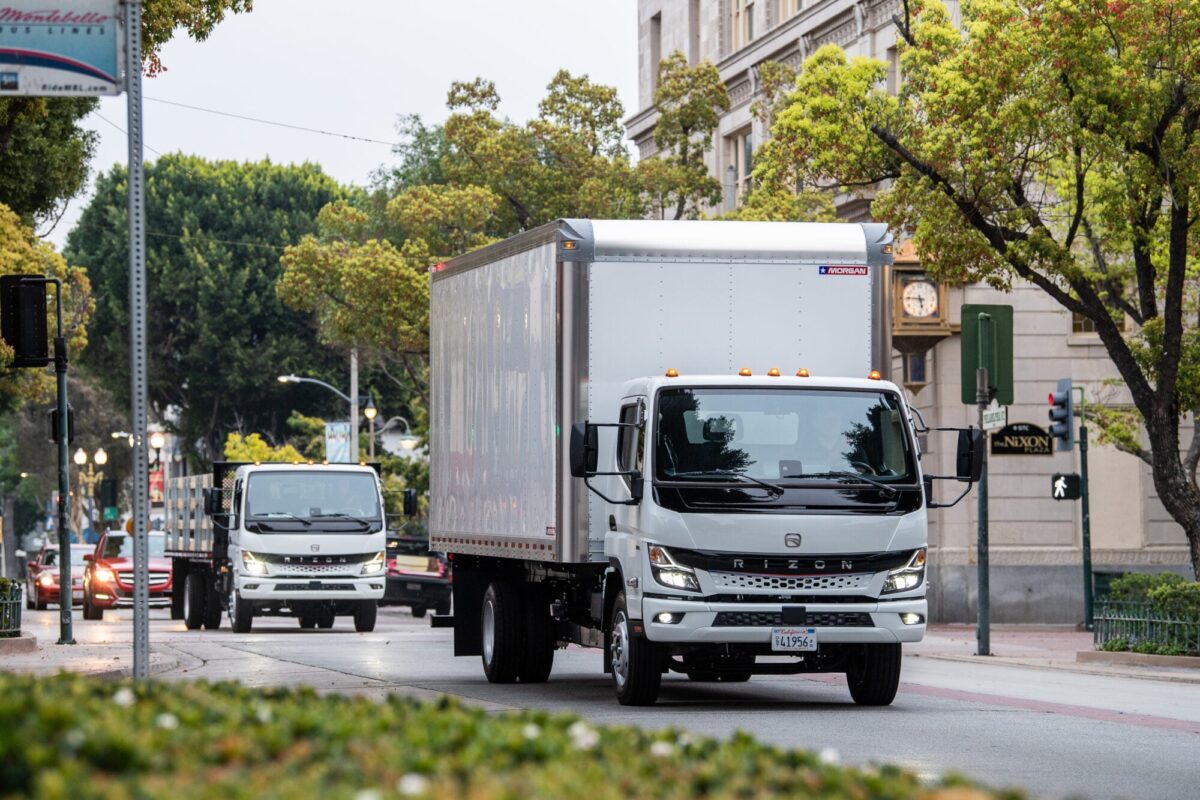
The first batch of Daimler Truck’s all-electric medium-duty trucks from Rizon have been delivered to customers in California.

The first imported Rizon medium-duty electric trucks have been delivered to customers in Los Angeles and San Diego. (Photo: Rizon)

Autonomous trucking software developer Plus has appointed Jon Morrison, formerly the president of Wabco and more recently the president of the Americas for ZF/Wabco, as its first chief revenue officer.

TruckWings, now part of ConMet, racked up significant fuel efficiency numbers in compressed natural gas- and diesel-powered Class 8 day cab trucks.

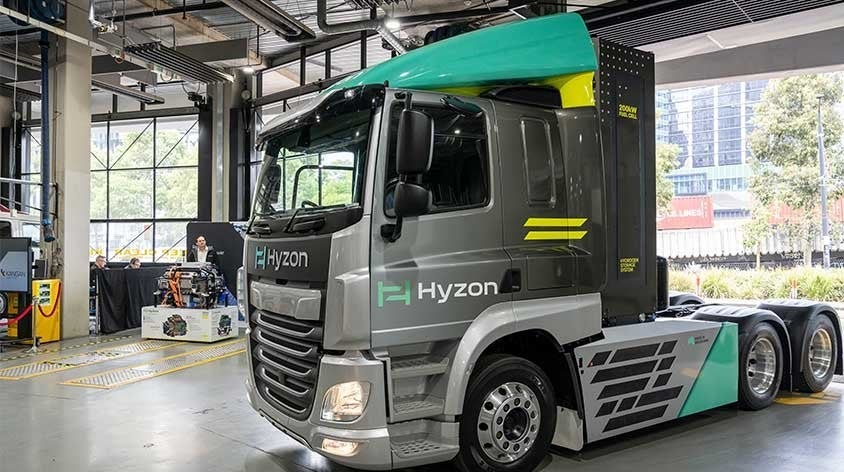
Fuel cell technology developer Hyzon launched the first of its 200-kilowatt single stack fuel cell systems in Melbourne, Australia.

Hyzon launched its 200-kilowatt fuel cell in an Australian Prime Mover, the Aussie term for a semi. (Photo: Hyzon)

Volvo Group and Renault Group have completed the creation of a joint venture for a new generation of electric vans called Flexis SAS. 

Electric truck manufacturer and services provider Xos closed its acquisition of ElectraMeccanica Vehicles Corp., adding $48 million to its balance sheet.

Electric truck deliveries in ones and twos are pretty common, but when Peterbilt Model 520EVs go to Anchorage, Alaska — with its less-than-EV-friendly temperatures — it’s worth noting.


Truck Tech episode No. 60: The Greenlane approach to electric truck charging

Greenlane, the $650 million-plus electric truck charging joint venture of Daimler Truck North America, NextEra Energy Resources and BlackRock will open three public charging stations between Los Angeles and Las Vegas this year with grander ambitions to follow.

That’s it for this week. Thanks for reading and watching. Click here to get Truck Tech via email on Fridays. And catch the latest in major events and hear from the top players on “Truck Tech” at 3 p.m. Wednesdays on the FreightWaves YouTube channel. Your feedback and suggestions are always welcome. Write to aadler@www.freightwaves.com.

FedEx initiates targeted layoffs; UPS sheds workers at Ontario airport 

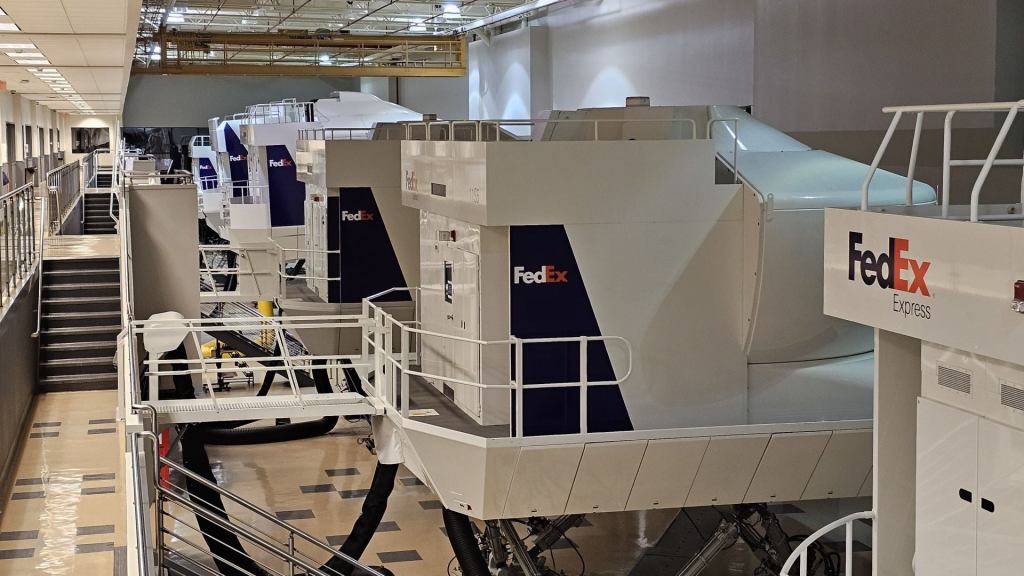
A bank of white and purple FedEx flight simulators in a building.

FedEx Corp. is laying off an undisclosed number of workers across the organization, despite posting stronger-than-expected quarterly results last week, as the company strives to hit targets for right-sizing the company. Meanwhile, parcel delivery rival UPS (NYSE: UPS) will eliminate more than 300 positions at its regional air hub in Ontario, California, because of slower volume.

In an unrelated move, FedEx Supply Chain Solutions said it plans to release more than 300 workers at a Georgia distribution center because the client is switching locations.

A pilot at FedEx (NYSE: FDX) said some of the layoffs involved non-union professional pilot instructors, some of whom are friends. The instructors are retired pilots or pilots hired off the street to teach at the training facility in classrooms and simulators.

Other instructors who flex between flying missions and teaching were not impacted. The move essentially reduces some of the pilot surpluses. The source asked not to be identified so as not to jeopardize employment status. 

“We made the difficult decision to reduce a small percentage of positions as we streamline and realign functions. Decisions of this nature are never made lightly and are the result of much thought and consideration for the needs of our business,” FedEx said in a statement to FreightWaves. “We are actively working with those affected by these changes to ensure they have the support they need during this transition.”

FedEx CEO Raj Subramaniam informed employees of the job cuts, which occurred in multiple areas of the corporation, in an internal memo on March 21. 

“Transformation is not easy. It comes with difficult decisions, changing structures, and new ways of working. … Our ability to continue to grow operating income in this difficult environment will depend on continued rigor in our DRIVE and transformation efforts that optimize our business and deliver profitable growth,” he said.

A company spokesperson declined to provide specific details about the workforce reduction.

Under pressure from Wall Street in 2022 to improve profits, FedEx launched DRIVE, a holistic campaign to root out $4 billion in structural and overhead costs by 2026. Leadership also acknowledged that operating three separate networks for express parcel, deferred parcel and freight shipments was uneconomical. Integration of people, facilities and technology across those divisions is underway and expected to deliver $2 billion in additional annual savings. 

Last year, excluding Amazon, the package market in the U.S. dropped by 2.4 million packages a day. 

Separately, FedEx’s contract logistics unit will release 326 workers at a warehouse in Union City, Georgia due to the client shifting business to another location. The layoffs will take place in two phases, beginning on April 8. According to a notice filed with the state of Georgia’s Office of Workforce Development in February, the facility is being closed and operations transferred to a facility in Jackson, Georgia. 

Third-party logistics providers commonly operate dedicated facilities for specific customers and exit leases for those buildings when the business relationship ends because the company wants to relocate, find another partner or downsize for financial reasons. 

UPS job losses

UPS, which is also adjusting to lower demand and higher operating costs from the new Teamster contract signed last year, plans to terminate 333 workers at its regional air hub at Ontario International Airport in California next month.

In a notice to the state Employment Development Department, the integrated delivery company said the layoffs are necessary because of lower air volumes. The Daily Bulletin, a local newspaper, first reported the airport reductions, which include supervisors and employees who process packages.

In 2023, UPS revenue was down 9.3% and adjusted operating income fell 28.7% to $9.9 billion.

In January, the company said it would cut 12,000 full- and part time management and contract jobs in response to the weak performance. Headwinds include a reset of an overheated parcel market, greater competition from Amazon and the U.S. Postal Service and sharply higher labor costs associated with last year’s new Teamster contract. 

UPS is also consolidating sort centers to gain efficiency through technology and economies of scale. Facilities that handle fewer packages are candidates for closure. 

Management has said it expects the first quarter to be the most difficult of the year before profits improve in the second half. 

UPS is also cutting dozens of jobs at its Charlotte, North Carolina, delivery center and laying off 331 people at a sort center that will be closed in Portland, Oregon, because of slow throughput, according to the Charlotte and Portland Business Journals. 

“We continue to right-size our network and staffing to meet volume demands and maintain industry-leading service. Our employees are extremely important to us, and we are working to place as many employees as possible in other positions. We remain committed to working with them throughout this transition and providing support,” said UPS in a statement.

Click here for more FreightWaves/American Shipper stories by Eric Kulisch.

Twitter: @ericreports / LinkedIn: Eric Kulisch / ekulisch@www.freightwaves.com

RECOMMENDED READING:

FedEx deactivates 17 more aircraft as cost controls pay off

UPS to close 200 sort centers in modernization push

103-year-old meat producer forced to seek bankruptcy protection

Deli meat producer Freirich Foods claims “temperature abuse” of nearly 1.2 million pounds of corned beef housed at a third-party cold storage facility was the sole reason the 103-year-old company was forced to file for bankruptcy protection.

CEO Paul Bardinas said the company tapped its credit line in January for $7 million as it ramped up production of corned beef, which makes up a large portion of the company’s annual sales, ahead of St. Patrick’s Day.

“Throughout the year, we typically operate just on our cash reserves, and we’re able to function week to week because we’re a solvent company — and we were — until this happened,” Bardinas told FreightWaves. “We were actually looking forward to a profitable first quarter and a good St. Patrick’s Day, but we did have to borrow money to build this inventory and to store it.”

Family-owned Freirich Foods, headquartered in Salisbury, North Carolina, has been operating since 1921. Bardinas said he’s the fourth generation involved in the company’s day-to-day operations.

While Bardinas declined to name the cold storage facility, Freirich Foods’ Chapter 11 bankruptcy petition, filed March 20 in the U.S. District Bankruptcy Court for the Middle District of North Carolina, lists claims against Americold Logistics and insurers, arising from “spoliation of product due to lack of refrigeration.”

“At the moment all we have is the spoiled product, obviously, because temperature abuse is the only thing that explains it,” Bardinas said. “And the only place we see it might have happened was at the cold storage facility. Whatever happened to the product had to be fairly substantial. Either it was in the cooler at the wrong temperature for a significant amount of time, or there was a fairly dramatic event where it warmed up.”

As of publication, Americold Logistics had not responded to FreightWaves’ request seeking comment or to confirm the corned beef had been stored at one of its facilities.

According to its website, Freirich Foods sells its corned beef product to BJ’s Wholesale Club, Eagle Giant and Price Chopper, among other large grocery chains along the Eastern Seaboard. 

“Everything seemed to go off without a hitch until we started receiving complaints from customers in early March who had received product from this facility about off conditions, including spoilage issues and discolored product,” Bardinas said.

He said the complaints sounded alarms for the deli meat producer, which also produces pastrami, roast beef and other products.

The company launched an investigation at its facility in North Carolina, which Bardinas said included the U.S. Department of Agriculture and the North Carolina Department of Agriculture.

“We conducted a fairly exhaustive investigation here at the facility to see if there was anything that could explain such a widespread issue with the raw material, with ingredients, with anything that may have happened,” Bardinas said.

Prior to customer complaints, Bardinas said the company had produced corned beef at its facility that shipped to the third-party cold storage facility as well as product that it shipped from its facility directly to customers. He claims that none of the product that shipped directly from its facility to food service companies or to retail customers had any product complaints.

“The only product that seemed affected was the product that went through the storage facility or that was housed at the cold storage facility,” Bardinas said. “We reached out to them when we first started to get complaints, trying to get some supporting documentation for the conditions in which our product has been stored temperature-wise and any data logging record they might have. They were unable to produce those.”

Freirich Foods was forced to withdraw all of its product, which amounted to about 1.2 million pounds of corned beef, because the company was facing a fairly large problem and needed data from the cold storage facility to know what happened, Bardinas said. 

“The company stopped responding to us,” he claims.

In its petition, Freirich Foods lists both its assets and liabilities as between $10 million and $50 million. The company states that funds will be available for distribution to unsecured creditors.

“Fortunately, I think the bankruptcy court understands our situation and has granted all our motions so our employees will continue to be paid,” Bardinas said. “We did our best to protect most of our vendors and suppliers by paying them up to date before we filed, so we’ve done everything we can to maintain those relationships because it was totally this event that’s caused us to file and we hope that whether it’s insurance or litigation, we can recover this loss and then continue as we were for the last 100 years, a solvent and profitable company.”

Do you have a news tip to share? Send me an email or message me @cage_writer on X, formerly Twitter. Your name will not be used without your permission.

Shuttered California trucking company files for bankruptcy
DAT blames ‘external forces’ for intermittent service outages
Illinois trucking company with 171 drivers files for bankruptcy

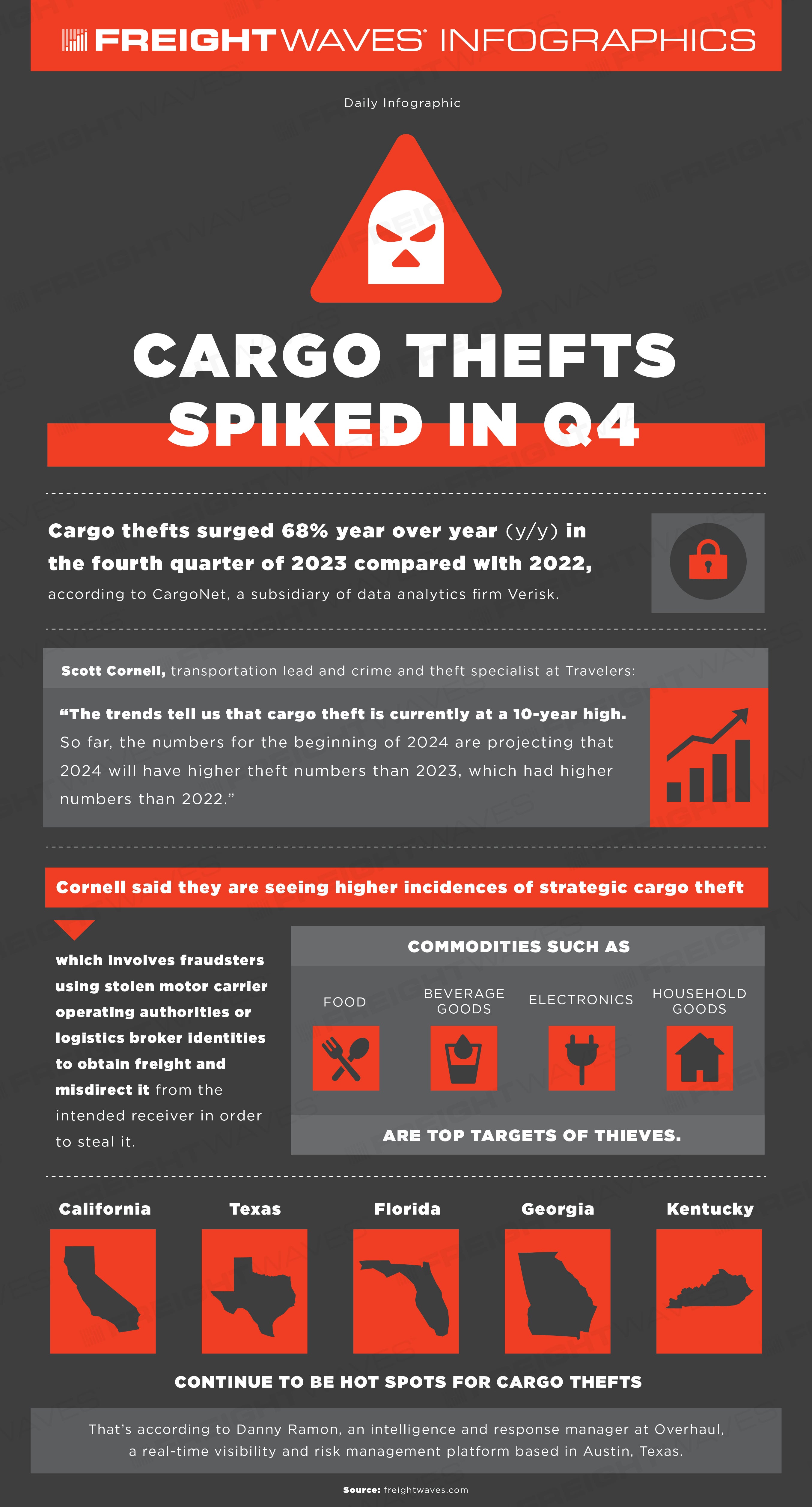
Freightwaves Infographics: Cargo thefts spiked 68% in Q4


To view more FreightWaves infographics, click here

Mississippi River shipping faces potential crisis for third straight year

Shipping along the Mississippi River could prove to be a massive headache in 2024, per a recent report from the National Oceanic and Atmospheric Administration.

An unusually warm and dry winter — which allowed the Upper Mississippi River shipping season to begin earlier than usual this year — might herald drought conditions in key areas of the Mississippi River Basin over the coming months.

“Of growing concern will be the potentially low flows on the Mississippi River this summer into fall due to well-below [average] snowpack and precipitation in most of the Northern Plains and Midwest,” Ed Clark, director of NOAA’s National Water Center, said in the report. “This could have potential impacts on those navigation and commercial interests that depend on water from the Mississippi River.”

If this forecast comes to pass, it would mark the third consecutive year in which the Mississippi River was at risk of bottlenecks.

Stuck between a shoal and a dry place

Shipping via barges along the Mississippi River is vital not only to the transportation industry but also to the broader U.S. economy. In 2019, for instance, more than 60% of soybeans grown in the U.S. were shipped along the Mississippi. The U.S. is the world’s largest producer of soybeans as well as its second-largest exporter.

In that same year, nearly one-fifth of the U.S.’s total crude oil exports traveled along the mighty Mississippi.

These freight flows took on heightened significance in early 2022, when the war in Ukraine threatened the world’s supply of such commodities.

But it was also in 2022 when the Mississippi was stricken by an extreme drought: At one point, more than 100 towboats and 2,000 barges — equivalent to 140,000 semis’ worth of freight — were stuck in the mud.

As a result of the capacity crunch, barge rates more than tripled their three-year average. Not even the wildest days of the 2020-21 truckload spot market saw such runaway growth.

Alternatives for grain shippers were limited at the time: Railroads were struggling to remedy service issues while the industry appeared to be barrelling toward its first strike since 1992 — though that was ultimately avoided by government intervention.

By the end of 2022, the Mississippi River drought is estimated to have cost the U.S. $20 billion in lost economic output.

Given the previous year’s challenges, it would have been hard for 2023 to bring about a comparable crisis. Somehow, it managed.

The culprit was once again an extreme drought that brought water levels in the Mississippi to historic lows at the height of grain’s shipping season. 

For a five-week stretch from late August to late September, downbound grain barge rates were up by an average of 25% year over year (y/y) — highly impressive growth over what was already a monster year for rates.

But by October, barge rates were moderating closer to their historical averages, despite no improvement in waterway conditions.

In its weekly Grain Transportation Report from Oct. 19, the U.S. Department of Agriculture noted that “barge rates are still below average — likely reflecting low corn and soybean export sales to China.” In fact, U.S. soybean exports fell 32% y/y in 2023.

The amount of crude oil and its products (e.g., gasoline, fuel oil) moving along the Mississippi also took a hit, though for the opposite reason: 2023 was a record-setting year for U.S. exports of oil and petroleum products, given the energy supply crisis that Europe was facing. Total exports of crude, gas and other fuel oils in 2023 were up 6.6% y/y and 180% on a 10-year basis.

Meanwhile, the amount of crude oil and petroleum products moving from the Gulf Coast to the Midwest on barges and tankers fell almost 20% y/y and 24% on a 10-year basis.

Murky waters ahead

Even assuming that 2024 fails to match the chaos of the two years prior, it is unclear what the future holds for the humble barge. As Rachel Premack summarized for FreightWaves in 2022, the industry is in the unenviable position of having the “low-margin, ultra-heavy shipments of rail, combined with the ease of entry of trucking.”

One forecast pins the U.S. barge transportation market at a 7.2% compounded annual growth rate (CAGR) from 2021 to 2028. Depending on whom you ask, such growth is either middling or magnificent.

On the one hand, large and mature companies typically expect a CAGR between 5% and 12%, with 8% being a broadly accepted benchmark.

But a comparison to the railroads might be more appropriate, given that both modes handle similar types of cargo and share a similar level of maturity. According to data compiled by New York University, four major rail companies have posted an average CAGR of 2.5% over the past five years, with an expected CAGR of 2.8% over the coming half-decade. Suddenly, the barge sector’s 7.2% target looks downright radiant.

The industry will also get a boost from federal spending thanks to the 2021 signing of the Bipartisan Infrastructure Law, which allocates a total of $2.25 billion to the Port Infrastructure Development Program (PIDP). The PIDP, in turn, is funding proposals like the Multimodal Port Enhancement Project in La Grange, Missouri, which aims to turn $11 million into a “new dry bulk cargo handling facility along the Mississippi River.”

But the commodities shipped in these barges have an uncertain future on the Mississippi. The USDA expects U.S. soybean exports to rise 9% y/y, albeit to a level 12% below the average of the past three years. Domestic crude production, meanwhile, is forecast to set new records in 2024 and ’25, positioning the U.S. for a continued streak as one of the top oil exporters at a time when Saudi Arabia and Russia are withholding supply.

Wisconsin court affirms Amazon Flex drivers were not independent contractors

A group of Amazon drivers who are part of the company’s Flex program have been affirmed by Wisconsin’s Supreme Court to be employees rather than independent contractors.

The state’s highest court on Wednesday declined to review an appeals court decision from last April that overturned a lower court decision.

A court in Waukesha County had ruled in favor of Amazon (NYSE: AMZN), which argued that its Flex drivers were independent contractors under state regulations. The Court of Appeals for Wisconsin reversed that lower court ruling and held the drivers were employees under state law.

The Amazon Flex program hires workers (whom Amazon sees as independent contractors) to deliver small packages out of their own cars. There is no Amazon-provided vehicle, and much of the Flex “fleet” is made up of individual automobiles rather than delivery vans.

Immediate issue: unemployment payments

At the root of the case is a decision handed down by the state’s Department of Workforce Development after an audit of Amazon’s activities in 2016-2018. The finding by the department, and then its affirmation by the state’s Labor and Industrial Review Commission (LIRC), had a practical impact of assessing Amazon slightly more than $200,000 in retroactive unemployment fees that the company had not paid for workers it believed were independent contractors.

Where the case fits in more broadly is that the ruling was based on how many tests of  Wisconsin’s multipart standard for determining the status of a worker, employee or independent contractor that Amazon could show it had met.

Independent contractor law often turns on a multipronged test that an employer will be judged on in litigation or regulation. The test determines whether a worker is truly independent or is an employee, regardless of whether the employer classifies that worker as independent.

Parallels with federal independent contractor law

The most controversial classification battle of late has been the test in the federal independent contractor law promulgated by the Wage and Hour Division of the Department of Labor. There are six factors in the Biden administration’s rule, many of which deal with the issue of control over a worker’s activities..

The Trump administration rule it replaced was similar in structure, but the Trump rule gave particular weight to two tests: control and the ability of independent contractors to profit from the level of effort and initiative they put into the job.

The Biden rule has been dubbed more of a “totality-of-the-circumstances” rule, with all six factors — and a seventh unspecified step opening the door to a wider interpretation — carrying equal weight. As a result, it is viewed as more likely to lead the Wage and Hour Division to find a worker is an employee rather than an independent contractor.

Wisconsin independent contractor law also has a multipronged test. One of the prongs in turn has nine definitions that deal with issues such as control, ownership of equipment and whether a worker performing a task ostensibly as an independent contractor has that service on offer to others besides the company employing the worker. Those issues are familiar to any observer of other federal or state standards, including the widely used 11-point Borello test.

Gotta have six…

The Wisconsin regulation is also specific: To qualify as an independent contractor, a worker needs to be in compliance with six of the nine definitions.

According to a summary of the case in the appellate court’s decision, LIRC, after getting the case from the Department of Workforce Development, found that Amazon met only one of the tests. Amazon appealed that decision to the Waukesha County Circuit Court, which found that Amazon had met all nine tests.

The appellate court found several of the nine points where Amazon did meet the burden to show a worker is independent. But the court didn’t find six, the magic number in Wisconsin.

For example, in Amazon’s favor was the fact that workers could be shown to be using their own vehicles in fulfilling their duties. The court also found that the costs of operations were borne by the Flex drivers. Those were two tests where Amazon passed, supporting the argument that the Flex drivers could be defined as independent.

But the court also found that Amazon could not show, for example, that the Flex workers had multiple contracts or that they were actively available to offer their delivery services to anyone else, even though wording in the agreement with the drivers says they can do so.

There also is a test that the employee is performing work that does “not directly relate to the employing unit retaining the services.” 

This echoes the B prong of the ABC test from California and Massachusetts (where it is codified) and New Jersey (where it is in civil law). That prong says for a worker to be deemed an independent contractor, he or she must be offering services that are “outside the usual course of the hiring entity’s business.”

It is the B prong that has created difficulties for the California trucking industry because trucking companies often hire independent contractors to move freight, the same business the trucking company operates in.

Delivery vs. logistics

“The services provided by the delivery partners were integrated and interwoven into Amazon Logistics’ business of quickly and efficiently shipping Amazon.com’s products to Amazon.com customers,” the appellate court wrote.

The court summed up Amazon’s view that the activities of “delivery partners” in the Flex program “[do] not directly relate to its business because the ‘fundamental nature’ of its business is logistics, not delivery.”

Amazon said it does not offer delivery itself but rather fulfills those delivery needs through a variety of service providers, including the U.S. Postal Service and FedEx (NYSE: FDX). (The companies that deliver using Amazon-branded vehicles are almost always owned and operated by an independent company under contract to Amazon.) 

The Wisconsin Supreme Court’s denial of review reverts the case back to the appellate level. In that decision, the court had reversed the Waukesha County order and instructed the lower court to enter an order “consistent with this opinion confirming LIRC’s order,” which requires the payment of the unemployment fees.

But with precedents like this, findings that a worker is an employee rather than an independent contractor can set the ground for litigation regarding a wide variety of issues, including minimum wage payments and workers’ compensation.

The Supreme Court decision to “dismiss as improvidently granted” the Amazon case generally comes with no comment from the court. A “DIG” ruling, as it is known, essentially says that while the Wisconsin Supreme Court decided to accept review of a lower case, it should not have done so and is punting the case back to the lower court.

But in a concurring opinion, Judge Ann Walsh Bradley criticized the court for not offering more details on its reasoning for rejecting further review of the Amazon case. “Without explanation, the court disposes of the case in a two-sentence per curiam decision, dismissing the case as improvidently granted,” she wrote. “Such a dearth of explanation has been the court’s pattern for the past seven years.”

That led to a concurring opinion by Judge Rebecca Grassl Bradley, who said not commenting on the rationale for rejecting review is standard practice, all the way up to and including the U.S. Supreme Court.

More articles by John Kingston

In-state Amazon Flex driver prevails in court, can avoid arbitration

Biden administration revising rule on independent contractors

Further appeals to block AB5 from California trucking seen as a long shot

5 things to know about cargo ship that brought down Baltimore bridge

More details are beginning to emerge about the MV Dali container ship that largely destroyed Baltimore’s Francis Scott Key Bridge on Tuesday.

In 2016, the Dali hit a wall at the Port of Antwerp in Belgium, damaging a large portion of its hull. The Dali’s owner and operator have also been sued for several work-related injuries since 2018.

Last year, the Dali was also cited for propulsion issues during a stop in Chile. Here are five things to know about the cargo ship:

MV Dali involved in collision at Port of Antwerp

The Dali’s collision with the bridge in Baltimore was not the first time the ship has been involved in such an incident.

The ship was also involved in an accident at the Port of Antwerp in Belgium in 2016. Port authorities said the vessel hit a berth/quay as it was trying to exit a container terminal, according to Newsweek.

The incident caused some “hull damage impairing seaworthiness.” No one was injured, but the ship was detained in Antwerp for repairs until it was deemed safe to travel.

“We as the Port of Antwerp-Bruges cannot give any additional information about the cause of the accident. After an incident, a ship can only leave the port once experts have determined that it can sail safely,” Port of Antwerp officials told Newsweek. “Vessels are checked on a frequent basis by various authorities and experts, which is a standard procedure.”

At the time of the 2016 accident, the Dali was owned by Oceanbulk Maritime, a Greek shipping company. That same year, the Dali was later sold to Grace Ocean Private Ltd.

Last year, the Dali was cited for a propulsion deficiency during an inspection at a port in San Antonio, Chile, according to gCaptain.

According to records from the public ship safety database Equasis, the deficiency was described as issues with “gauges, thermometers, etc.” 

There was no detention for the Dali resulting from the deficiency. Three months later the ship was subject to a follow-up inspection by the U.S. Coast Guard, but no deficiencies were recorded.

Dali’s owners, operator sued for worker injuries

Synergy Marine Group, which currently operates and crews the Dali, and its owner, Grace Ocean Private Ltd., have been sued four times since 2018 for worker injuries, according to PennLive.

The lawsuits, which did not involve the MV Dali, were filed in U.S. federal court over allegations of negligence tied to injuries sustained on other ships owned and operated by the companies.

In 2019, a man from Oregon claimed he had broken several bones after falling 25 feet to the ground when a rope ladder he was using to board the MV Star Leader cargo vessel snapped.

A Texas worker said he was injured in 2019 when a hatch on the MV Star Leader was prematurely opened without warning by another crew member.

A longshoreman in Savannah, Georgia, sued Synergy after he claimed he fell 5 feet on a gangway whose handrail had collapsed, injuring his back and shoulder in 2021.

All three lawsuits were settled out of court.

A fourth case, involving a worker at Port Houston who said he was pinned underneath a stack of metal pipes he was trying to remove, was dismissed.

MV Dali was built in 2015

The Dali’s current owner is Grace Ocean Private Ltd. The ship was built in 2015 by shipbuilder Hyundai Heavy Industries at the company’s facility in Ulsan, South Korea.

The vessel is a nearly 1,000-foot-long NeoPanamax cargo ship weighing 120,000 tons, with a container capacity of 9,971 twenty-foot equivalent units.

Grace Ocean Private Ltd. was founded in Singapore in 2009 as a marine services and transport company. The firm has a global fleet of 50 ships, including bulk carriers, container vessels and tankers.

Dali is operated by Synergy Marine Group

The Dali is managed by Synergy Marine Group, a charter company that calls itself the world’s third-largest ship manager with over 640 vessels, according to its website.

The company was founded in 2006 by Rajesh Unni, who is also Synergy’s executive chairman. Synergy provides shipowners with services such as technical management, crew management and marine services.

Synergy is headquartered in Singapore and operates through a global network of over 25 offices in 13 countries, employing over 1,800 people. 

Shipping giant Maersk was chartering the Dali

At the time of the Dali’s collision with the Francis Scott Key Bridge, the ship was chartered by Danish shipping giant Maersk.

When the Dali struck the bridge around 1:30 a.m. on Tuesday, it was embarking on a 27-day backhaul voyage to Colombo, Sri Lanka, according to Marine Traffic.

Synergy said all 22 Dali crew members, including the two pilots on board, were accounted for and there were no reports of any injuries.

“We deeply regret this incident and the problems it has caused for the people of Baltimore and the region’s economy that relies on this vitally important port,” Synergy said in a news release.

Maersk said it is working with customers who have cargo containers on the Dali.

“We are deeply concerned by this incident and are closely monitoring the situation,” Maersk said in a news release. “We understand the potential impact this may have on your logistics operation, and will communicate to our customers once we have more details from authorities. Our teams are on hand to support you with your planning, should you need any assistance.”

More articles by Noi Mahoney

Port of Baltimore’s indefinite closure deals blow to city, state economy

Baltimore bridge collapse may cost billions, dramatically disrupt supply chains

State of Freight: Reasons to be bullish on second half of 2024

Echo Global Logistics grows cross-border footprint

 2 bodies recovered after Francis Scott Key Bridge collapse

Divers have recovered the bodies of two men who died when the Francis Scott Key Bridge collapsed early Tuesday morning after a cargo ship crashed into it. 

Authorities announced Wednesday night at a news conference that divers had found the bodies of Alejandro Hernandez Fuentes, 35, and Dorlian Ronial Castillo Cabrera, 26. The men were discovered inside a red pickup truck about 25 feet underwater, said Col. Roland Butler Jr.

Divers have moved from a recovery mission to a salvage operation due to the conditions they face underwater. A “superstructure” of bridge debris has prevented the divers from reaching the area where they believe the other victims are located, Butler said.

“We’ve exhausted all search efforts in the areas around this wreckage, and based on sonar scans, we firmly believe the vehicles are encased in the superstructure and concrete that we tragically saw come down,” he said.

Here’s what to know about the collapse.

Cargo ship lost power 

Maryland Gov. Wes Moore said the Dali, a Singapore-flagged ship carrying cargo, lost power before it slammed into the bridge around 1:30 a.m. Tuesday. 

He said it’s not clear what led to the ship’s loss of power but that the mayday call was issued due to the power issues preventing the steering of the Dali.

“The force of this ship is almost unimaginable,” U.S. Transportation Secretary Pete Buttigieg said on Wednesday. “This is a vessel that was about 100,000 tons carrying its load. So, 200 million pounds went into this bridge all at once, which is why you had the almost instant catastrophic result.” 

4 remain missing, presumed dead 

Four people remain missing and are presumed dead. Those missing are part of a work crew that was repairing potholes overnight Tuesday when the bridge collapsed. 

Their identities haven’t been publicly released, but officials said Wednesday night that the victims are from Mexico, Guatemala, El Salvador and Honduras. CASA, which works with immigrant and working-class families, identified two of the men as Miguel Luna and Maynor Suazo Sandoval, from El Salvador and Honduras.

Luna was a husband and father of three. Sandoval was a husband and father of two. 

“They were working construction alongside friends, with two workers surviving and the rest perishing as the bridge came tumbling down,” CASA said.

Two people survived the disaster, one of whom was hospitalized and released Wednesday, Butler said. Their identities haven’t been released by authorities. Moore said one of the survivors lived because a first responder told him to get off the bridge just before it collapsed. 

Bridge collapsed in seconds  

Within moments of the Dali hitting the bridge, it broke apart and collapsed into the chilly Patapsco River.

A video shared on social media shows the ship losing and regaining power at least twice. Smoke appears to plume out of the ship as it inches toward the 1.6-mile bridge, which vehicles were using, seemingly oblivious to what was occurring below them on the water. The vehicles exited the bridge with only moments to spare. Moore said authorities have no information about any additional vehicles in the water, other than those belonging to the construction crew.

The Dali was traveling at 8 knots, about 9 mph, when it struck the bridge, Moore said.

Audio from authorities paints a picture of how police responded in the moments leading up to the collapse. An officer can be heard directing police over the radio to hold traffic because “there’s a ship approaching that just lost their steering.”

An officer raised concerns over a “crew working on the bridge right now” and discussed plans to notify the crew’s foreman and have them evacuate the bridge. Within moments of discussing removing the crew, another officer jumped on the radio, exclaiming that “the whole bridge just fell down.”

“Start — whoever — everybody — the whole bridge just collapsed,” the officer said.

Global supply chain impacts 

The closure of the Port of Baltimore, which handled a record $80 billion worth of foreign cargo in 2023, will have an impact on the global supply chain, Moore said. Shipping in and out of the port is suspended until further notice.

“The collapse of the Key Bridge is not just a Maryland crisis. The collapse of the Key Bridge is a global crisis,” he said. “The national economy and the world’s economy depends on the Port of Baltimore.”

The port was listed as the 20th-biggest in the country by the Bureau of Transportation Statistics. Moore in February touted the port’s success as “one of the largest economic generators in Maryland” after its private terminals handled a record 52.3 million tons of foreign cargo in 2023.

The port generates some 15,300 direct jobs, with nearly 140,000 jobs linked to the port. It ranks first for volume of autos and light trucks, roll-on/roll-off heavy farm and construction machinery, imported sugar, and imported gypsum. It is the second-largest exporting hub for coal in America. 

At least 8,000 dockworkers have been affected by the collapse, the governor said. It’s unclear when the port and bridge will be rebuilt.

U.S. Sen. Ben Cardin said it was a top priority to reopen the shipping lanes. Fellow Maryland Sen. Chris Van Hollen said clearing the waterway would cost $40 to $50 million — and that was a preliminary estimate.

President Joe Biden vowed a rapid rebuilding effort.

“As I told Gov. Moore, I directed my team to move heaven and earth to reopen the port and rebuild the bridge as soon as humanly possible,” he said. “It’s my intention that the federal government will pay for the entire cost of reconstructing that bridge.”