TMS tech needs greater functionality to empower brokerages

This fireside chat recap is from FreightWaves’ 3PL Summit on Wednesday.

FIRESIDE CHAT TOPIC: Future of Freight Brokerage Software

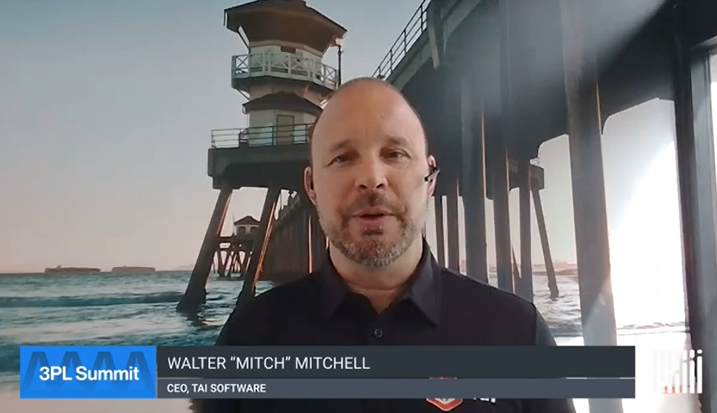
DETAILS: Walter Mitchell, CEO of Tai Software talks about recent developments and innovations impacting freight broker software. He dives into how automation and AI are changing operations and workflows while removing needless manual tasks.

KEY QUOTES FROM WALTER MITCHELL:

“Today, as technology has evolved, we’re kind of in the second phase of TMS. The first phase [just having a TMS] was great. But now we’re in the second phase where we need a TMS that really helps our operations team and our accounting operations team do their job really well.”

“A lot of tech companies, including FreightTech companies, want to leverage AI. But in context, there’s a lot of things AI needs to do for it to be able to do its thing. … You have to get the table prepared before you can just tap below it for dinner. We’re looking at things AI can do really well now and then things that we’re working on to let it do better in some of these features for brokers.”

“What we’re seeing today and what we’re doing at Tai is taking AI and adding it to the workflows, like what we’ve done with the SONAR product where we’ve taken the SONAR product and integrated it in context to the world around what the freight broker is doing every single day.”

“I think right now the bleeding edge with AI is around email integration, especially for the freight brokers. And, that email integration includes things like… pulling in documents and creating shipments from them, attaching emails to shipments so that you’re providing that full context around what you’re doing as a freight broker. I think that’s what we’re going to see the most movement on in 2024, as well as helping automate things like check calls and so forth.”

Lufthansa Cargo profit tumbled 86% last year

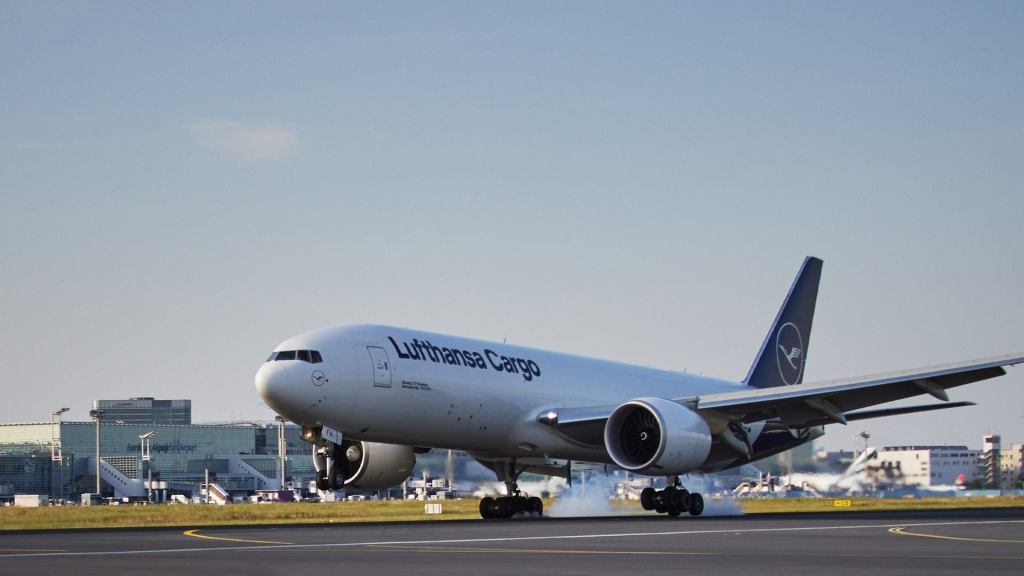
Blue-tailed Lufthansa Cargo jet touches down on a runway.

Sharply lower yields due to excess capacity from passenger flights combined with higher costs led to an 86% plunge in Lufthansa Cargo’s operating profit in 2023, underscoring how challenging the year was for the entire air logistics industry.

Lufthansa Group (DXE: LHA) on Wednesday reported its third best financial results in history, but the cargo subsidiary was battered by lower demand and rates as the global economy returned to more normal patterns following the COVID crisis. With more predictable supply chain activity and weak economic growth in Europe, there was less need for faster transportation options.

Lufthansa Cargo’s adjusted operating profit tumbled to 219 million euros ($239 million) from $1.7 billion in 2022, behind a 37% drop in core transportation revenue to $3 billion. The profit margin was cut from 34.6% to 7.4%, suggesting the company likely earned less than its cost of capital.

Global airfreight volumes, writ large, decreased 2% year over year in 2023 on the heels of an 8% decline in 2022, according to the International Air Transport Association. Yields fell 32%.

Lufthansa management forecast a slight increase in demand for 2024, with profit levels staying about the same, despite robust airfreight volumes across the industry so far this year. Market researchers report air cargo volumes jumped about 14% in January and an additional 11% in February compared to the same periods in 2023. 

A major headwind for cargo was the company’s injection of more passenger flights, which raised the amount of cargo capacity across the network by 7% and weighed on pricing. In fact, volume of 7.5 billion freight ton-kilometers was 3% higher than the previous year, while yields fell 39.3% — an indication the top line was most harmed by falling rates. Increased capacity was reflected in a 1.9-point drop in the cargo load factor, meaning less than 60% of available cargo space was filled.

Despite the reduced year-over-year performance, yields were still better than prior to the pandemic.

The company doesn’t break out expenses for the logistics segment, but across the entire group they increased 14% to cover higher labor and maintenance costs. Lufthansa Cargo’s profits undoubtedly were impacted by the higher costs. On Thursday, Lufthansa ground staff walked off the job, while on Wednesday cabin crew voted to strike as they seek a 15% wage increase, a potential harbinger of further profit erosion, Reuters reported.

Lufthansa Cargo is the 16th-largest cargo airline in the world by shipping activity. It operates 17 Boeing 777 freighters on long-haul routes and four Airbus A321 converted freighters for same-day e-commerce customers within Europe, and is scheduled to receive an additional 777 factory freighter from Boeing in the first half of the year. Supply chain delays briefly kept two of the narrowbody cargo jets out of service earlier this year.

Eleven aircraft are operated by Lufthansa Cargo crews under the Lufthansa Cargo brand. Six aircraft are chartered from AeroLogic, a joint venture with DHL, and operated by AeroLogic on behalf of Lufthansa Cargo. Lufthansa Cargo also manages the belly cargo for Lufthansa and all sister airlines besides Swiss International.

Revenue for Lufthansa’s logistics segment, which includes Lufthansa Cargo, the 50% stake in Aerologic, airfreight container specialist Jettainer, on-demand logistics provider time:matters, e-commerce service Heyworld and a customs brokerage unit, was $3.2 billion. 

Lufthansa is a bellwether for the air cargo logistics sector, and its results show that even well-managed companies weren’t immune from the global downturn in freight activity. Logistics giant Kuehne+Nagel, for example, reported revenue in its air logistics division fell 41% last year and that operating profit dropped 61%. Expeditors International said overall operating income fell 40%. Cargo revenue at the big three U.S. international airlines — American, Delta and United — dropped more than 30%. And Air Canada, which also has freighter aircraft, saw cargo revenue decrease by 27%.

Infrastructure and service upgrades

Lufthansa is investing about $544 million to modernize its cargo hub in Frankfurt, Germany, with the goal of enabling faster handling speeds and service capabilities for specialty product lines such as pharmaceuticals. About 80% of Lufthansa Cargo’s global traffic flows through Frankfurt. Cross-border e-commerce is the fastest growing airfreight product.

Construction of the new high-stacking warehouse, including an automated transport system, began last year. In addition to the new building, Lufthansa will upgrade existing buildings and warehouses at the Lufthansa Cargo Center. The project is expected to be completed by 2030.

Lufthansa Cargo recently introduced a new ultra-expedited service offering for time-critical freight called td.Zoom that can shave nearly a day off transit time for an intercontinental shipment compared to td.Pro. It also expanded digital capabilities in the past year, offering direct system interfaces to its booking system to key accounts.

Overall, Lufthansa Group more than doubled net profit to $1.8 billion behind a 15% hike in revenues related to strong travel demand. Group airlines include Swiss International Airlines, Austrian Airlines, Brussels Airlines, Eurowings, Discover Airlines and newly founded Lufthansa City Airlines. Lufthansa is also working with the European Commission to finalize taking of a 41% stake in Italy’s national carrier ITA Airways. 

Click here for more FreightWaves/American Shipper stories by Eric Kulisch.

Sign up for the weekly American Shipper Air newsletter here.

RELATED READING:

Lufthansa Cargo profits wiped out in Q3

E2open stock pops higher on announcement it is launching ‘strategic review’

Supply chain software provider E2open, with a new CEO in place and Elliott Investment Management still holding a significant stake in the company, is initiating a “strategic review” on its future.

The announcement Thursday morning sent the company’s stock price climbing. At the close, E2open’s stock on the Nasdaq was $4.33 a share, up 6.91% on the day but more importantly, up 101% from its recent low of $2.15 on Oct. 11. Its intraday high Thursday was $4.57.

Andrew Appel, who had the interim tag taken off his CEO title in February, suggested in a prepared statement that the review should not be viewed as a step before E2open sells itself to another buyer. “We remain highly confident in our ability to execute this growth plan and in e2open’s potential as a stand-alone company,” Appel said.

Appel replaced Michael Farlekas, who was ousted in October. 

Looming in the background for launching the strategic review is the 13.8% stake in E2open (NASDAQ: ETWO) taken by Elliott Investment Management in October. That stake, according to a 13D filing with the Securities and Exchange Commission, was a combination of about 9% equity ownership and the balance held as options to buy more shares in the company.

In its filing announcing the stake in E2open, the management company said E2open shares are “undervalued” and that it would engage in discussions with E2open management.

Possible outcomes from the discussions, Elliott said in that filing, were “potential changes in  operations, management, organizational documents, composition of the Board, capital or corporate structure, sale transactions, dividend policy, strategy and plans.” The company does not pay a dividend.

“As responsible stewards for our stakeholders, we are undertaking this strategic review to explore a full range of options to further accelerate growth and value creation,” Appel said. 

The statement released by E2open added that there is no deadline for the completion of the review, “and there can be no assurance that this process will result in any particular outcome.”

The company said there would be no further comment on the review until it’s completed.

That echoed what CFO Marj Armstrong said in January on the only quarterly earnings call with analysts held since the Elliott stake was disclosed. “E2open routinely engages in ongoing and collaborative dialogue with shareholders, and our board and management team are committed to evaluating all potential pathways to maximizing shareholder value,” Armstrong said, before adding that there would be no further comment on the action by Elliott Management.

Elliott’s website says that as of the end of 2023, it managed about $65.5 billion in assets.

In the statement announcing the strategic review, E2open Chairman Chinh Chu was quoted as saying that the new team led by Appel “has already made progress executing a comprehensive and customer-centric plan to drive growth and innovation.”

The review announcement also affirmed E2open’s earlier projections for the full fiscal year that ended Feb. 29. That guidance was subscription revenue of $533 million to $536 million, GAAP  revenue of $628 million to $633 million and adjusted earnings before interest, taxes, depreciation and amortization of $215 million to $220 million.

But while that is an affirmation of the most recent guidance, it is down from what was first projected May 1, 2023 when fourth-quarter earnings for the prior fiscal year were released. 

At that time, full-year subscription revenue for fiscal 2024 was projected to be $545 million to $555 million, revenue was to be $655 million to $670 million, and adjusted EBITDA was projected as $218 million to $228 million.

More articles by John Kingston

Dispute over ESG policies leads to a director departure at Werner

ACF spurs small gain in zero-emission drayage trucks at Port of Long Beach

SEC backs off on requiring companies to report scope 3 emissions

Pilot plans to add 35 travel centers, 500 truck parking spaces

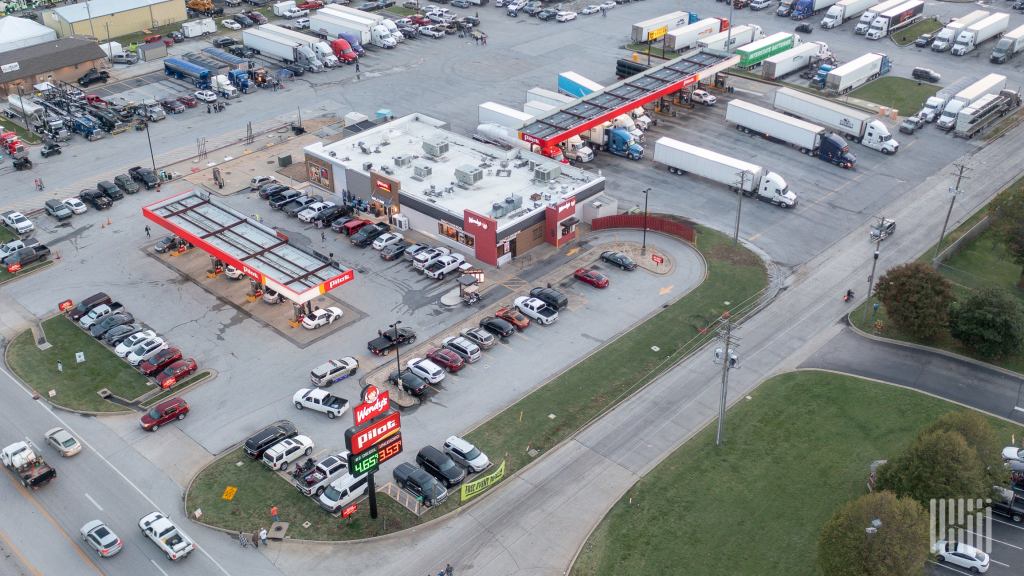
Pilot Travel Centers is adding 35 travel centers and more than 500 truck parking spaces across the country as part of its 2024 growth plan. 

Tennessee-based Pilot, North America’s largest travel center network, also plans to add more than 30 truck maintenance and tire service shops to its travel centers.

“Expanding into new communities and enhancing our services remains a key part of our long-term strategy,” Allison Cornish, senior vice president of store modernization and development at Pilot, said in a news release.

The additional parking comes as truckers grapple with a nationwide shortage of parking. That doesn’t just cause stress for drivers — the American Trucking Associations found that truckers spend 56 minutes daily scouting out parking — it also poses hazards to all drivers. The Federal Highway Administration calls the parking shortage “a national safety concern.”

“It is essential that commercial truck drivers have access to safe, secure and accessible truck parking,” the agency said. “With the projected growth in e-commerce and truck traffic, the demand for truck parking will continue to outpace the supply of public and private parking facilities and will only exacerbate the truck parking problems experienced in many regions.”

The ATA found that truckers experience the most difficulty finding parking in New York, New Jersey, Pennsylvania, Illinois and Georgia.

What else is being done?

The U.S. Department of Transportation in January announced $4.9 billion in infrastructure funding, including millions designated for parking facilities:

  • $180 million to the Florida Department of Transportation for 917 parking spaces along Interstate 4 in Osceola, Seminole and Volusia counties.
  • $92 million to the Missouri State Department of Transportation for Interstate 70 reconstruction, which includes parking facilities and information systems.
  • $40 million to the Lehigh-Northampton Airport Authority in Pennsylvania to construct a cargo facility, including truck parking.
  • $12 million to Washington, California and Oregon transportation departments to build 54 truck parking facilities along Interstate 5 and to deploy a regional truck parking information management system.
  • $8 million to the Wisconsin Department of Transportation to reconstruct a rest area on Interstate 90 near Sparta and expand parking from 16 spaces to 70.

The DOT in September announced $80 million in grants to help expand access to truck parking, marking a 65% increase in funding for truck parking projects compared to 2022. The funding will help drivers locate parking space information in real time with signs along highways in Kentucky, Delaware and Indiana. 

Texas, Louisiana, Florida and Tennessee received millions in funding to construct truck parking facilities, which will add hundreds of parking spots along the roadways.

Burning of chemicals after Ohio derailment was unnecessary, NTSB head says

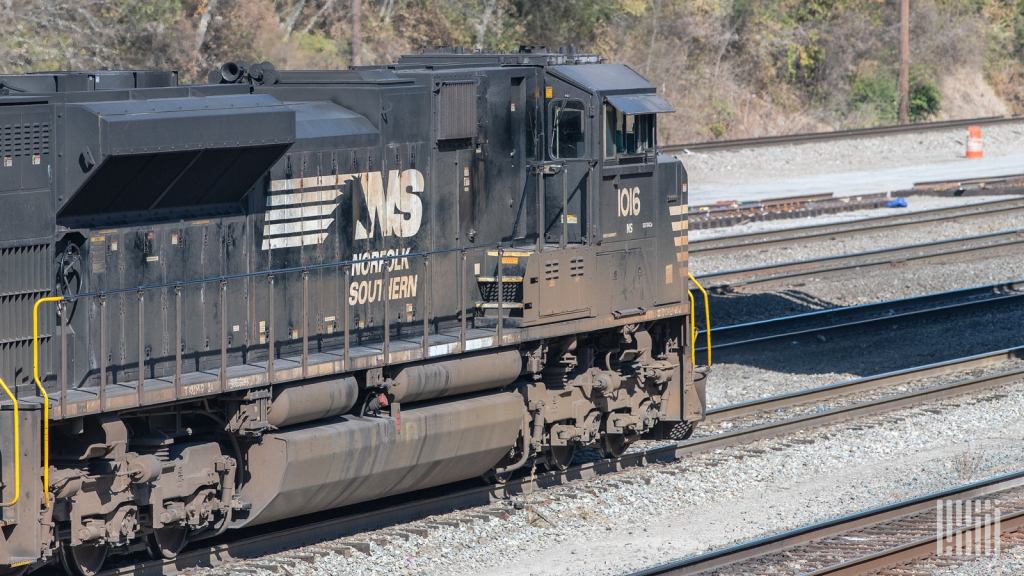
There was no need to burn dangerous chemicals in rail cars in order to prevent an explosion after a Norfolk Southern train derailed in East Palestine, Ohio, on Feb. 3, 2023, the chair of the National Transportation Safety Board told a U.S. Senate committee Wednesday.

Under questioning by Sen. J.D. Vance, R-Ohio, Jennifer Homendy testified before the Senate Commerce, Science and Transportation Committee that temperatures in the cars had stabilized well before the burn was conducted and were too low to cause, in Vance’s words, “a runaway chemical reaction” and “an uncontrolled explosion.”

“It seems based on the data that we have that there was not a ton of reason to do the [controlled] burn, and that of course is what spread toxic chemicals all over this community and the surrounding region,” Vance said.

No one was injured in the derailment or as a result of the burn, but about 2,000 residents were temporarily evacuated, and questions about long-term health consequences linger.

“The factual information in our docket shows that Oxy Vinyls [the company shipping the chemicals] was on scene and providing information to Norfolk Southern and their contractors on the fourth, fifth and sixth [of February],” Homendy said. “They informed them that … there was no justification to do a vent and burn.”

But when officials were deciding whether to conduct the burn, she said, Gov. Mike DeWine and the incident commander were not given full information, including statements by experts for Oxy Vinyls that it wasn’t necessary.

“The incident commander didn’t even know [the Oxy Vinyls experts] existed,” she said. “Neither did the governor. So they were provided incomplete information to make a decision.”

Norfolk Southern defended the burn in a statement released after the hearing.

“The successful controlled release prevented a potentially catastrophic uncontrolled explosion that could have caused significant damage for the community,” the railroad stated.

The NTSB plans to release a final report June 25 in East Palestine on the cause of the derailment.

Homendy’s testimony comes amid a battle over leadership at Norfolk Southern (NYSE: NSC).

NS has defended itself against criticisms by activist investor Ancora Holdings that CEO Alan Shaw makes too much money and that another derailment last week, this one in Pennsylvania, adds urgency to the need for new leadership.

Ancora has proposed eight independent directors, who would make former UPS executive Jim Barber Jr. CEO of NS and former CSX executive Jamie Boychuk COO. Norfolk Southern wants shareholders to approve its own slate of 13 candidates.

NS said it has taken significant steps to enhance safety, including hiring an independent safety consultant, boosting employee training and joining the Federal Railroad Administration’s Confidential Close Call System.

The railroad got a boost recently when investment bank UBS moved NS’ rating from Neutral to Buy, pushing up the railroad’s stock price.

SEC backs off on requiring companies to report scope 3 emissions

Tracking the full impact of greenhouse gas emissions down the supply chains of publicly traded companies will not be required by the Securities and Exchange Commission, the agency decided Wednesday.

Scope 3 emissions are those generated by a company in the supply chain two steps away from the reporting company, though it would not be dealing directly with those companies.  The initial rule proposed by the SEC would have required publicly traded companies to report their scope 3 emissions in public disclosures. 

But the SEC pulled back on that rule even as it approved a broad reporting rule that still will require the vast majority of publicly traded companies to report scope 1 and scope 2 emissions. The rule was approved 3-2, with three Democrats voting yes and 2 Republicans voting no.

Scope 1 emissions are those coming directly from a facility or equipment of the reporting company, like a manufacturing plant or a truck fleet. A company required to report scope 2 emissions would need to report, for example, on the carbon footprint of a supplier of raw materials to a manufacturing operation. 

But if the requirement went out to scope 3 emissions, the emissions profile of the suppliers of such things as electricity to the raw material provider would need to be reported to the SEC and by extension to the investment community for publicly traded companies.

Comments received in opposition to scope 3

The more than 800 pages detailing the SEC rule had an extensive recap of the thousands of comments received by the SEC on the proposed rule, which was first released in 2022. 

“A significant number of commenters raised serious concerns about requiring Scope 3 emissions disclosures,” the SEC said. “Some asserted that the Commission lacks the authority to require disclosures of information that may come largely from non-public companies in registrants’ value chain; others questioned the value of Scope 3 emissions disclosures for investors, citing their concerns about the reliability of the metric; others focused on their view of the costs and burdens of gathering, validating, and reporting the information.”

Lindsay Azim, a director at Gartner Inc. (NYSE: IT), which does extensive consulting on supply chains, said the excising of the scope 3 emission requirement was expected. But she emphasized that the passage of the broader SEC rule is a big step.

“Climate risk is financial risk,” Azim said, and the rule drives that point home. But she added that “all the risk is in scope 3. So there is a huge blind spot there.”

For a manufacturing company, knowing the level of emissions in scope 1 and scope 2 is important, “but we know that 90% of the climate risk is in their value chain.” Information that omits that is “not telling the whole story,” she added.

Azim conceded that the burden of producing scope 3 emissions data is “huge.” That is why “no one is surprised” by the SEC action.

But U.S. companies are not entirely out of the woods regarding scope 3 emissions disclosure.

California and Europe are still out there

Most prominently, California has enacted legislation that will require scope 3 emissions reporting from companies doing business in the Golden State.

The law firm of Dentons, in a blog post from October, said estimates were that 8,000 companies would fall under the California scope 3 emissions requirement. Specific requirements from the California Air Resources Board have not been released yet, but Dentons said reporting requirements would be expected to begin in 2027.

There also are reporting requirements in Europe under the Corporate Sustainability Reporting Directive (CSRD). According to consulting firm Oliver Wyman, that requirement could pull in close to 12,000 companies worldwide.. 

In addition, some companies have set emissions targets and standards that will require carbon footprint information from parties it deals with regardless of the SEC’s action. 

In an interview on FreightWaves’ Drilling Deep podcast last year, Laura Rainier, the senior research director in the talent and sustainability team at Gartner and a colleague of Azim,  talked about the private sector trend toward requiring emissions reporting beyond anything a government might require.

“I think we’re seeing a lot of momentum around organizations reporting on their greenhouse gas emissions, because their customers are asking them for this type of data,” Rainier said. “So even if it’s not part of your values, it’s certainly starting to become required as a kind of a player in a major value chain.”

Mindy Lubber, the president and CEO of Boston-based sustainability nonprofit Ceres, also emphasized that the SEC decision is not the death knell for scope 3 emissions disclosure.

“For most companies and financial institutions, indirect emissions throughout a company’s value chain represent the largest source of a company’s transition risk,” Lubber said in a statement on the Ceres website. “While we are disappointed the rule does not include key provisions from their 2022 proposal, including the mandate of the disclosure of Scope 3 emissions, investor demand for the disclosure of Scope 3 emissions continues to grow and many companies will be required to disclose this data in other jurisdictions.”

For publicly traded companies in the supply chain, the rule adopted by the SEC still has plenty of specifics beyond simply reporting scope 1 and scope 2 emissions. Some of the other required disclosures will be:

  • “Climate-related risks that have had or are reasonably likely to have a material impact on the registrant’s business strategy, results of operations, or financial condition.”
  • Information on what a company is doing to “mitigate or adapt to a material climate-related risk.”
  • A wide range of information that all ties back to disclosing how the company is at risk for climate-related occurrences.
  • Financial estimates on what weather-related incidents might do to the reporting company.

More articles by John Kingston

Dispute over ESG policies leads to a director departure at Werner

ACF spurs small gain in zero-emission drayage trucks at Port of Long Beach

BMO’s Q1 earnings show more credit deterioration in trucking industry

More trailers means more contracts, says Repowr Chief of Staff

This fireside chat recap is from FreightWaves’ 3PL Summit on Wednesday.

FIRESIDE CHAT TOPIC: Reimagining the Possibilities of Trailer Sharing

DETAILS:  Repowr Chief of Staff A.J. Cheek explains why brokers can benefit from trailer sharing and how asset management can be rethought.

KEY QUOTES FROM A.J. Cheek:

“I think positive times are ahead. But even coming out of [the freight downturn] is going to be challenging. We think that Repowr and access to trailers certainly can help brokers withstand that. What I mean by that is having access to trailers can allow you to tap into more contract freight, which gives these brokerages staying power. So they’re not subject to the market nearly as much as they are if they’re only living and dying by … whatever the trailer may be.”

“The future is bright for us. We think that we’re well positioned to sort of ride the uptick in our market. We definitely are subject to freight cycles just like everybody else in our industry. Thankfully we’ve been able to … withstand the downcycle. We’ve certainly seen our average order value go down as the price of a trailer goes down, that sort of thing, but from a growth standpoint we’ve maintained growth through that entire downcycle.”

Florida poised to enact law against predatory truck towing

Florida poised to enact law against predatory truck towing

(Photo: Jim Allen/FreightWaves)

Following the passage of a bill in the Florida House and Senate, the governor appears poised to sign the legislation, which addresses predatory towing fees aimed at trucking companies. A Florida Senate staff member familiar with the legislation told FreightWaves, “We haven’t heard anything to the contrary, so we’re pretty confident the towing bill will be signed into law.” If signed by Gov. Ron Desantis, the law will go into effect July 1. 

FreightWaves’ John Gallagher wrote, “According to Florida Trucking Association (FTA), towing and storage operators would be required to maintain and publicize a rate sheet listing all fees related to vehicle recovery, and provide it upon request to vehicle owners, lienholders and insurance companies.” Additionally, wrecker operations would be required to furnish the rate sheet to the owner or operator if present before attaching a vehicle to a wrecker. If a fee charged is higher than the published rate, then it can be considered unreasonable. 

These legislative moves follow a report by the American Transportation Research Institute last November that highlighted numerous examples of predatory towing fees following large truck crashes. Gallagher wrote, “The study found that excessive rates and unwarranted additional service charges were the two most common forms of predatory towing, experienced by 82.7% and 81.8% of surveyed motor carriers, respectively.”

The rise of driver fitness and media influencers

(Image: FreightWaves/DriverReach)

On a recent episode of the Taking the Hire Road podcast, Jeremy Reymer, founder of DriverReach, interviewed Michael Lombard, president of Lombard Trucking, about driver health, his experiences as a CDL driver and being a driver influencer. FreightWaves’ Ashley Coker Prince writes, “Trucking is in Lombard’s DNA. When his great-great-grandfather immigrated to the U.S. in the early 1900s, he began peddling ice out of a horse-drawn carriage in Connecticut. That operation grew into the original Lombard Trucking, one of the largest motor carriers in the Northeast at the time.” The Motor Carrier Act of 1980 was a contributing factor to the downfall of the carrier but the legacy lives on through Lombard’s driving career.

While Lombard originally didn’t consider driving, following his service in the Marines, he got his CDL and began documenting his life on the road online while training to run marathons. His feedback from drivers about the importance of a healthy lifestyle on the road started his career in trucking health advocacy.

For trucking fleets burdened by higher costs, the health and welfare of long-haul drivers is gaining more attention. Lombard said, “The lifestyle of a driver reduces life expectancy, taking upward of 10 years off their life. Instances of chronic illness are very much escalated from the normal population.”

A study on health disparities for long-haul truck drivers paints a grim picture, stating, “These excessive risks constitute underappreciated and underestimated economic and public health risks, as they pose threats to the drivers themselves, jeopardize U.S. trucking companies, place strain on the U.S. health care system, and threaten the lives of other roadway users in the event of highway accidents. Thus, broad and immediate preventive action is warranted to address these disparities.”

Market update: February LMI Transportation and Price indexes rise

(Source: Logistics Managers’ Index)

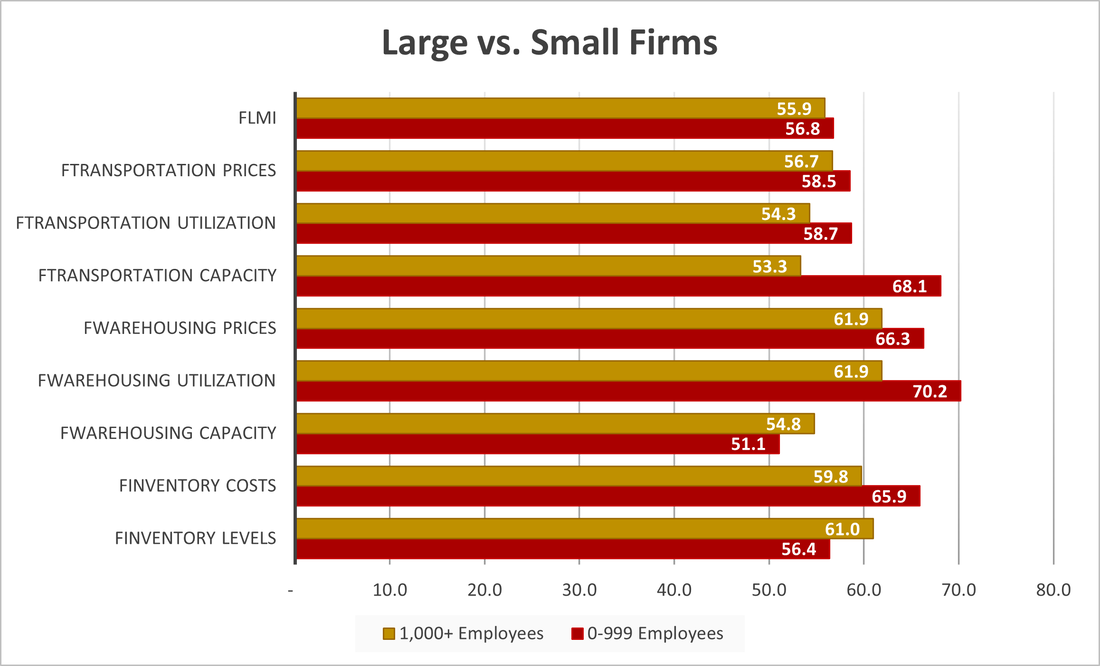
On Tuesday the Logistics Managers’ Index released its February data, which saw the aggregate index increase 0.9 points from January’s reading of 55.6 to 56.5 points. This gain matches October 2023 as the highest reading in the past 12 months. The report highlights progress in transportation and upstream inventory growth at the manufacturing and wholesale levels as contributing factors.

It notes that excess transportation capacity continues to hinder a turnaround in the freight market. The Transportation Capacity Index was up 6.4 points to 60.9 in February, but the growth appears to favor smaller fleets. The report adds, “Interestingly, capacity remained relatively tight for larger firms (those with 1,000+ employees) relative to smaller firms; with the larger LMI respondents reporting a growth rate of only 53.3 to their smaller counterparts’ 68.1. This difference may suggest that larger firms who are often dealing with a more national network are still finding tightness in long-haul that may not exist for more regional shippers.”

Regarding truckload demand, the report notes that upstream movements are expanding at a greater rate than downstream. FreightWaves’ Todd Maiden writes, “Upstream firms (60.9), like wholesalers and manufacturers, returned a stronger price indication than downstream firms (52.7) like retailers. The overall transportation pricing subindex slowed as February progressed. It registered a 62 in the first two weeks of the month compared to 52.4 in the back half of the month.”

FreightWaves SONAR spotlight: Spot rate declines press pause

(Source: FreightWaves SONAR)

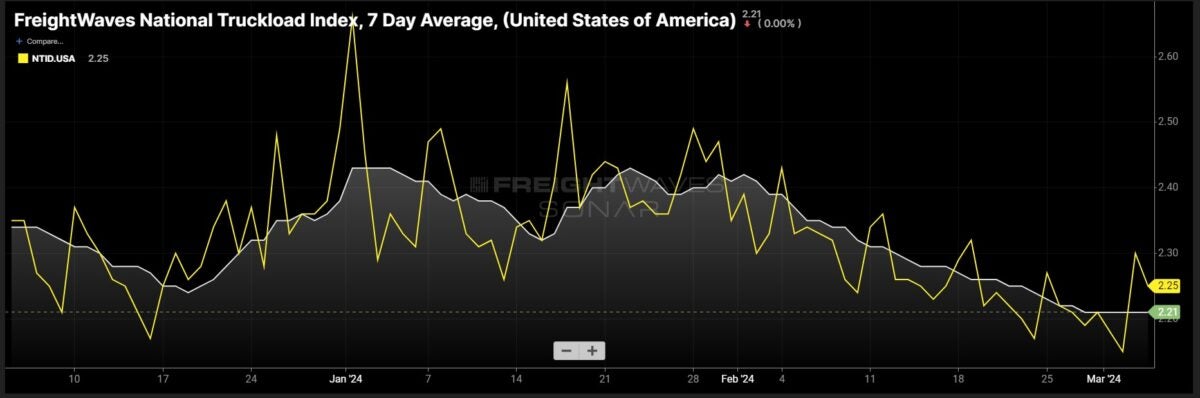
Summary: The gradual decline in spot market rates beginning in early February has taken a pause during the first week of March, according to the FreightWaves National Truckload Index 7-Day Average (NTI). Recent volatile upward NTI Daily (NTID) movements have for now contributed to a bottoming out of spot market rates. In the past week all-in spot rates fell 1 cent per mile from $2.22 on Feb. 26 to $2.21. Removing an estimated fuel surcharge, spot market line-haul rates remained flat w/w at $1.59 per mile. The post-holiday spot rate boost, extended by severe winter weather in January, appears to have come to an end. Excess trucking capacity in the spot market remains the primary barrier to a sustained and prolonged recovery in spot market rates.

Additionally, lower outbound tender rejection rates paired with improving outbound tender volumes in the contracted space suggest that shippers who are enjoying improved load tender compliance may have little incentive to move excess contracted freight onto the spot market. Another development to watch is whether shippers will require additional assistance with spring special projects and ad hoc freight or if their routing guides, flush with excess capacity, can handle higher volumes. Given the abundance of transportation capacity relative to demand, shippers have many options at their disposal as the freight market downcycle stubbornly persists.

ACF spurs small gain in zero-emission drayage trucks at Port of Long Beach (FreightWaves)

Is the rate roller coaster about to turn (FreightWaves)

Dispute over ESG policies leads to a director departure at Werner (FreightWaves)

Truck driver sentenced for stealing rig hauling Mike’s Hard Lemonade (FreightWaves)

TSA rule change provides regulatory relief to air logistics providers (FreightWaves)
Cummins CEO moves company forward after record civil emissions fine (FreightWaves)

Like the content? Subscribe to the newsletter here.

Transfix partners with Rocket Shipping for LTL offering

Digital freight marketplace Transfix announced Thursday that it has partnered with transportation provider Rocket Shipping to provide customers with a new less-than-truckload booking feature.

“Our partnership with Rocket Shipping leverages their deep expertise in LTL and final-mile services, integrating this knowledge directly into Transfix’s Shipper App and combining it with our decade of experience in full truckload,” Jonathan Salama, co-founder and CEO of Transfix, told FreightWaves. “This collaboration brings efficiency and effectiveness to the freight operations of small and midsize businesses and midmarket shippers that we believe have been underserved.”

Salama notes that small and midsize shippers frequently resort to manual booking processes for their LTL shipments. But this approach opens the door to inefficiencies and errors, such as inadvertent residential deliveries and incorrect equipment bookings. Such mistakes can result in unexpected costs for the shippers.

Moreover, these shippers often face challenges in securing competitive rates due to their lower shipping volumes and limited negotiating power. Additionally, complex claims and damages resolution processes negatively impact customer satisfaction and add to shipping costs.

“Looking ahead, we believe this partnership with Rocket Shipping will not only help solve multiple pain points these shippers face, but also spark significant innovation and growth within the industry,” Salama said. “Specifically, we see the potential to increase access to advanced shipping tools for small and midsize businesses, as well as the opportunity to drive sustainability through load consolidation and empty mile reduction. Ultimately, all to enable these smaller players to compete on a more level playing field.”

Gabe Pankonin, CEO of Rocket Shipping, envisions partnerships like this as the future of the “integrated marketplace approach.” In this model, companies concentrate on their specialties, such as full-truckload logistics for Transfix and LTL for Rocket Shipping, while collaborating to provide customers with a comprehensive logistics solution through a single platform for managing their shipments.

“Transfix’s Shipper app will begin to democratize access to the best companies in each sector,” Pankonin explained. “Shippers have historically had to compromise expertise and pricing power for convenience. They have used big-box brokerages to manage all modes in one platform. … The shippers will benefit by being able to access each of these companies and modes in one platform without having ‘all their eggs in one basket,’ so to speak.”


Evaluating FreightTech: Prioritizing business needs and user enablement

CloudTrucks launches new offerings, acquires Shipwell’s brokerage

OTR Solutions acquires back-office automation platform Epay Manager

Daily Infographic: Teamsters, Anheuser-Busch reach new 5-year contract


To view more FreightWaves infographics, click here