Can Karno technology generate a buyer for Hyliion?

Unwinding the powertrain business at Hyliion Holdings was uncomfortable, especially for 175 employees who lost their jobs in November. But the leaned-out startup is making some progress in its pivot to energy distribution through a fuel-agnostic power generator.

Whether the plan is sufficient to generate revenue and perhaps attract a buyer for the once high-flying special purpose acquisition company are the big unknowns.

The Karno generator, which Hyliion purchased from GE in August 2022 for its since-canceled Hypertruck ERX, qualifies for $40,000 in incentives this year under the Inflation Reduction Act. The system is more expensive than diesel but cheaper than a fuel cell, CEO Thomas Healy told me this week. He declined to specify the price.
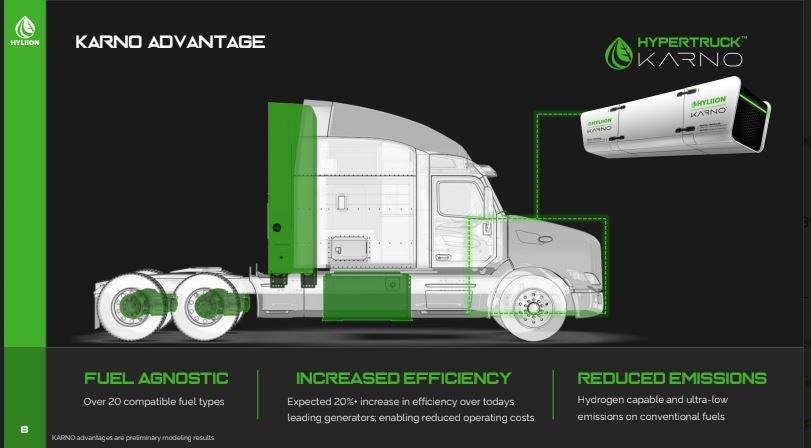
Before dropping the Hypertruck ERX powertrain, Hyliion saw it as a next-generation solution for making electricity from a variety of feedstocks. (Image: Hyliion)

Hyliion has attracted nascent customer interest in the technology that has been facetiously compared to Doc Brown’s flux capacitor in the “Back to the Future“ movie trilogy.

Cost discipline makes 2nd chance possible

That Hyliion has the resources to try another business line comes from practicing financial discipline. By guarding a large part of the $560 million in proceeds from its reverse merger with Tortoise Acquisition Corp. 3 ½ years ago, Hyliion has a second chance that some profligate SPAC-backed startups squandered.

Had Hyliion pursued the Hypertruck ERX, it would have burned through its cash hoard at a faster clip.

“Our decision around [exiting] powertrain was more focused on the major shifts happening in all electrification,” Healy said. “Volumes aren’t at levels that anyone was expecting.”

Slowdown in electric truck adoption

A court challenge delaying California’s Advanced Clean Fleets rule contributes to some rethinking on electric trucks. The Minnesota Trucking Association this month released a report cautioning fleets to adopt a “go slow” approach on regional and long-haul electric trucks.

The Hypertruck addressed the long-haul challenge by pairing a natural gas generator with an electric powertrain that would convert natural gas to electricity on board and allow 1,000 miles between fill-ups.

But the first-generation Hypertruck proved complex and expensive. The price topped $400,000 after a yearlong delay in getting parts and paying up to get small quantities during the pandemic. Fleets liked the Hypertruck enough to order ones and twos, but not enough to make it profitable.

Healy saw Karno as an advanced generator for the next-gen Hypertruck. Hyliion retains intellectual property that could be used later. Or it could be sold or licensed to bring in cash. 

“Over time, we will look to reduce how much IP coverage we have just from a cash conservation standpoint,” Healy said. “You don’t need as much if you’re not in that business. We’ll keep the parts that we see as really relevant.”

Rethinking Karno’s application

The idea of Karno as a stand-alone electric generator was always in the back of Healy’s mind. Now it is front and center.

If it proves reliable, Karno could become a staple to make electricity for the growing number of electric truck infrastructure developers. Bringing power to warehouses and capturing and converting flare gases from oil and gas fields and landfills are other uses.

Hyliion CEO Thomas Healy demonstrated the Karno generator at the Advanced Clean Truck Expo in May 2023 in Anaheim, California. (Photo: Alan Adler/FreightWaves)

“The EV charging space is one we’re heavily pursuing,” Healy said. “The problem we’ll run into is the volume they’re looking for. It is a lot of power for our early production. We don’t want to be solely dependent on that market because of how much volatility we’ve seen in that space.”

3 applications for Karno technology

Well-heeled infrastructure developers like TerraWatt Infrastructure, Forum Mobility, WattEV, Zeem Solutions and Voltera could augment utility-provided grid power with Karno technology.

One developer — Healy would not say which — told him its original thinking around Karno would be to use it while waiting for full grid energizing of a site, then move it to another site. Now it is thinking of keeping it in one place and ordering a second Karno for the additional site.

Hyliion successfully tested Karno in converting flare gas to electricity in the Permian Basin. Backup power for data centers is another potential market. A successful Karno could push legacy players like Cummins, Generac, Caterpillar and Kohler.

“We can pose a real competitive threat to the incumbent players if we can execute on the generator as we think we can,” Healy said.

The Karno could help generate electricity at truck charging sites, convert flare gas into electricity, or power buildings and warehouses. (Photo: Alan Adler/FreightWaves)

Activist board drives Hyliion actions

Hyliion began 2024 with $291 million in capital and expects to invest $40 million in Karno development this year. Its board of directors hasn’t set a deadline, but it wants to see revenue and a path to gross margin. Or it wants the company’s cash returned to shareholders. The stock price Wednesday hovered around $1.38. Before the merger in October 2020, it traded above $50.

“We expect that the reduction in expenses associated with the wind-down of our powertrain segment will result in approximately a 70% reduction in cash burn this year compared to last,” Healy told the one analyst who dialed into the company’s Q4 earnings call on Valentine’s Day.

In a highly unusual move for a pre-revenue company, Hyliion repurchased $20 million of its own stock in Q4 because shares were trading at one-third the value of just its cash and investments. The same board that held Healy accountable to make the ERX viable or drop it encouraged the share repurchase.

Since that time, two high-profile board members — former U.S. Transportation secretaries Andrew Card and Elaine Chao — have left the board.

Is Cummins waiting in the wings?

The presence of Cummins Inc. on the board and in management is noteworthy. 

Former Meritor — now part of Cummins Inc. — CEO Jay Craig chairs the board; former Cummins President Richard Freedland is a director. And Hyliion earlier this month hired Govindaraj “Govi” Ramasamy as its chief commercial officer. He spent the previous 17 years at Cummins in power generation.

Hyliion has both worked with and been challenged by Cummins. The two worked together to certify Cummins’ 12-liter natural gas engine for the Hypertruck. But the California Air Resources Board granted only one year of emissions certification.

Cummins is discontinuing the 12-liter engine. To keep going with the Hypertruck, Hyliion would have had to certify the 15-liter natural gas version going into production this year. 

With robust horsepower and torque ratings, Cummins’ 15-liter natural gas offering — the first of several fuel-agnostic offerings that includes a hydrogen version in 2027 — is attracting heavy fleet interest. Jose Samperio, Cummins vice president of on-highway products, told me in October the 15-liter could reach 10% market share where natural gas offerings historically command 2%.

As for Karno, it could be a nice fit for Cummins, which makes a lot of diesel-powered generators and has a growing data center business. But expect Cummins to allow Hyliion to pay for Karno’s development and validation before getting out its checkbook.
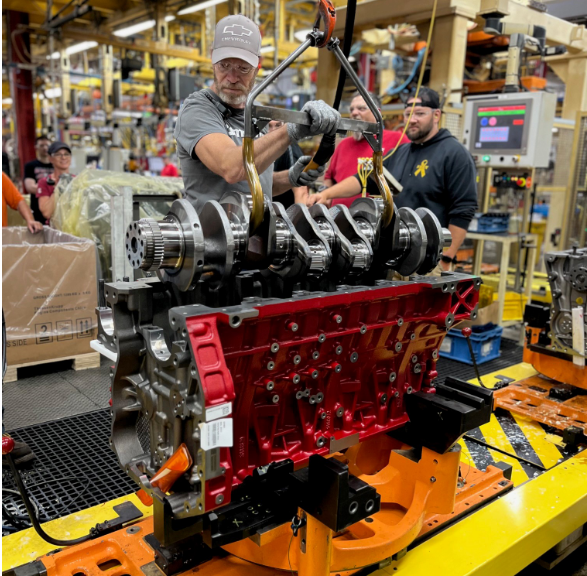
The Cummins 15-liter natural gas engine could be on a trajectory to 10% market share, according to Cummins vice president of on-highway products. (Photo: Cummins)

“The definition of being a public company is you’re always for sale,” Healy said. “But it’s not something that we’re actively pursuing at this time.”

Stay tuned.


A walkaround of Torc Robotic’ headquarters, where it all began

Torc Robotics headquarters abuts the Virginia Tech Transportation Institute in Blacksburg, Virginia. It is where it all began for the now Daimler Truck North America subsidiary back in 2005. Here’s a walk through Torc’s history with Nick Elder, Torc’s vice president of commercialization.

That’s it for this week. Thanks for reading and watching. Click here to get Truck Tech via email on Fridays. And catch the latest in major events and hear from the top players on “Truck Tech” at 3 p.m. Wednesdays on the FreightWaves YouTube channel. Your feedback and suggestions are always welcome. Write to aadler@www.freightwaves.com.
Discounted tickets for the Future of Supply Chain on June 4-5 in Atlanta are yours for the taking. Get ’em today.

Daily Infographic: Georgia breaks export record with almost $50B in trade


To view more FreightWaves infographics, click here

How FedEx could win by losing its Postal Service business

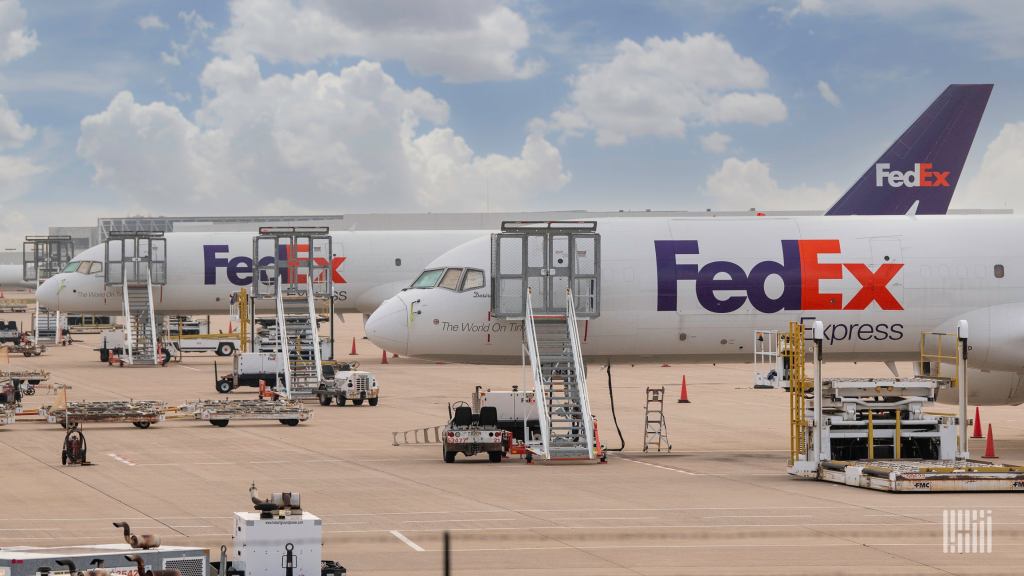
Purple-tailed FedEx cargo planes waiting on the tarmac, with ladders up to pilot door.

FedEx would benefit from the partial, or complete, loss of its huge contract with the U.S. Postal Service because it would force the parcel delivery giant to downsize a bloated and expensive air transport network, which could help revive profitability, said Brandon Oglenski, who covers the company for Barclays Bank.

FedEx Express (NYSE: FDX) and UPS (NYSE: UPS) move similar quantities of domestic and international express packages, but because FedEx has a much bigger airline, it chases low-yielding general cargo to fill excess capacity, contributing to lower earnings than investors have expected in recent years, according to the senior transportation and logistics analyst.

As part of a $4 billion cost campaign and initiative to consolidate portions of its Express, Ground and Freight networks, management recently outlined a three-pronged approach for driving aircraft density that doubles down on dedicating aircraft for deferred freight. The new strategy, dubbed Tricolor, is designed to segregate priority overnight parcels from slower freight to keep sort centers more fluid and lower expenses.

“FedEx’s new Tricolor initiative muddies the water, making it less clear how much air capacity and cost the company will reduce. Nonetheless, we view potential cessation of USPS flying or a renegotiated contract as driving earnings upside for FedEx,” Oglenski said in a recent client report. “We see FedEx as potentially able to cut 50% of daytime network capacity if the USPS contract is not renewed, which we estimate could save the company $1.5 billion.

“UPS operates a much smaller daytime air operation, effectively only flying aircraft where two-to-three day service commitments cannot be achieved by truck. We believe a similar footprint at FedEx could be accretive to earnings, as the company would not be trying to sell expensive air capacity into truck dominated linehaul markets.”

Postal business becomes a burden

A majority of FedEx Express’ air network is geared to daytime flying for the Postal Service. Over nearly a quarter-century, the Postal Service has grown into FedEx’s largest customer. Conversely, FedEx has been the largest provider of air transportation capacity to the Postal Service for 20 consecutive years, according to data compiled by David Hendel, a transportation attorney at Culhane Meadows. But under a streamlining initiative four years ago, the agency decided to use less air transportation and rely more on cheaper ground carriers, which is eating into FedEx Express volumes distributed via its Memphis, Tennessee, hub.

FedEx’s revenue from its Postal Service contract in the fiscal year ending Sept. 30, 2022, fell $236 million to $1.9 billion and is expected to decrease again in Hendel’s next list. Postal business represents 4% of total and 10% of domestic Express revenue at FedEx. The contract previously generated annual revenue of at least $2 billion. 

FedEx devotes about 100 aircraft to carry postal business at an annual cost of about $3 billion, according to Oglenski’s research. In its December earnings report, the company identified the Postal Service contract as a $400 million drag on earnings. The Priority Mail packages that FedEx primarily hauls have a similar service (two to three days) and pricing profile to packages moved by ground transport, which translates to lower yields and margins when using air transport.

Source: Barclays

FedEx officials privately acknowledge that the Postal Service contract is barely profitable. Minimum service requirements have forced FedEx to commit expensive plane capacity to relatively low-yielding parcel volume.

Pat DiMento, FedEx’s vice president of flight operations and training, recently told a group of airline employees that the postal contract led to network inefficiencies as FedEx accommodated increases in mail volumes while priority flying at night stayed the same, according to audio of the private meeting obtained by FreightWaves. A route from Raleigh, North Carolina, to Memphis, for example, might only require a small jet for overnight delivery, but FedEx will upsize to a larger freighter to meet the daytime mail requirement.

FedEx is likely to lose 50% of its daytime flying with the Postal Service, he speculated.

UPS air network is leaner

Largely due to the Postal Service business, domestic air operations are much larger at Fed Express than at UPS despite their having a similar share of the high-yielding express package market.

FedEx’s mainline fleet is 43% larger than UPS’ — 418 to 292 aircraft, according to company fact sheets. The company operates 24% more flights and has 40% more capacity than its rival, resulting in annual airline operating expenses of $18 billion compared to $8 billion at UPS, Oglenski estimated. (He acknowledged the figures are skewed a bit because FedEx tends to allocate a greater share of parcel network costs in the airline to the income statement than does UPS.) People intimately familiar with the company also say its founding by Fred Smith as an air delivery company has made it difficult to downsize the airline.

Source: Barclays

The Barclays analyst said air assets with high fixed costs are justified for express networks. They depend on highly orchestrated operations with precision scheduling to meet demanding service expectations, and carriers can charge a significant premium above standard transportation.

While FedEx generates $6 billion more global airfreight revenue than UPS, overreliance on the air network has suppressed operating profits for a long time, Oglenski argued.

Under the Tricolor strategy, however, FedEx also intends to aggressively go after heavyweight cargo booked by logistics providers to offset slower growth in the main Express product and declining postal business. Executives announced that the fleet will be reallocated to the so-called Orange network, which will operate off-schedule to carry heavy freight that doesn’t require maximum speed and is better suited for a truck-fly-truck delivery model than flying the entire trip. These planes will fly into primary and regional sortation centers such as Newark, New Jersey, and Oakland, California, during the daytime when workers have more time to build dense pallets. The idea is that by segregating parcels and freight, the hub facilities will operate more efficiently because the two shipment types are processed differently.
Although management has publicly discussed shrinking the freighter fleet in line with lower demand, DiMento said the new strategy is aimed at shippers with both parcel and freight needs that like using a single service provider when possible.

“If we don’t capture some of that middle band, we will never get their [shippers’] freight that is also in the priority range. Right now, we don’t offer much in that middle band to save money for these companies. So they are trying to capture that so that we can also grow what is our priority, international business,” he said in the private meeting.

Management pushed back on the characterization that the company is going after general cargo, saying the Orange network will function as an extension of the carrier’s shared truckload networks around the world.

Tricolor “expands FedEx’s offerings across the globe for freight shipments which have similar characteristics to less-than-truckload vs. the much heavier and lower yield per-pound consignments which are the provenance of traditional all-cargo carriers,” Richard Smith, president and CEO of airline and international at FedEx Express, said in a letter to FreightWaves. “In addition to international LTL shipments, the Orange network handles International Economy packages that similarly interface with FedEx’s global ground parcel systems at very low incremental costs.”

Source: Barclays

Oglenski questioned the attempt to offer underutilized aircraft space to the “saturated deferred freight market, dominated by improved and much lower cost LTL offerings from the likes of FedEx Freight, Old Dominion and XPO.”

When the Postal Service contract comes up for renewal later this year, FedEx needs to renegotiate for better pricing on a smaller piece of the Priority Mail business or consider walking away from the contract, he said. FedEx has previously said the Postal Service contract will need to be revised for it to consider renewal.

“We appreciate the relationship we have enjoyed with the United States Postal Service for the past 22 years. Like any other customer relationship, we are focused on ensuring it continues to make good business sense for both parties as we each realign our networks for the future,” the company said in a statement. 

Jettisoning the postal business presents an opportunity to halve the daytime air operation and rely more heavily on cheaper linehaul movement of deferred packages, as UPS does, said Oglenski.

“While we find the desire to keep capacity in the market admirable, decades of margin underperformance and lack of generating re-investable returns suggest the more prudent action is downsizing operations,” he wrote.

Click here for more FreightWaves and American Shipper articles by Eric Kulisch.

FedEx braces for 50% cut in Postal Service air contract

FedEx fleet restructure poses threat to freighter operators

Triumph factoring group’s new COO sits atop a business that has doubled

Kimberly Fisk has been in the factoring business long enough to remember when factoring was known as the F-word.

But the growth that Fisk, recently installed chief operating officer at Triumph Financial Services LLC, has seen in her 12 years at Triumph is enormous. Triumph now purchases about 600,000 invoices per month for factoring. Five or six years ago, she said, “It was about half of that, because we have grown much more in size in the last couple of years.”

FreightWaves interviewed Fisk as she began her first full year at Triumph Financial Services, the factoring business previously known as Triumph Business Capital. It is part of Triumph Financial Inc., which last year also went through a name change from Triumph Bancorp (NASDAQ: TFIN).

Fisk’s appointment came a little more than a year after Tim Valdez moved over from TriumphPay to become president of the factoring group. Fisk mentioned him and said the group’s leadership is “reinvigorating our team to really have a client mentality first, making sure that we’re offering our clients exceptional customer service.”

The focus at the parent corporation, Triumph Financial, has been on its open-loop payments network at the TriumphPay division. But the reality is that in the fourth quarter, interest income at Triumph Financial Services was $35.4 million. At TriumphPay, total interest income was $12.9 million, though it was EBITDA-positive for the first time.

Although factoring is the purchase of a receivable, what’s been notable about the financial performance of the factoring group at Triumph is that the direction of the yield on its average receivable actually has declined in recent years, despite the overall trend in interest rates.

For example, in the fourth quarter of 2019, the final full quarter before the pandemic, that yield was 17.2%, according to Triumph’s earnings report. But in the 12 months of 2023, the quarterly average interest was in a fairly tight range of 13.59% to 14.07%, with the 13.7% of the fourth quarter not far from the 13.85% in the fourth quarter of 2022.

The interest rate on factoring loans, Fisk said, “used to be known as about the highest interest rate, and it’s not that anymore.”

Those kinds of yields may look incredibly rich from the outside. And maybe the fact that there are so many factoring companies suggests it is profitable enough to support an enormous base of lenders.

But as Fisk said, “It takes a lot of systems to run a factoring company. So it’s interesting when people get in, sometimes they turn around and want to get out.”

That average yield does not consist solely of the interest rate or “haircut” charged to the trucker. “You have your employee costs, if you have a referral partner that you’re paying, you have your cost of funds,” Fisk said. “There’s a lot of components that any factor would have to consider as far as what would be built into their yield.”

Triumph has tried not to get too far down in the pit by competing on interest rates as the market softened in recent years. “We’re really trying not to dive off the deep end,” Fisk said, though she added that competition has eased recently. “The markets are not doing that any longer, anyway, and I think a lot of people are feeling the same way.”

For emphasis, Fisk added: “We’re not in a competitive market where we’re going to drive down rates and fight over price. Triumph is going to make sure everyone understands the value that you’ll get from us and that we will maintain it.”

While the basic value proposition of factoring has not changed — a driver or fleet getting paid faster — what Fisk said Triumph and other factoring companies are offering to even larger fleets is what amounts to a shifting of some back-office operations out of the carrier and on to the factoring lender.

In the past, the individual drivers or small fleets that turned to factoring companies could often be described, according to Fisk, as “I’m not bankable so I’m going to go factor.” It was then in the interview that Fisk made the analogy to the F-word, and said factoring “had a stigma about it.”

“And now you see a lot of clients using factoring, even up to very large-size fleets,” she said. Among the advantages that the industry touts, Fisk said, is that factoring can “remove unnecessary back-office administrative stuff because we offer invoice presentment and invoice creation.” The carrier needs to present the initial basic documentation — still, in many cases, a scan of a paper-based invoice — but it greatly reduces the number of back-office personnel needed at the carrier, or the hours needed by the individual owner-operator.

No covenants in factoring

Another factoring advantage touted by companies like Triumph: less restrictive lending practices. Fleets that are tied to loans or asset-based lending will have covenants and other requirements on their finances that don’t come with factoring as a financing source. “A lot of these clients are comfortable with the services that we offer and not having those financial covenants in place,” Fisk said.

How a smaller factoring company can be successful if it doesn’t have the technological capabilities found at the larger firms comes down to personal relationships, according to Fisk. If a small-fry company survives without it, Fisk said, it’s likely because “you’re probably doing something well as far as relationships are concerned.”

Factoring is a highly fragmented industry. A company like Triumph has 300 to 400 employees, and it likely isn’t even the largest factoring company; RTS Financial generally is considered to be the biggest. 

Given that fragmentation, factoring has long been seen as a financial sector ripe for consolidation, in light of the number of small lenders that may not have the competitive advantages that larger companies have (or might need to file for bankruptcy for other reasons.)

Nothing cooking on the acquisition front

But Triumph has not made any acquisitions of late and Fisk did not anticipate that changing.

“We’ve been really focused on our client experience, and we’re not really looking to build our balance sheet through acquisition,” she said. “We’re looking at our technology efficiencies and really spending time with developing our own people.”

(By contrast, Love’s Travel Stops, which did not make any acquisitions in its extensive factoring segment, may be looking to do so in 2024, according to a recent interview with Love’s President Shane Wharton.)

The technological efficiencies Fisk referred to have meant personnel costs should stay in check. “Instead of having to add head count, our systems can do a lot of the work for us,” she said.

The network system at the heart of the payments sector at Triumph Financial processes invoices mostly for brokers, but there are factoring companies (and some shippers) that use it as well.

Triumph CEO Aaron Graft has said multiple times that it is important that the factoring clients using the network won’t have their information shared to Triumph’s factoring group. 

Fisk said Triumph Financial Services keeps an arms-length relationship with the TriumphPay network, to the point that not all invoices are processed through it. “It depends on what the network is offering,” she said. “Anywhere we can get efficiency through the technology, we can connect with it into our processes.”

She said the two groups within Triumph have different technologies and different technology teams. “So we’re very separated,” Fisk said. 

More articles by John Kingston

Investment bank praises Triumph Financial but cuts its stock price rating

TriumphPay pulls in biggest audit and payment network customer so far: Worldwide Express

Wells Fargo lowers stock rating amid wait for TriumphPay’s profitability

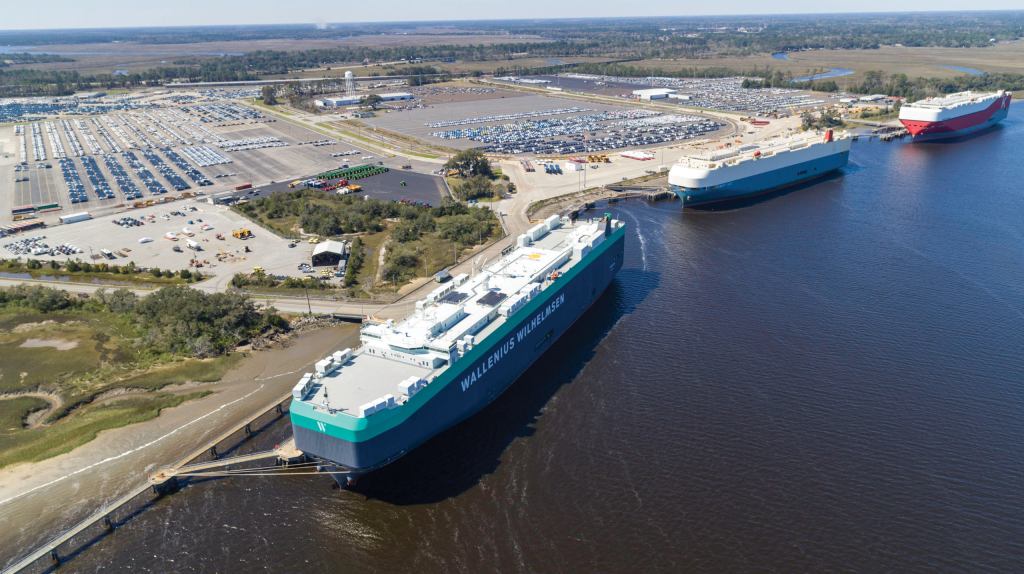
Business up in January at ports of Savannah, Brunswick

The Port of Savannah kicked off 2024 with a modest gain in container shipments, moving 428,000 twenty-foot equivalent units in January, a 1.5% year-over-year (y/y) increase from the same month last year.

The port ended calendar-year 2023 with a total of 4.9 million TEUs, a decrease of 16% compared to 2022. 

Higher inflation rates and interest rates slowed consumer spending, resulting in higher inventories in warehouses, according to officials for the Georgia Ports Authority (GPA).

“With the new year, we are beginning to see renewed strength in container volumes, which should result in more favorable comparisons moving forward the next six months,” Griff Lynch, CEO of the GPA, said in a news release

Cargo moved by rail at the Port of Savannah reached 47,132 containers in January, a 27% y/y increase. Officials for GPA attributed gains in rail cargo movements to the completion of the $220 million Mason Mega Rail last year.

The project provides 24 miles of on-terminal track on 90 acres next to the port’s Garden City Terminal.

“The investments we’ve made in rail capacity have not only increased the number of containers the Port of Savannah can handle each year, but extended our reach to new markets that can be served effectively by Garden City Terminal,” Lynch said.

At GPA’s Port of Brunswick, the Colonel’s Island Terminal handled 65,400 units of roll-on, roll-off cargo in January, compared to 57,127 units during the same period last year. 

More articles by Noi Mahoney

Trump-supporting truckers boycott loads to New York City

Border bridges blocked as former rail workers seek back pay

329 layoffs hit freight-related firms in Texas

SOS: Cellular outage strikes freight

Welcome to the WHAT THE TRUCK?!? Newsletter brought to you by Dynamic Logistix. In this issue, cell outage downs freight; Convoy returns; State of Freight recap; and more.

Cell outage reverberates through freight


X


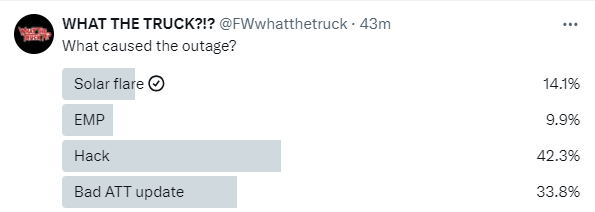
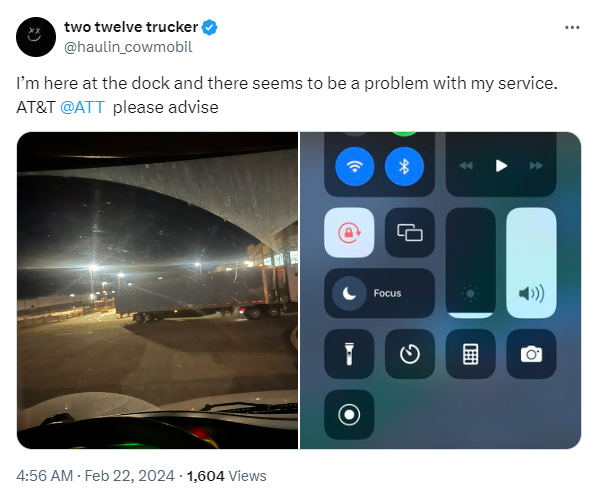
Solar flare, hack, EMP, botched network update? What happened? — Woke up at 6 this morning to a tweet from Chadad alerting us that his entire fleet’s communication was down.

“Woke up to all the phones in my house having no cell service here in Central Arkansas. Then I get on my laptop using satellite internet and see that all of our trucks have stopped communicating through their GPS devices all throughout the United States.” — Chadad on X

Speculation has run rampant online that the cause of this could be anything from a foreign hack to a Russian space electromagnetic pulse (EMP) to a solar flare. In fact, Space.com reports, “Two outbursts from the sun occurred as widespread cellphone outages were reported throughout the United States on Thursday.”

One weird thing is that my wife and I have the exact same phone and are on the same AT&T plan but hers got SOS’d while mine was fine. Wouldn’t an EMP or solar flare harm both? We’re not the only ones reporting that some AT&T lines on the same tower are working while others are not.


X

I don’t know if that completely rules out a hack or a flare, but AT&T is officially saying that it was a botched system update.

The company wrote, “Some of our customers are experiencing wireless service interruptions this morning. Our network teams took immediate action and so far three-quarters of our network has been restored. We are working as quickly as possible to restore service to remaining customers.”

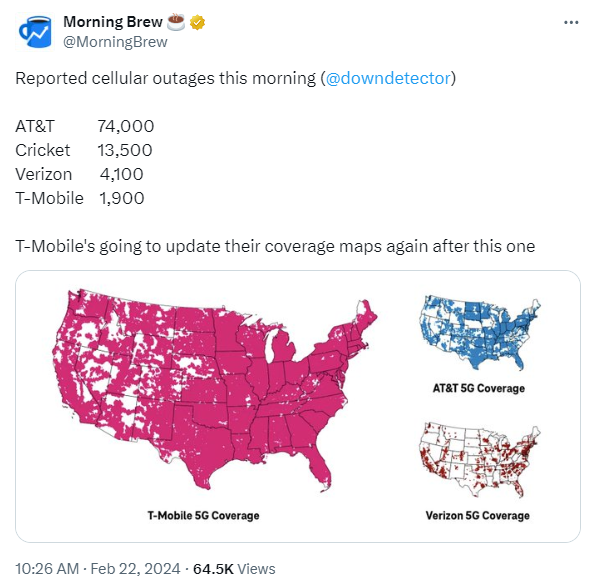
According to Downdetector, more than 70,000 AT&T customers were impacted during the outage’s peak.


X

Freight impacts


X

MFA authentication, load board logins and phone systems hit — While immediate freight impacts are not yet known, according to multiple channel checks this outage has hampered operations inside and outside the truck.

Two-factor authentication is proving to be problematic when the cell phones go down. Zach Webber, president at A.N. Logistics, tweeted, “Locked out of Truckstop and DAT 🫠”


For those who can get into a load board, some are seeing carrier notes such as, “No brokers with AT&T.” 

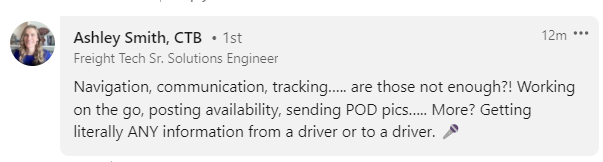
One industry insider who wishes to remain anonymous said, “If more megacompanies start transferring comms for things like check calls, arrival and load/unload information, or even bill of lading information uploads off of truck tablets and onto smartphone apps, it leaves us vulnerable to these types of disruptions.”


LinkedIn

Many drivers are reporting that they’re out in the dark with HQ until they can find a wi-fi signal. Remote sales teams are also struggling to communicate while on the road.


X

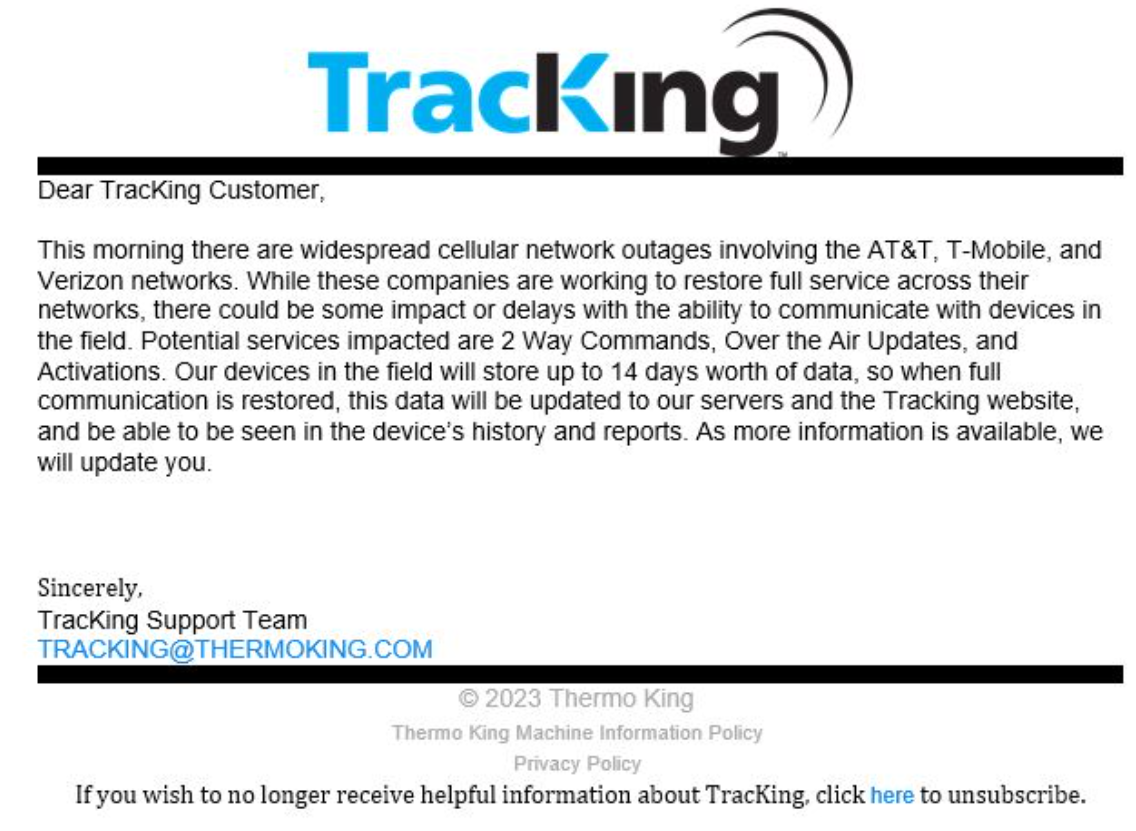
Thermo King has updated its customers about the outage and warned that communications could be delayed due to it.

And just in from FreightWaves, “Motive, Samsara and Trimble are a few of the transportation tech platforms that reported issues, warning customers of potential problems. These systems use cellular data to track drivers’ locations, send messages and dispatch information, meaning an AT&T outage can sever that communication.”


X

Uber drivers parked — Rideshare and food delivery drivers on the AT&T network were also reporting that they’re stuck in their driveways. No cell signal means no rides or food for customers.


X

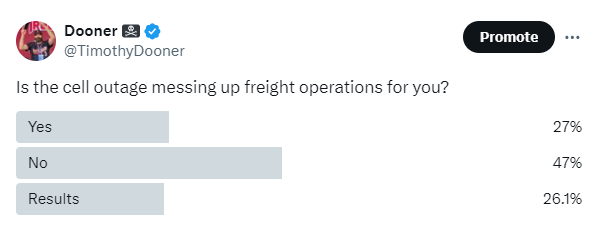
Sound off — Have you been impacted by the outage? How so? Email me your answer.

A fix? — If you haven’t done so yet and you’re stuck on SOS, hard reboot your phone. It may bring you right back up. Remember how I mentioned my wife’s phone at the start of this? It worked for her.

Flexport relaunches Convoy platform

Resurrection — Back in October when Convoy shut down, the freight world was abuzz with speculation of what would become of the company that at one point was valued at $3.8 billion

It shouldn’t be a big surprise that Flexport swept in to pick up Convoy’s tech stack last November. The two have been in a partnership since 2021.

At the time, Ryan Petersen, Flexport CEO and founder, wrote in an email to Flexport staff, “Flexport’s strategy will be to offer a full range of trucking services to our customers who value us as a one-stop-shop for global logistics.”


X

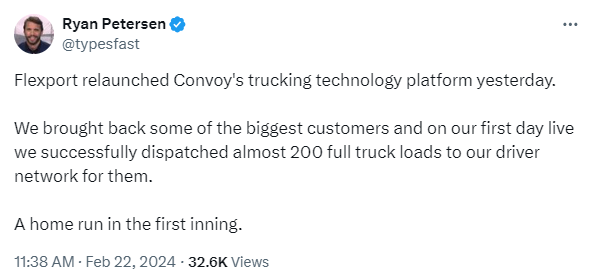
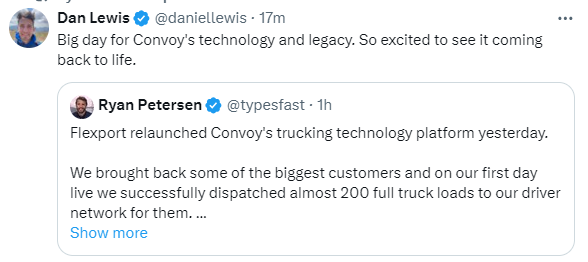
Today, Flexport announced that the Convoy platform has been up and running on the company’s system since Wednesday and Flexport has already booked almost 200 full truck loads through it.


X

FreightWaves’ Noi Mahoney reports, “Flexport plans to expand Convoy’s offerings for brokers in the second quarter of this year. Brokers will soon have access to capacity backed by fraud detection technology and ongoing automated predictive performance scoring and quality control.”

Don’t miss WHAT THE TRUCK?!? this Monday when Flexport’s Ryan Petersen joins the show. We’ve got a lot to talk about!

Meme of the week

X

Freight’s Babylon Bee strikes again — Like we covered on Wednesday’s episode of WTT, the New York trucker strike is not having any impact on freight and is a story mostly spun up on social media and by media outlets. That didn’t stop X user Freight Bandit from taking the opportunity to troll the platform. 

To his credit, he has since deleted the post as his grandson had seen it — an eerily similar excuse that Chicago Ray used when he deleted his New York boycott video.


A depressing state of freight with a glimmer of hope?


SONAR

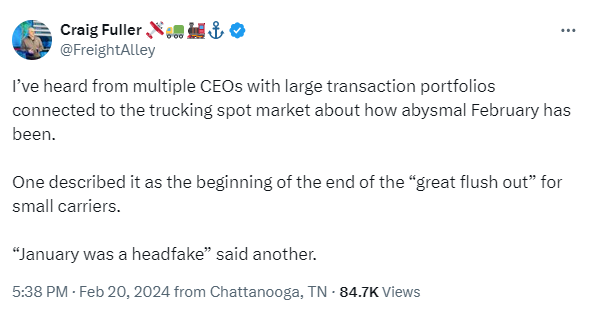
“Abysmal” — During Wednesday’s State of Freight webinar, FreightWaves’ CEO and founder may have called the market “abysmal” but he’s still bullish on the second half of the year.


X

So, when will a January head fake improve to a normalized market? During the webinar, Fuller said, “I have become more bullish. … I wouldn’t say it’s a quarter ahead, but maybe two quarters.”

What needs to happen for that to become a reality? Fuller points to the spread between contract and spot rates and the need to further reduce capacity. There’s been a big bleed out of both brokers and carriers since 2022 but not enough to offset the record number of both who entered the market during the pandemic.

Read FreightWaves’ John Kingston’s full breakdown of the State of Freight webinar here.

The rest of the noise

Robot recession? (Business Wire)

WTT Friday

CEO spends week with trucker to solve parking problem; Will’s Journey; Convoy returns — This Friday on WHAT THE TRUCK?!?, I’m joined by Trucking Parking Club’s Evan Shelley and Autumn Transport owner-operator Chris Thomas. Shelley just spent over a week riding along with Thomas so he can better understand the truck parking problem and issues driver face. We’ll find out what the two learned from each other and about solving these issues.

Will Jenkins is back with his latest venture Journey. After successfully building MoLo and selling it to ArcBest for $235 million, Jenkins is back to building. Now his new company Journey aspires to be the transportation recruiting resource and the premier community-based sales academy for the industry.

Travelers’ Scott Cornell shares the insurance market perspective on industry and market issues.

Plus, latest news, weirdness and trends.

Catch new shows live at noon EST Mondays, Wednesdays and Fridays on FreightWaves LinkedIn, Facebook, X or YouTube or on demand by looking up WHAT THE TRUCK?!? on your favorite podcast player.


Now on demand

Are truckers really boycotting New York?

Why Matt Silver won’t be buying Coyote

Thanks for reading and feel free to forward this to a friend.


Tweet @ Dooner

Email me

Subscribe to the newsletter

Subscribe to the show

Apple Podcasts

Spotify

YouTube

TikTok

Twitter

Or simply look up WHAT THE TRUCK?!? on your favorite podcast player. 

Don’t be a stranger,

Dooner

Truck tech impacted by AT&T outage: Here’s what’s happening

AT&T began experiencing sweeping outages of its cellular networks across the United States on Thursday morning. While mass reports of driver connectivity issues have not surfaced, back-end TMS and visibility systems are experiencing outages.

Motive, Samsara and Trimble are a few of the transportation tech platforms that reported issues, warning customers of potential problems. These systems use cellular data to track drivers’ locations, send messages and dispatch information, meaning an AT&T outage can sever that communication.

Omnitracs and Verizon Connect were some of the platforms not affected, as of press time. 

Why is a cell outage a big deal? 

ELDs piggyback on a cellular provider through the device itself or by linking with a driver’s cell phone, according to Thomas Wasson, FreightWaves’ enterprise trucking expert. 

An outage at a large nationwide provider like AT&T impacts both ELD devices and drivers whose cell phones are connected to the AT&T network, resulting in outages and potential log errors. For fleets and safety departments, log errors or omissions of hours of service can result in what appear to be falsified logs if a driver’s impacted logs are inspected and fail to account for missing time.

For carriers impacted, one way to work around the disruption is to have drivers revert to manual paper logs until service is restored. This adds the challenge to drivers of securing paper logbooks, which can result in extra costs and out-of-route miles. Afterward, drivers will need to account for that missing time in the ELD once functionality is restored.

Another challenge will be the gaps in driver position and location history, which may impact automated tracking and cause disruptions to service, as customers and freight brokers may note inaccurate location updates when determining an ETA.

Drivers themselves won’t always notice these outages, since their ELD will show the correct time, but back-office staff will likely be worried since a driver will show as a certain distance out for a few hours and not update.

It is likely that some platforms will come back throughout the day, but the impact for drivers will be seen later on.

AT&T made a statement about the widespread outage, but no cause has been identified. 

An industry source told CNN it could be related to how cellular services hand off calls from one network to another.

According to Downdector, Los Angeles, Houston, Dallas and Atlanta are a few of the major areas in the U.S. experiencing the AT&T outage.

Driver recruitment with Charles Gracey

All about driver recruiting with Charles Gracey

(Image: FreightWaves/Charles Gracey)

On Tuesday, Loaded & Rolling interviewed Charles Gracey, aka “The Dr. Phil of Trucking,” president and founder of Hot Seat Services and host of the Sense per Mile podcast, about the state of driver recruiting and recent tech developments. Gracey discussed the driver recruiting pipeline, which starts with the collection and vetting of leads for potential candidates. Historically, the cost per lead was viewed as an important metric, with many carriers focusing on minimizing the cost of acquiring each lead. The downside of this strategy was that driver recruiters wasted time and energy “chasing donuts” as they attempted to vet leads and gauge driver interest. Drivers expressing interest and successfully contacted are then encouraged to fill out an application for review. A recruiter will work on scheduling the necessary background checks before eventually offering the position, while setting up transportation and lodging arrangements for the driver to begin orientation.

Gracey noted that the recruiting process can be difficult even in the best of circumstances, with thousands of potential applicants but only a tiny fraction getting an offer and successfully completing orientation. For example, out of 1,000 leads only 10 drivers may survive the vetting process or complete the application process before showing up. A troubling statistic Gracey noted was the rise in orientation no-shows: After the company pays thousands of dollars in travel, lodging and other fees, the driver ghosts the carrier and simply doesn’t show up. This used to be around 1 in 3 but is now 1 in 2, a 50% success rate. Gracey believes part of this is a change in driver culture and norms, with many drivers preferring not to tell a carrier they are no longer interested and instead failing to show up. Gracey said carriers used to note these refusals on the Drive-A-Check report, but fewer carriers are recording the no-shows or other carriers are not taking them into consideration. For carriers, the challenge is finding better-quality leads and using technology to find the right driver who is both interested and intends on completing the process.

You can view the entire interview here.

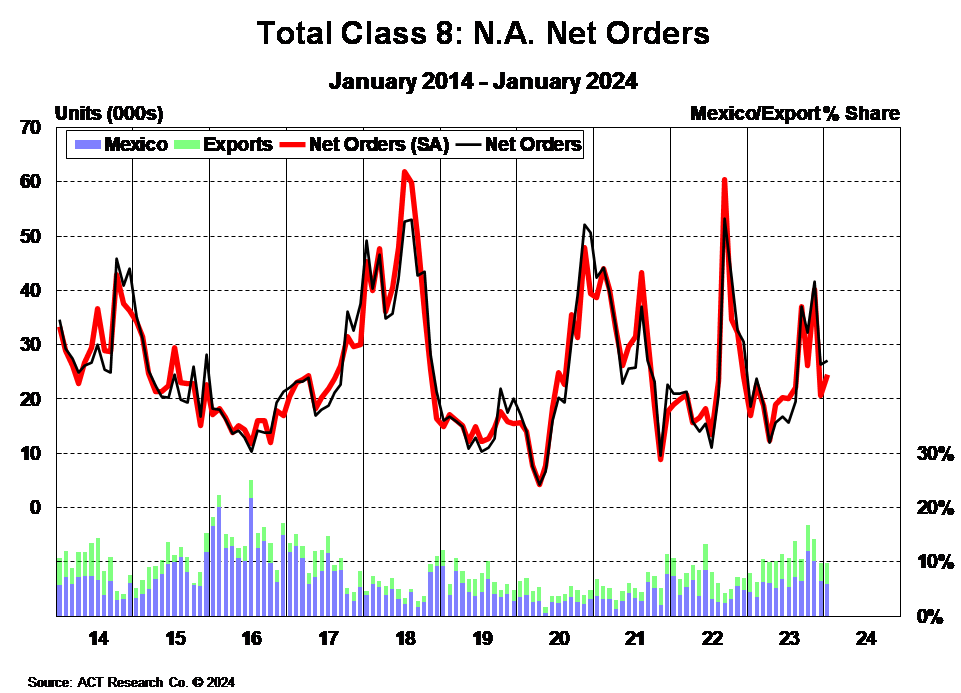
January Class 8 Tractor orders up 44% y/y

On Monday, ACT Research released its January Class 8 net order data which saw final January Class 8 orders up 45% year over year to 27,125 units. The report noted that in the U.S. alone, Class 8 tractor orders surged 44% y/y to 16,765 to an above-replacement-level rate. FTR Transportation Intelligence, another market intelligence firm, noted preliminary Class 8 orders in January of 26,400 units, up 2% m/m and 35% y/y. 

Kenny Vieth, ACT’s president and senior analyst, said in the report: “Seasonality is one component, but given the state of for-hire truckload rates, we continue to suspect private fleets as the primary driver behind US tractor demand. As well, the LTL segment remains a bright spot relative to TL and is likely also contributing. The US economy’s current strength doesn’t hurt either.”

While private fleets spurred growth, there remain concerns that inventory gluts may begin after fleets restock. Vieth adds, “Class 8 inventories rose 1,909 units m/m to 66,277 in January, up 14.3% y/y. Following December’s dash to get equipment finished ahead of regulations starting at the beginning of 2024, Class 8 retail sales totaled 24.5k units in January, up 2.9% y/y. Amid the weakest period of the year for retail sales, and with still strong production, we continue to see risk in the potential for rapid inventory escalation in early 2024.”

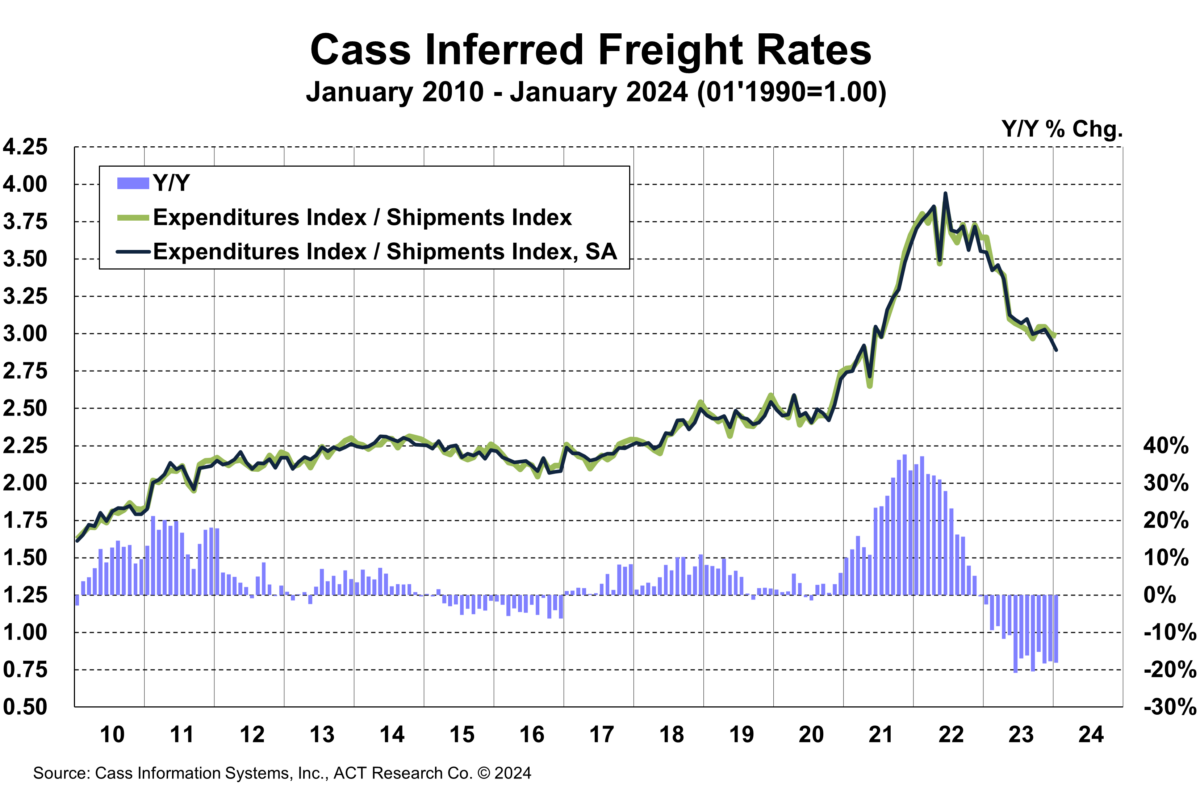
Market update: Cass January data reports ‘Frozen Freight’

Freight audit and payment provider Cass Information Systems recently released its January Freight Index data, which saw shipments fall 3.5% month over month but flat when seasonally adjusted. Expenditures and freight rates continued to fall compared to the previous year, with expenditures down 24.3% y/y and inferred freight rates off by 18.1%. Winter weather may have had an impact. FreightWaves’ Todd Maiden writes, “Inclement weather negatively impacted freight demand during January, meaning shipments would have likely been up sequentially in a normal year.”

The average cost of a shipment seasonally adjusted continued to decline for the 10th consecutive month, falling 2.6% m/m and 18% y/y. The report notes that while truckload rates didn’t decline as drastically, modal mix changes may be a contributing factor. There were some signs of optimism in the report which noted that, “While trucking demand remains soft overall, rising import and intermodal trends are key leading indicators of a recovery in trucking this year.”

Further freight expenditure declines are predicted, with the report adding, “U.S. freight spending, as measured by the expenditures component of the Cass Freight Index, fell 19% in 2023, after a record 38% surge in 2021 and another 23% increase in 2022. It’s set to decline about another 16% in 1H’24, assuming normal seasonal patterns from here.”

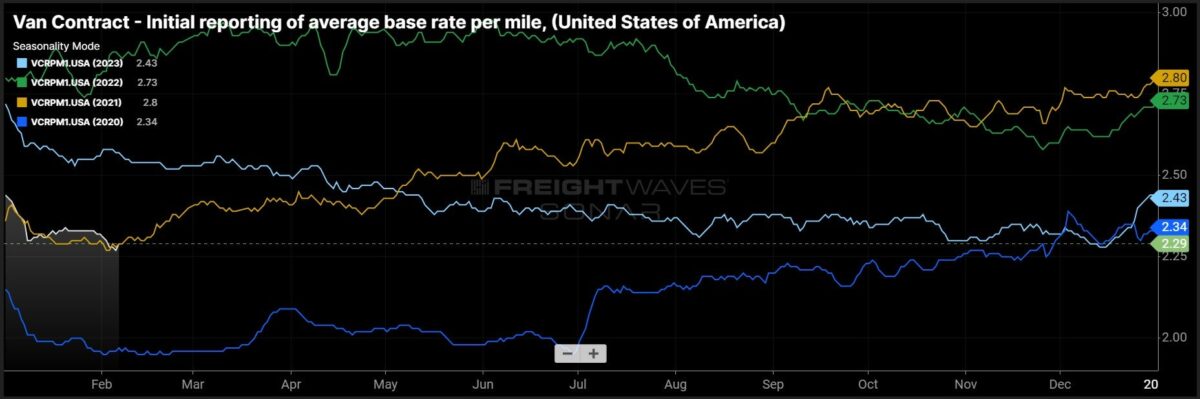
FreightWaves SONAR spotlight: Initial contract rate per mile back to 2021 levels

(Source: FreightWaves SONAR)

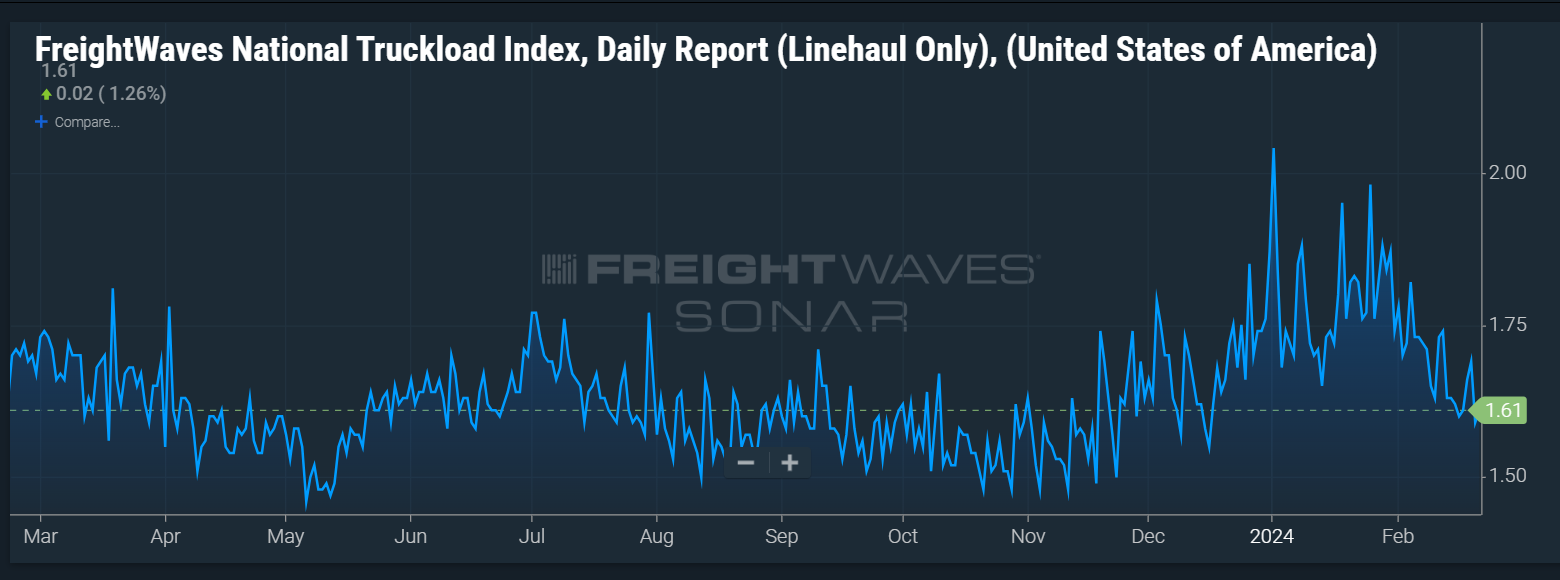
Summary: The steady decline in contracted rates has returned to levels not seen since 2021 as trucking capacity relative to truckload demand weighs down rates. The Van Contract – Initial average base rate per mile measures the average base rate without fuel or accessorial charges and is reported on a 14-day lag. The spot market linehaul-to-contract-rate spread is currently 54 cents per mile but is expected to widen, as linehaul rates fell 12 cents per mile from $1.75 per mile to $1.63 per mile on Feb. 19. Truckload carrier executives noted on their recent Q4 earnings reports that customers are still seeking rate concessions but fleets are attempting to push back, arguing that their costs are much higher than in years prior, or potentially reducing fleet truck count and increasing their dedicated offerings at the expense of over-the-road or one-way offerings. 

Adding further challenges for fleets are ongoing declines in both all-in spot market rates and outbound tender rejection rates. The nationwide outbound tender rejection rate fell 16 basis points in the past week from 4.91% on Feb. 12 to 4.75%. While carriers are losing pricing power in contract markets, the spot market has not fared better in the past week. The FreightWaves National Truckload Index 7-Day Average (NTI) fell 5 cents per mile all-in from $2.31 on Feb. 12 to $2.26. Spot market uncertainty extends out to the NTI 28-Day Outlook, which projects the National Truckload Index Forecast (NTIF) rising to $2.32 per mile the first week of March before declining to $2.29 per mile all-in on March 19.

Bid season off to bumpy start, trucking heads say (FreightWaves)

FMCSA sends plan for a detention time study to OMB (Land Line)

Declines persist in dry van contract replacement rates (Trucking Dive)

Live on stage: The complex relationship between a trucking job and life (FreightWaves)

Motive countersues fleet tech rival Samsara over patent infringement (FreightWaves)
State of Freight takeaways: Is a weak February the bottom of the cycle? (FreightWaves)

Like the content? Subscribe to the newsletter here.

J.B. Hunt’s acquisition of Walmart’s intermodal fleet part of long-term agreement

A J.B. Hunt intermodal container being pulled on a highway

J.B. Hunt Transport Services announced Thursday it has entered a long-term intermodal deal with Walmart that includes volume and capacity commitments. As part of the deal, J.B. Hunt will acquire Walmart’s intermodal assets.

The multiyear deal expands an existing relationship between the two Northwest Arkansas companies, with J.B. Hunt (NASDAQ: JBHT) buying Walmart’s (NYSE: WMT) intermodal containers and chassis. Neither the size of the fleets nor the purchase price was disclosed.

“Today’s announcement is a testament to the mutual trust and shared vision our companies have developed over time, and innovative arrangements like this one demonstrate J.B. Hunt’s disciplined approach to strategically allocating capital to advance our mission of driving long-term value for our people, customers and shareholders,” said Spencer Frazier, J.B. Hunt’s executive vice president of sales and marketing.

J.B. Hunt has made numerous investments in intermodal capacity in recent years.

Two years ago, the company announced plans to expand its container fleet to 150,000 units, or 40%, by 2025 to 2027. It has also been investing in transloading facilities near some of the nation’s largest ports.

J.B. Hunt further aligned with rail partner BNSF Railway (NYSE: BRK-B) in November by launching Quantum, a premium intermodal service focused on converting highway freight to rail by emphasizing quicker and more consistent delivery times. The companies also have a new cross-border service in place in and out of Mexico, and J.B. Hunt will benefit from the opening of BNSF’s Barstow International Gateway, which will serve the ports in Southern California.

“Walmart’s long history of working with J.B. Hunt has many milestones of innovation and growth,” said Fernando Cortes, Walmart’s senior vice president of transportation. “This agreement will strengthen our commitment to delivering goods at an everyday low cost to our customers and members.”

Deutsche Bank (NYSE: DB) analyst Amit Mehrotra said the deal is unlikely to burden the intermodal market with excess capacity at a time when freight markets are still weak.

“We think the investment by JBHT is significant, but it’s part of the company’s existing commitment to get to 150k containers … and we note this purchase would represent capacity that is already in the market and comes with incremental volume commitments,” Mehrotra said in a Thursday note to clients.

“The true test is Intermodal volume and profit growth over the mid to long term. But this announcement appears to set the company up very well when the next upcycle comes, allowing it to continue increasing earnings power cycle over cycle.”

More FreightWaves articles by Todd Maiden

Inside Zeem Solutions’ bold plan to electrify fleets across the US

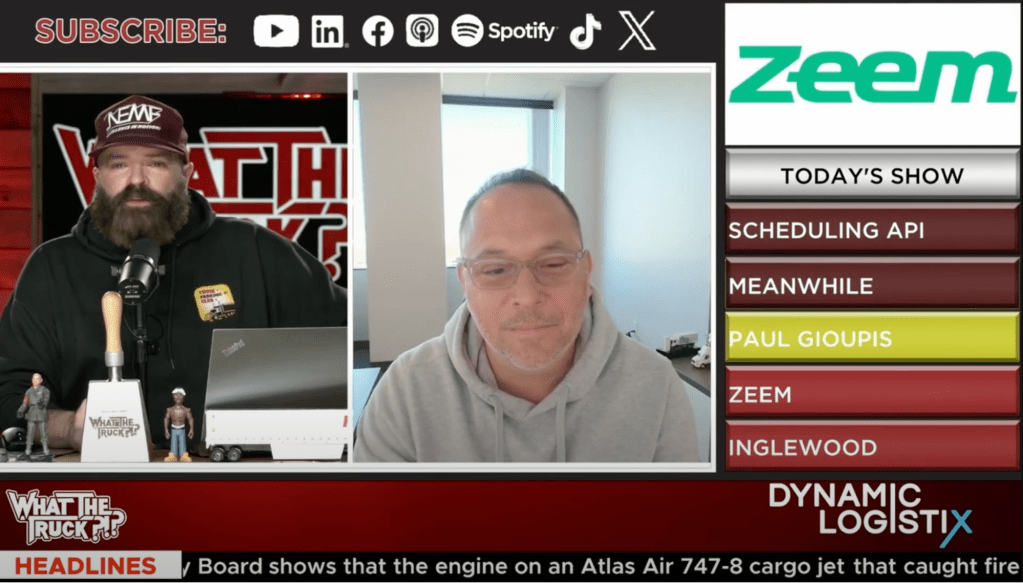
The world is hurtling toward electric vehicle adoption, and Paul Gioupis, co-founder and CEO of Zeem Solutions, wants his company to facilitate that transition for commercial fleets.

On What the Truck?!?, Gioupis highlighted Zeem Solutions’ efforts in creating essential EV infrastructure for medium- and heavy-duty fleets. With its flagship EV charging hub near Los Angeles International Airport, equipped with a vast array of both fast and standard charging ports, Zeem stands as a leader in supporting fleets amid stringent environmental regulations and the push for cleaner transport solutions.

Gioupis elaborated on the obstacles facing fleet operators, from sourcing electric trucks to securing reliable chargers, and explained how Zeem Solutions’ comprehensive service model addresses these issues. This model not only encompasses charging and maintenance but also ensures vehicles are primed and ready for drivers, streamlining the shift.

“The reality is that [the technology is] incredibly expensive,” Gioupis said. “The product is premature. The chargers don’t work all the time. So what happens is you need a deep knowledge to really understand, first of all, the truck itself, and then of course the charger and then the utility interaction.”

Building the foundation for EV fleets

Zeem’s facility near LAX, boasting 78 DC fast-charge ports and 53 AC ports, can meet the daily charging needs of quite a few trucks.

But the company’s ambition extends beyond Los Angeles, aiming for national expansion with strategic sights on crucial port locations like Long Beach, California; Savannah, Georgia; SeaTac in Washington; and Newark, New Jersey. These areas, vital for their economic and environmental impact, are prime sites for the subsequent expansion phase, aligning with regulatory movements that advocate a cleaner, diesel-free environment.

Transitioning fleets to electric of course raises technological, logistical and financial challenges. Zeem Solutions meets these challenges with a comprehensive service model that offers charging solutions and a seamless, hassle-free package including vehicle leasing, charging, maintenance and fleet management for fleet operators. The company wants to actively enable electrification through strategic infrastructure development and innovative business practices.

“I’m an investment banker in my DNA,” Gioupis said. “I’m not doing anything unless this makes money and pencils out and it’s scalable across the country.”

Addressing electrification challenges and looking ahead

As Zeem broadens its reach, it’s focusing on demystifying the electrification process for fleets nationwide. The company is confronting electrification challenges directly and offering crucial infrastructure support for the industry’s move toward cleaner transportation. This effort is about more than just adding charging stations; it’s about establishing a comprehensive ecosystem that supports an EV fleet’s entire life cycle, all from one centralized location.

This forward-thinking strategy to address significant electrification barriers showcases an alignment with broader sustainability and efficiency goals. By leveraging partnerships and strategically positioning near major ports, Zeem ensures fleets have the resources needed for a smooth electric transition.

Looking forward, Zeem’s vision is not merely reacting to the present demand for EV infrastructure but is also anticipating the needs of tomorrow’s fleets. With a model emphasizing economic viability and scalability, Zeem Solutions is helping lay the groundwork for a sustainable, efficient future in commercial transportation. 

“We’ve made over 1.7 million phone calls,” Gioupis said. “We’ve engaged 16,000 fleets that have come to us and said, ‘OK, if you’re crazy enough to fund this and you’ll come back and it’s [as good as] or better than the cost of diesel, I’ll give it a try.’”