




WASHINGTON – Seaports, waterway operators, and shippers are telling the Trump administration that a national freight plan will be incomplete without a significant focus on maritime transportation.
Comments filed with the U.S. Department Transportation by the Port of Los Angeles, the American Waterways Operators (AWO), and the National Waterways Conference echo a common theme: that maritime freight is undervalued and should be a higher priority within DOT’s National Freight Strategic Plan (NFSP), which is under review by the department.
“The lack of recognition and inclusion of waterborne freight transportation, and the omission of maritime facilities and networks in this national freight transportation framework creates a disconnect between the essential role of our ports and waterways and the broader goals of freight transportation, and highlights the need for a more balanced and inclusive approach in the NFSP,” said Julie Ufner, President and CEO of NWC, whose members includes ports, barge operators, and agriculture exporters.
Ufner also pointed out that the map designating the current National Multimodal Freight Network (NMFN) – which is to be used in conjunction with the NFSP – includes only 138 public ports, despite data showing more than 350 public ports “and thousands of private terminals in active use,” Ufner said. “At the same time, other modes, including privately held railroads, are abundantly represented on the map.”
Gene Seroka, executive director of the Port of Los Angeles, stressed that a “whole-of-government approach” to maritime policy is needed, recommending DOT integrate a National Maritime Strategy with the NFSP “which is critical for improving supply chain resilience, enhancing economic competitiveness, and advancing national security,” he wrote in comments filed with DOT.
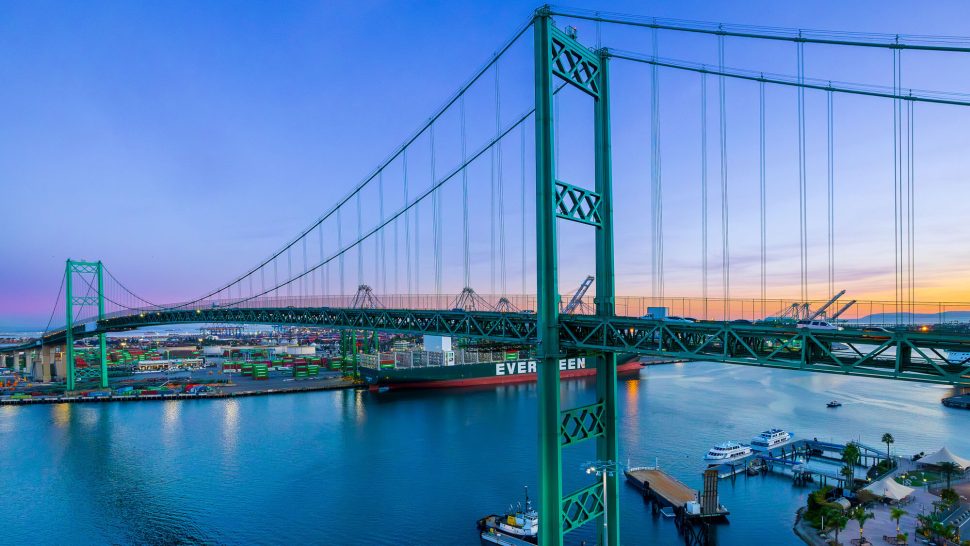
Seroka told DOT that a $1.5 billion project he announced last month to raise the Vincent Thomas Bridge, a suspension bridge that traverses the port and is used heavily by trucks hauling in and out of the port, is an example of how integrating road and marine strategies can benefit both sectors.
“The current clearance of the bridge is a constraint on the newest, supersized cargo vessels, barring access to 40% of the port’s terminal capacity,” he said. Raising the bridge by 26 ft. to 211 ft. would open the port to larger container ships “and preserve a significant amount of the nation’s port capacity” he stated.
The port also pushed DOT to expand the criteria for identifying corridors providing access to manufacturing and agriculture to include those that provide access to logistics hubs and retail centers, “which represent a significant portion of the modern economy.”
AWO, which represents barge companies and others that operate on inland waterways and along the coast, urged DOT and the Maritime Administration (Marad), an agency under DOT, should coordinate with other federal agencies to better integrate domestic Marine Highway Routes into the strategy “to ensure shippers are aware of the benefits of maritime transportation … to achieve full multimodal transportation network integration,” said Caitlyn Stewart, AWO’s vice president for regulatory affairs.
Steward also suggested that DOT and Marad coordinate with shippers “to identify opportunities to use maritime transportation to meet their needs.”
Related articles:
Brokerage Compliance Symposium
The day before F3. Every compliance issue you face - fraud exposure, carrier liability, FMCSA rules, cargo theft, insurance gaps - navigated by attorneys and operators defining best practices in a changing industry.
F3 Awards Dinner
The night before F3. FreightTech100 companies honored. FreightTech 25 and Shipper of Choice winners revealed live. Cocktail reception into dinner and live music - 300 industry leaders in one purpose-built room.
F3: Future of Freight Festival
Industry-defining keynotes, rapid-fire technology demos, and industry leaders networking in experiences across Chattanooga - plus the inaugural F3 Awards Dinner featuring the FreightTech and Shipper of Choice reveals.
The day before F3. Every compliance issue you face - fraud exposure, carrier liability, FMCSA rules, cargo theft, insurance gaps - navigated by attorneys and operators defining best practices in a changing industry.
The Signal at Chattanooga Choo Choo • Chattanooga, TN Register NowThe night before F3. FreightTech100 companies honored. FreightTech 25 and Shipper of Choice winners revealed live. Cocktail reception into dinner and live music - 300 industry leaders in one purpose-built room.
The Signal at Chattanooga Choo Choo • Chattanooga, TN Register NowIndustry-defining keynotes, rapid-fire technology demos, and industry leaders networking in experiences across Chattanooga - plus the inaugural F3 Awards Dinner featuring the FreightTech and Shipper of Choice reveals.
The Signal at Chattanooga Choo Choo • Chattanooga, TN Register Now