U.S. freight railroads delivered one of their strongest performances in years during March 2026, signaling that the goods-producing economy is regaining meaningful momentum across multiple sectors.
According to the Association of American Railroads’ (AAR) latest Rail Industry Overview, total U.S. rail carloads averaged 230,401 per week in March — the strongest March result since 2019 and the highest monthly average since October 2022. Carloads rose 1.7% year-over-year, marking the third consecutive monthly increase.
For the first quarter, carloads totaled 2.68 million, up 4.2% from 2025 and the strongest Q1 performance since 2019.
The recovery is notably broad-based: 12 of the 20 major carload categories posted year-over-year gains in March, a trend that has held since January. This breadth suggests genuine stabilization and expansion in the underlying goods economy.
Intermodal traffic also showed improvement, averaging 280,076 units per week (the second-highest March level on record) and rising 1.4% year-over-year.
Industrial Goods Signal Strength
Rail volumes tied to industrial activity are among the clearest bright spots, with firming demand across industrial inputs and chemicals.
Chemical shipments stand out as a particularly strong indicator. The AAR report states: “Chemical shipments remain one of the clearest indicators of industrial health, and they continue to outperform.”
March chemical volumes reached a record weekly average of 35,580 carloads, up 5.5% year-over-year. First-quarter chemical volumes were the highest on record. This performance reflects the competitiveness of U.S. chemical producers, supported by advantaged domestic natural gas prices that provide both energy and feedstock, pointing to sustained domestic production and export demand.
Grain traffic also contributed significantly, with volumes up 10.3% to over 97,900 carloads in March and the highest Q1 since 1993.
Carloads excluding coal — a cleaner read on industrial, agricultural, and consumer-linked freight — averaged 171,338 per week in March, the strongest March level since 2008 and the highest monthly level since August 2019. Year-to-date, these volumes are up 4.5% and at their highest level since 2015.
New trade data adds further evidence of a manufacturing buildup. Capital goods now make up a record 41% of all U.S. goods imports — largely specialized equipment supporting future production capacity — while the overall trade deficit in the first two months of 2026 is down 55% compared to the same period in 2025. This shift points to businesses actively positioning for expanded domestic output.
SONAR Data and Shipper Sentiment Reinforce Industrial Resilience
Complementing the rail strength, FreightWaves SONAR flatbed data shows clear resilience in industrial and construction-related freight.
Flatbed tender rejection rates have remained elevated in recent weeks, frequently exceeding 40% in March — levels well above year-ago figures and indicative of significant capacity tightness in the open-deck segment. The SONAR Flatbed Truckload Volume Index, when adjusted for tender rejections, has averaged 22% higher in March compared to 2025. This reflects notable strength in the spot market for heavy industrial freight.

Spot market momentum is further confirmed by broker-posted data from Truckstop.com. Load postings reached the highest level since June 2022 and ran 26% above the same week in 2025. This strength in posted loads underscores robust underlying demand across equipment types.
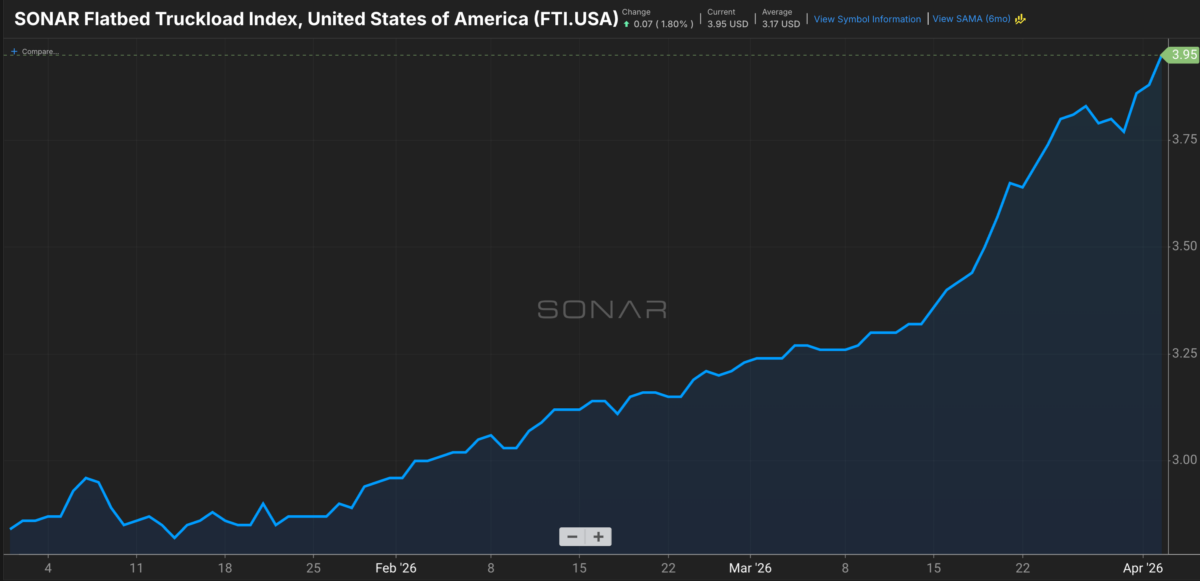
SONAR’s National Truckload Index (NTI.USA) — the seven-day moving average of booked dry van spot rates (fuel included) — provides additional depth, showing rates breaking out to new cycle highs in the $3.10 per mile on Friday, the strongest levels since March 2022. Flatbed was even more robust (FTI.USA) hitting the highest levels ever recorded at $3.95 per mile. This spot market strength underscores accelerating carrier pricing power and tightening capacity in the for-hire truckload sector.
Further support for improving freight demand comes from the American Trucking Associations (ATA) For-Hire Truck Tonnage Index, which surged 2.6% in February to 116.2 (2015=100) — its highest level in three years. The index also rose 2.1% year-over-year, the largest annual gain since October 2022. The ATA surveys its own carrier members, who tend to haul more shipper-direct (contract) freight than spot market freight, providing a valuable read on committed, longer-term volumes that often move ahead of spot market trends.
This tightness in flatbed markets — which move heavy industrial goods, steel, building materials, machinery, and construction inputs — aligns closely with the rail report’s signals of improving manufacturing. The ISM Manufacturing PMI® reached 52.7% in March (its highest in more than three years), and output rose 1.3% year-over-year in February. Factors such as data center construction, seasonal construction ramp-up, and broader industrial rebound appear to be driving sustained demand for flatbed capacity.

Further confirmation comes from Bank of America’s proprietary bi-weekly Truckload Demand Indicator from its shipper survey. The indicator rose to 60.2 in the latest reading (up from 57.9), marking an 18% increase year-over-year and signaling solid underlying demand for freight heading into the spring shipping season. BoA’s shipper survey, which has tracked the market since 2012, adds strong shipper-level validation to the improving rail and flatbed trends.
FreightWaves SONAR now delivers the most comprehensive view of freight markets through its new rail data dashboard, which features both bulk rail and intermodal volumes. The bulk rail dashboard is specifically designed to give subscribers the most complete picture of freight markets by integrating high-frequency AAR rail data with SONAR’s proprietary truckload, intermodal, and market indices. This allows users to get a comprehensive view of the industrial economy. Visit GoSONAR.com for a trial.

Together, the strong rail carload performance (especially ex-coal and in chemicals), record capital goods imports, elevated flatbed activity, positive shipper sentiment from the BoA survey, ATA tonnage gains, robust spot market load volume from Truckstop.com/FTR and SONAR’s NTI, and SONAR’s integrated rail insights paint a consistent picture: the industrial sector is showing genuine resilience and early signs of expansion heading into Q2.
The AAR Freight Rail Index (FRI) supports this view, with average Q1 levels reaching their highest in nearly five years, pointing to steady expansion in freight-intensive sectors such as manufacturing, construction inputs, and export-oriented production.
Outlook
Manufacturing activity is improving, with the ISM Manufacturing PMI® at its highest reading in more than three years. Rail traffic, flatbed markets, ATA tonnage, BoA shipper sentiment, spot market load volume strength, capital goods import trends, and SONAR’s new rail data dashboard are converging to confirm that industrial demand is strengthening.
For shippers, carriers, and analysts, these signals from rail carloads and flatbed trucking — all accessible in one integrated platform on SONAR — provide high-frequency confirmation of a broadening industrial recovery as we move into the second quarter.
Brokerage Compliance Symposium
The day before F3. Every compliance issue you face - fraud exposure, carrier liability, FMCSA rules, cargo theft, insurance gaps - navigated by attorneys and operators defining best practices in a changing industry.
F3 Awards Dinner
The night before F3. FreightTech100 companies honored. FreightTech 25 and Shipper of Choice winners revealed live. Cocktail reception into dinner and live music - 300 industry leaders in one purpose-built room.
F3: Future of Freight Festival
Industry-defining keynotes, rapid-fire technology demos, and industry leaders networking in experiences across Chattanooga - plus the inaugural F3 Awards Dinner featuring the FreightTech and Shipper of Choice reveals.
The day before F3. Every compliance issue you face - fraud exposure, carrier liability, FMCSA rules, cargo theft, insurance gaps - navigated by attorneys and operators defining best practices in a changing industry.
The Signal at Chattanooga Choo Choo • Chattanooga, TN Register NowThe night before F3. FreightTech100 companies honored. FreightTech 25 and Shipper of Choice winners revealed live. Cocktail reception into dinner and live music - 300 industry leaders in one purpose-built room.
The Signal at Chattanooga Choo Choo • Chattanooga, TN Register NowIndustry-defining keynotes, rapid-fire technology demos, and industry leaders networking in experiences across Chattanooga - plus the inaugural F3 Awards Dinner featuring the FreightTech and Shipper of Choice reveals.
The Signal at Chattanooga Choo Choo • Chattanooga, TN Register Now