




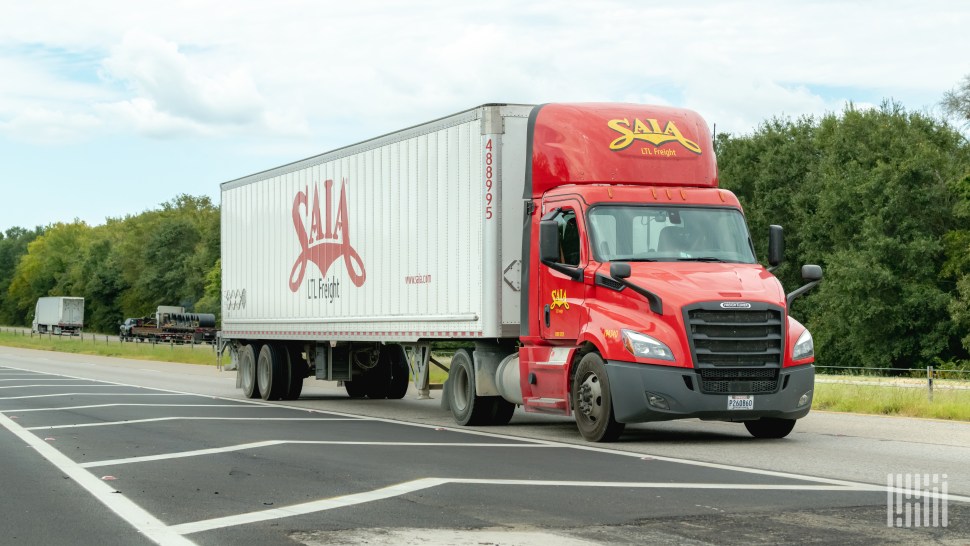
Less-than-truckload carrier Saia is leaning on cost controls and efficiency initiatives across an expanded terminal network to bridge the gap to an eventual recovery.
The Johns Creek, Georgia-based company reported third-quarter adjusted earnings per share of $2.81 on Thursday, which was 25 cents ahead of the consensus estimate but 65 cents lower year over year. The adjusted number excluded a one-time real estate gain of $14.5 million.
(Higher interest expense from debt incurred to fund terminal purchases and a slightly higher tax rate combined for a 6-cent drag on the period.)

Saia’s (NASDAQ: SAIA) revenue was down just slightly y/y to $840 million, but came in $11 million better than the consensus estimate. Tonnage declined 1.5% y/y and revenue per hundredweight, or yield, was flat, excluding fuel surcharges.
On a y/y comparison, Saia’s tonnage deteriorated throughout the quarter. After logging a 0.9% increase in July, tonnage fell 2.2% and 3.3% in August and September, respectively.
October tonnage is down 4% y/y, with management noting on a call with analysts that the first couple of weeks of the month were a little weaker than normal. Knight-Swift Transportation (NYSE: KNX) voiced similar commentary about the first half of October when it reported results last week.
Saia’s monthly tonnage declines were against tough prior-year comps, ranging from plus-5% to plus-10%.
Daily shipments were down 2% y/y but increased 3% from the second quarter. Both its new and legacy terminals saw sequential improvement.
Shipments per day were up 4.2% sequentially at the 39 terminals it opened since the beginning of 2022. Legacy terminals saw a 3% sequential increase in shipments. Approximately 70% of the volume growth occurred in 1-day and 2-day lanes, with two-thirds of the wins coming from existing customers.
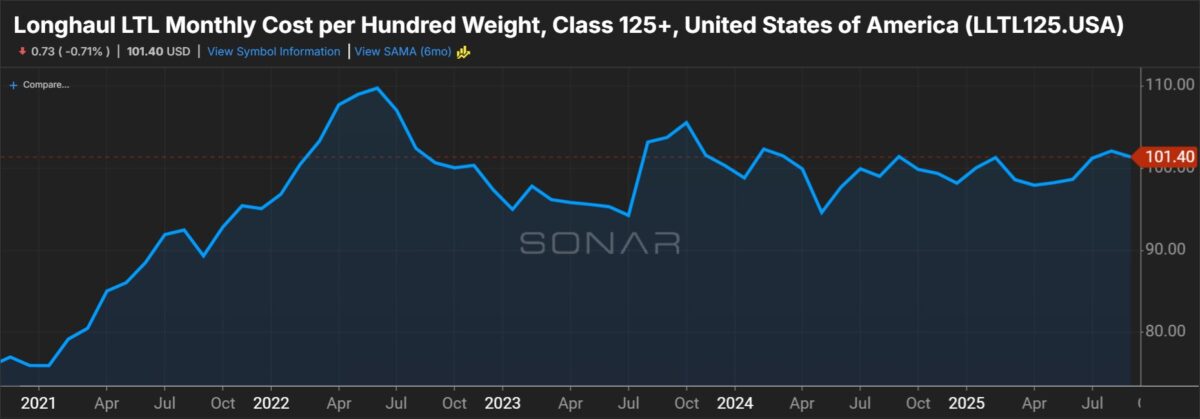
Management countered questions around flattish yields on the call, saying the pricing environment “remains very rational.” It pointed to contractual rate increases averaging 5.1% in the quarter and a new 5.9% general rate increase that was implemented on Oct. 1.
The company reported an 87.6% adjusted operating ratio (inverse of operating margin), which was 250 bps worse y/y but 20 bps better than the second quarter. The result was ahead of management’s guidance (100 bps of sequential deterioration) and normal seasonality (100 to 200 bps of degradation).
Adjusted cost per shipment was up 4.6% y/y and just slightly offset by a 0.9% increase in revenue per shipment (a 370-bp negative spread).
The new terminals reported 100 bps of sequential OR improvement in the quarter and are now operating below a 95% OR on average.
Salaries, wages and benefits expenses (as a percentage of revenue) increased 50 bps y/y. Headcount was down 3% y/y in the quarter. Saia implemented an annual wage increase of 3% on Oct. 1.
The company normally sees 250 to 350 bps of margin degradation from the third quarter to the fourth quarter, but management said the OR will likely be off by 300 to 400 bps this year due to the subseasonal demand trends. That implies a 91.1% OR (at the midpoint), 400 bps worse y/y, and tied for its worst operating since the pandemic. (Saia reported a 91.1% OR in the 2025 first quarter.)
Shares of Saia were up 1.6% at 3:10 p.m. EDT on Thursday compared to the S&P 500, which was down 0.7%.
Brokerage Compliance Symposium
The day before F3. Every compliance issue you face - fraud exposure, carrier liability, FMCSA rules, cargo theft, insurance gaps - navigated by attorneys and operators defining best practices in a changing industry.
F3 Awards Dinner
The night before F3. FreightTech100 companies honored. FreightTech 25 and Shipper of Choice winners revealed live. Cocktail reception into dinner and live music - 300 industry leaders in one purpose-built room.
F3: Future of Freight Festival
Industry-defining keynotes, rapid-fire technology demos, and industry leaders networking in experiences across Chattanooga - plus the inaugural F3 Awards Dinner featuring the FreightTech and Shipper of Choice reveals.
The day before F3. Every compliance issue you face - fraud exposure, carrier liability, FMCSA rules, cargo theft, insurance gaps - navigated by attorneys and operators defining best practices in a changing industry.
The Signal at Chattanooga Choo Choo • Chattanooga, TN Register NowThe night before F3. FreightTech100 companies honored. FreightTech 25 and Shipper of Choice winners revealed live. Cocktail reception into dinner and live music - 300 industry leaders in one purpose-built room.
The Signal at Chattanooga Choo Choo • Chattanooga, TN Register NowIndustry-defining keynotes, rapid-fire technology demos, and industry leaders networking in experiences across Chattanooga - plus the inaugural F3 Awards Dinner featuring the FreightTech and Shipper of Choice reveals.
The Signal at Chattanooga Choo Choo • Chattanooga, TN Register Now