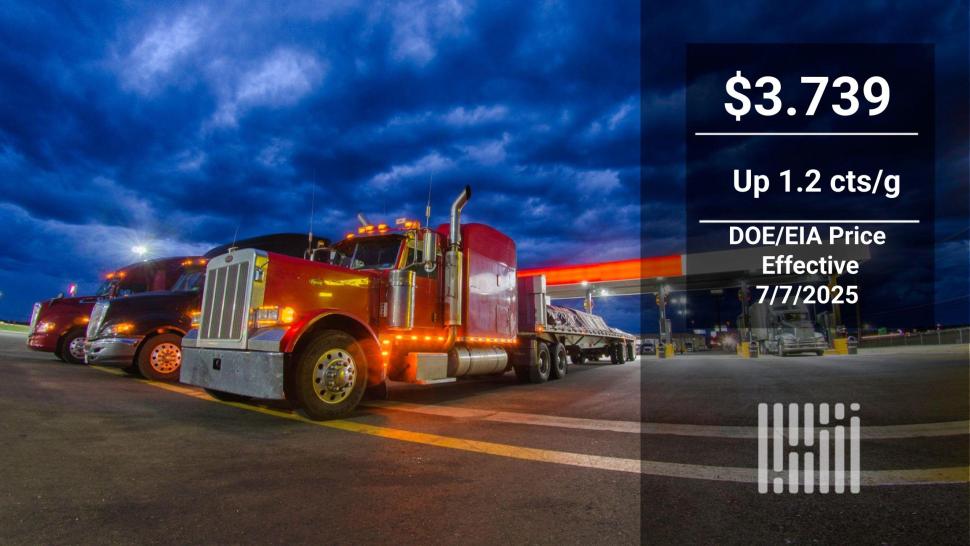
The benchmark price used for most fuel surcharges rose this week, resuming an upward trend that broader markets appear to believe have some more room to rise.
The weekly Department of Energy/Energy Information Administration average weekly retail diesel price rose 1.2 cents/gallon effective Monday, announced Tuesday, to $3.739/g. It’s the fourth increase in the last five weeks, with the price effective June 30, a week ago, posting a decline in that stretch.
While broad market forecasts continue to show an oil surplus in the second half of 2025, the OPEC+ group this past weekend acted as if the supply/demand balance was calling for more oil to be put on the market, and that’s what it did.
A subset of the OPEC+ group met virtually Saturday and agreed to add 548,000 barrels/day of oil back on to the market in August. That the group was going to increase its supply was a foregone conclusion.
But market analysts expected the OPEC+ group to add just another 411,000 b/d increase, which has been the size of the increases the group has been approving for several months.
The increases have been an unwinding of a series of cuts in output that the OPEC+ group–which consists of OPEC and a group of non-OPEC oil exporters nominally led by Russia–had in place since 2023.
The increases are the opposite of what might be expected given the forecasts of a supply/demand imbalance that favors buyers.
In the most recent monthly report of the International Energy Agency, the IEA said “in the absence of a major disruption, oil markets in 2025 look well supplied.”
The IEA spelled out a scenario in which global oil demand was expected to increase just 720,000 bd this year. The increase for July and August alone would cover that higher demand.
Despite the larger than expected increase in supply coming out of OPEC+, oil markets came out the weekend with a sharp increase. Ultra low sulfur diesel on the CME commodity exchange rose 5.13 cts/g to $2.4211/g, having climbed 11.39 cts/g since June 27. However, prices have not regained the highs that accompanied the early days of the fiercest fighting between Iran and Israel in mid-June.
Crude and diesel prices on CME were slightly higher in early trade Tuesday.
In a separate action, according to news agencies, Saudi Arabia announced an increase in its price formula for August sales that reflected a belief in a strong market.
Saudi crude pricing is calculated as a differential against key benchmarks, such as Brent for European sales and a basket of crudes in the U.S. The differential moves up and down in decisions announced by the Saudis a month in advance and are looked to by the broader market as a sign of how the Kingdom views strength in demand.
The other factor continuing to drive diesel prices higher, at a rate faster than changes in crude markets, remains global inventories. In an article published Monday, Bloomberg quoted the energy analysis firm of Energy Aspects which said in June, diesel output as a percentage of total products output globally was 31.4%, which it said is significantly less than normal levels.
That can be seen in the spread between ULSD and Brent on CME. A comparison of the front month produces a spread that has settled at more than 70 cts/g for the last five trading days. At the start of June, it was just over 50 cts/g.
More articles by John Kingston
XPO rating cut by S&P, agency cites continuing weak freight market
Two positive votes on logistics at Moody’s: GXO and C.H. Robinson
Brokerage Compliance Symposium
The day before F3. Every compliance issue you face - fraud exposure, carrier liability, FMCSA rules, cargo theft, insurance gaps - navigated by attorneys and operators defining best practices in a changing industry.
F3 Awards Dinner
The night before F3. FreightTech100 companies honored. FreightTech 25 and Shipper of Choice winners revealed live. Cocktail reception into dinner and live music - 300 industry leaders in one purpose-built room.
F3: Future of Freight Festival
Industry-defining keynotes, rapid-fire technology demos, and industry leaders networking in experiences across Chattanooga - plus the inaugural F3 Awards Dinner featuring the FreightTech and Shipper of Choice reveals.
The day before F3. Every compliance issue you face - fraud exposure, carrier liability, FMCSA rules, cargo theft, insurance gaps - navigated by attorneys and operators defining best practices in a changing industry.
The Signal at Chattanooga Choo Choo • Chattanooga, TN Register NowThe night before F3. FreightTech100 companies honored. FreightTech 25 and Shipper of Choice winners revealed live. Cocktail reception into dinner and live music - 300 industry leaders in one purpose-built room.
The Signal at Chattanooga Choo Choo • Chattanooga, TN Register NowIndustry-defining keynotes, rapid-fire technology demos, and industry leaders networking in experiences across Chattanooga - plus the inaugural F3 Awards Dinner featuring the FreightTech and Shipper of Choice reveals.
The Signal at Chattanooga Choo Choo • Chattanooga, TN Register Now