




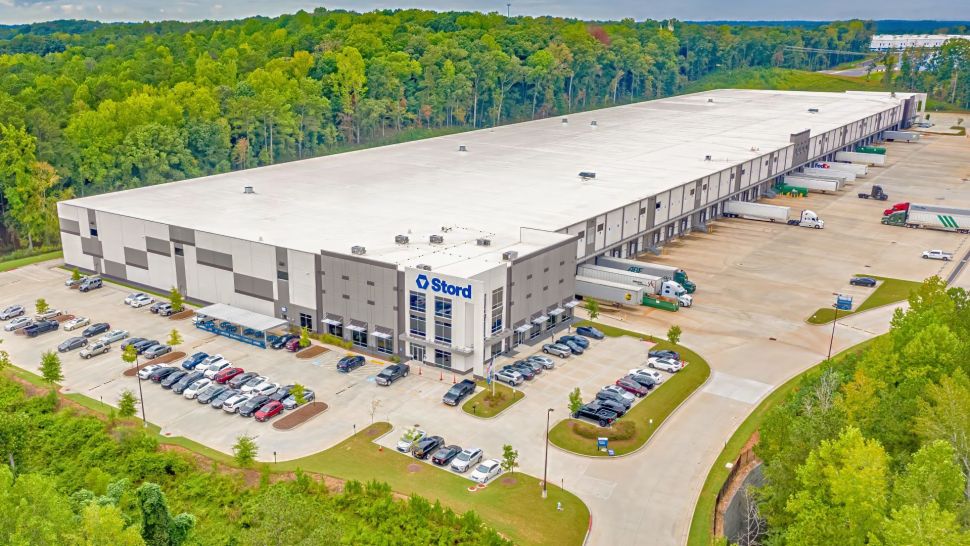
Fast-growing e-commerce logistics specialist Stord announced Tuesday it has raised $250 million in late-stage venture capital funding that values the company at $3 billion and will be used for rapid development of artificial intelligence and robotics technology so smaller brands can better compete with retail giants like Amazon.
The Series F funding round brings the total amount raised by Stord since its 2015 founding to more than $775 million, doubling the company’s value in 12 months. The large funding round was led by Strike Capital, along with other existing investors, and could mean the company is preparing for an initial public offering.
Stord manages e-commerce inventory for more than 1,000 customers, primarily small-to-medium direct-to-consumer merchants like AGI, True Classic, and Native, but also enterprise-level clients. Services include online checkout, fulfillment, last-mile delivery and returns, with a technology platform that manages inventory, order processing, warehouse pick-and-pack and parcel carrier selection.
The company has made eight acquisitions in the past six years — a large number for a startup — including Ware2Go from UPS and Penny Black, a startup software-as-a-service solution that provides hyper-personalized post-purchase inserts, in 2025 and Shipwire from Ceva Logistics in January. The logistics provider also bought a former Quiet Logistics warehouse this year to expand its footprint in the Dallas market.
Analysts say Atlanta-based Stord has attracted investors and a high valuation because it has been able to position itself as a technology company that uses software to orchestrate e-commerce fulfillment services from a dozen regional warehouses and an expanded network of partner facilities.
Stord’s thesis is that e-tailers are moving away from stitching together disparate third-party logistics providers, carriers and software systems and instead seek integrated platforms that unify technology with physical fulfillment to deliver the speed, reliability and transparency customers demand. These companies prefer not to use Amazon fulfillment because they want to control the customer relationship and data, and generate higher margins.
“For years, every independent brand has been left to figure out on their own how to compete against the consumer experience Amazon has spent decades and hundreds of billions building. By every measure, independent brands have been losing. Stord exists to level that playing field,” said co-founder and CEO Sean Henry in a news release. “We give independent brands the complete commerce stack: the fulfillment network, software, and AI, to deliver a consumer experience that surpasses Prime. Our vertical integration and scaled network create compounding advantages that deliver better, faster, cheaper outcomes with every order we touch.”

The new funds will go towards launching Stord Labs, a development hub that aims to rapidly build, validate and deploy agentic AI, robotics and advanced automation by leveraging data from real orders coming through the company’s live operating system instead of relying on generic AI, and expanding the fulfillment network. Stord says its physical infrastructure, combined with vertically integrated technology and a massive and growing dataset will allow it to train models on live fulfillment data across nearly 100 facilities, leapfrogging normal technology deployment cycles and making the network smarter, faster and cheaper to operate than.
In March, Stord significantly expanded its AI platform, adding chat, search and a personalized intelligence stream to its smart offerings. The interconnected AI assistants give e-commerce brands the tools to make accurate decisions with real transactional data, it said. Chat, for example, is a conversational AI assistant embedded directly into the Stord platform. It connects to every layer of operational data including orders, inventory, shipments, carrier events, routing logic, compliance rules, and historical performance and synthesizes answers in seconds that would otherwise take teams hours or days of cross-referencing reports, exporting spreadsheets, and scheduling meetings.
Queries brands can run include, “Why was order #482901 delayed and what carrier was responsible?” or “Which SKUs are trending toward stockout this week?”
Stord says revenue has grown by a factor of 10 over the past four years. As a private company, it hasn’t publicly disclosed its actual revenue, but database GetLatka put last year’s revenue at nearly $150 million. Stord instead touts that the gross merchandise value of goods fulfilled through its platform is $15 billion, a 50% jump since late last year.
The company says faster growth closely followed the launch of ChatGPT. In 2024, Stord expanded its Stord One Warehouse software and shifted from being primarily a logistics operator to a full-fledged supply chain technology vendor for businesses that have their own warehouse capacity. The company’s software business tripled last year and is growing faster than the overall business, with new bookings in the first quarter more than doubling from the prior quarter.
“We believe the rise of agentic purchasing will increasingly favor platforms where software and physical operations are deeply integrated. Stord is building that infrastructure,” said John Lagomarisino, a partner at Strike Capital.
Other Stord investors include Kleiner Perkins, Founders Fund, Franklin Templeton, Baille Gifford, G Squared and Bond
Eric Pong, logistics partnership director at AfterShip who writes on Substack as the Ecommerce Logistician, says the experience of logistics hybrids such as Flexport (freight forwarding), Convoy (truck brokerage) and Deliverr (fulfillment) should serve as a cautionary tale for Stord investors.
“Using money to buy growth and market share is not sustainable. At some point growth decelerates, and once the allure of being a high growth tech startup vanishes, valuations come crashing down to earth,” he said in a May 5 column. Flexport, for example, reached a peak valuation of $8 billion in 2022 and now is estimated to be worth $2 billion.
Stord’s “strategy is working for now,” he said, “but growth through acquisitions rooted in valuation arbitrage and dependent on further fundraising is risky. Every acquisition adds revenue, but also adds operational complexity, integration risk and makes it look less like the pure tech play that justifies its valuation premium. At some point, investors may just see a logistics company with in-house tech and price it accordingly.”
Click here for more FreightWaves/American Shipper stories by Eric Kulisch.
Write to Eric Kulisch at ekulisch@freightwaves.com.
RELATED STORIES:
Quiet Logistics dismantling continues with warehouse, customer transfer to Stord
Stord buys e-commerce specialist Shipwire from Ceva Logistics
Brokerage Compliance Symposium
The day before F3. Every compliance issue you face - fraud exposure, carrier liability, FMCSA rules, cargo theft, insurance gaps - navigated by attorneys and operators defining best practices in a changing industry.
F3 Awards Dinner
The night before F3. FreightTech100 companies honored. FreightTech 25 and Shipper of Choice winners revealed live. Cocktail reception into dinner and live music - 300 industry leaders in one purpose-built room.
F3: Future of Freight Festival
Industry-defining keynotes, rapid-fire technology demos, and industry leaders networking in experiences across Chattanooga - plus the inaugural F3 Awards Dinner featuring the FreightTech and Shipper of Choice reveals.
The day before F3. Every compliance issue you face - fraud exposure, carrier liability, FMCSA rules, cargo theft, insurance gaps - navigated by attorneys and operators defining best practices in a changing industry.
The Signal at Chattanooga Choo Choo • Chattanooga, TN Register NowThe night before F3. FreightTech100 companies honored. FreightTech 25 and Shipper of Choice winners revealed live. Cocktail reception into dinner and live music - 300 industry leaders in one purpose-built room.
The Signal at Chattanooga Choo Choo • Chattanooga, TN Register NowIndustry-defining keynotes, rapid-fire technology demos, and industry leaders networking in experiences across Chattanooga - plus the inaugural F3 Awards Dinner featuring the FreightTech and Shipper of Choice reveals.
The Signal at Chattanooga Choo Choo • Chattanooga, TN Register Now