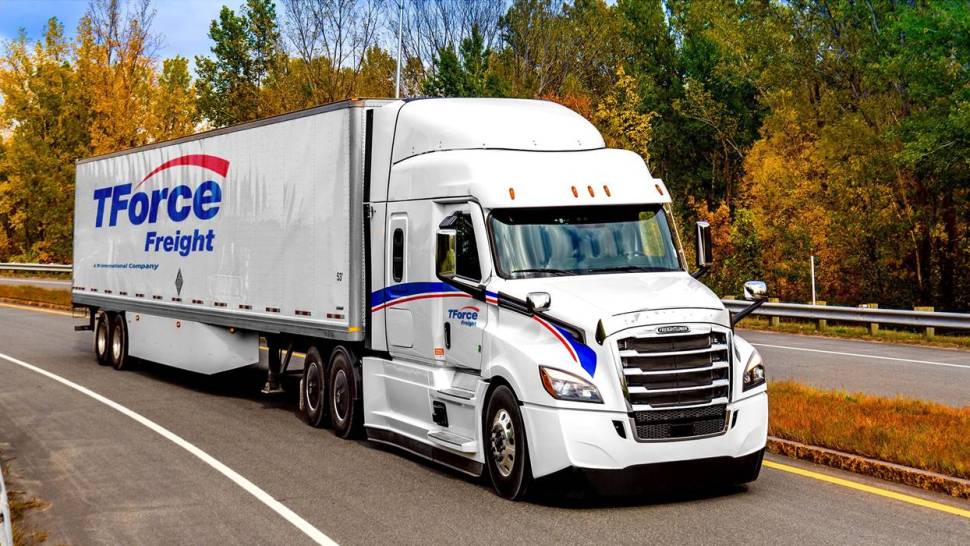
(A summary of the financial performance of TFI can be found here.)
Even as the quarterly comparisons to 2024 were mostly negative, TFI International CEO Alain Bedard used his earnings conference call with analysts Friday to offer a solidly positive view of his company, and a strong outlook into 2026.
He doesn’t always do that; Bedard has been known to be blunt in assessing issues faced at TFI, particularly in its U.S. LTL operations which were built off the back of the acquisition of UPS Freight in 2021.
While most of the year-to-year comparisons were negative, the company’s U.S. LTL operating ratio (OR) of 92.2% was flat from a year ago and sequentially improved from the second quarter OR in that segment of 94%.
Bedard also noted that total LTL operating income for the company–Canadian and U.S. combined–was $78 million which was up sequentially from the second quarter figure of $73.5 million. However, that was down from $96 million in 2024’s second quarter.
While the overall outlook was positive, Bedard was pessimistic about the fourth quarter, which was already one-third in the books when he held the TFI earnings call. He said the company expects a deterioration in OR of 200 to 300 basis points “because of this slow volume environment,” citing the U.S. government shutdown as one reason for the weak market.
Tax bill seen as a boost
But in a theme that has come up in freight markets recently, Bedard said he expects the impact of the Big Beautiful Bill to be positive in TFI’s markets next year “The consumer will probably get some tax refunds, the investment that will probably take place in the U.S. industrial sector, we feel way way better about ‘26 than what we went through about 2025,” he said, according to a transcript of the earnings call.
Bedard also touted the management of the LTL group. “The new team is really all hands on deck,” he said. “We’ve been working on our costs. We’ve also been working and improving our service.” Bedard also touted how TFI did in the recently-released Mastio report, which he said confirmed greater customer satisfaction.
Bedard was open about where TFI’s service still has room for improvement. He said next-day service is “up to par” compared to its peers.
“Where we still have issues is second day and third-day service and the guys are working actively on that,” Bedard said. “We are improving. We’re not where we should be, but that is really the goal, to get this up to our peers on the second and third day service.”
In response to a question from Morgan Stanley’s Ravi Shanker, Bedard said TFI has “fixed” its small to medium-sized business segment. “We lost too much of that in ‘24,” Bedard said.
Bedard spoke of other improvements in the U.S. LTL sector. Sending out freight without fully knowing who was going to be paying was a problem in the past, Bedard said. “We hold on to the freight now until we know who actually is going to be paying that bill,” he said.
TFi fleet operations in the past might see a truck stuck for 80+ hours in a shop. “Now we’re down to about 45 hours,” Bedard said. He described that as “still too much,” but was a positive development.
Claims ratio still an issue
The claims ratio of 0.7%, which has long been a problem lamented by Bedard on earnings calls, continues to be excessive by industry standards. “ So now we have a team that focuses on that day in, day out in trying to get that 0.7% down to a more normal level,” Bedard said.
Bedard, as he has done before, touted TFI’s performance in generating free cash flow. It resulted in something relatively infrequent in trucking recently: a dividend increase. TFI took the occasion of the quarterly earnings to announce a 2% increase in its quarterly dividend, to 27 cents.
In a market featuring layoffs, Bedard made comments about the company’s workforce that would have been soothing to any employees. He’s not in favor of big reductions.
The financial performance might be better if there were reductions in the size of the workforce, he said. As an example, Bedard cited the truckload operations and a loss of steel business from Canada to the U.S., which he said is “dead for us.”
“So what do you do?” Bedard asked rhetorically. “We have those trucks parked and we have those drivers at home because that’s the only thing we could do.”
But things will change at some point, and that’s what Bedard said TFI is planning for. “We have to protect our staff because the problem is when this business gets back on track, you don’t want have to rehire drivers and at the same time, also rehire the staff.” he said.
Other notable Bedard observations during the call:
- He predicted full autonomy for trucks in ten years. “When you think about that, all the edge that a nonunion carrier has versus a union carrier will probably disappear,” he said. The former UPS Freight operations are unionized by the Teamsters. He hedged and said such a move to autonomy could take 15 years.
- The year-to-year stability in the U.S. LTL OR came despite a 10.4% drop in revenue, to $429.6 million. “That tells you the heavy lifting that our guys are doing today and becoming more process-oriented,” Bedard said.
- TFI was built on the back of acquisitions. Bedard has boasted about the company’s balance sheet early in the call, and said in 2026, TFI “hopefully” might make an acquisition, “but it’s always difficult to do a deal when the target doesn’t want to sell.” The best use of cash flow at TFI has been to buy back its stock, Bedard said. “But now things could change with this macro environment, and maybe it’s best to put the buyback on hold for now,” he said.
More articles by John Kingston
DAT execs in two forums discuss how it seeks to reshape the freight sector
NMFTA’s freight classification overhaul: surprising shipper preparedness
Beautiful women, open doors and drivers: trucking cybersecurity risks proliferate
Brokerage Compliance Symposium
The day before F3. Every compliance issue you face - fraud exposure, carrier liability, FMCSA rules, cargo theft, insurance gaps - navigated by attorneys and operators defining best practices in a changing industry.
F3 Awards Dinner
The night before F3. FreightTech100 companies honored. FreightTech 25 and Shipper of Choice winners revealed live. Cocktail reception into dinner and live music - 300 industry leaders in one purpose-built room.
F3: Future of Freight Festival
Industry-defining keynotes, rapid-fire technology demos, and industry leaders networking in experiences across Chattanooga - plus the inaugural F3 Awards Dinner featuring the FreightTech and Shipper of Choice reveals.
The day before F3. Every compliance issue you face - fraud exposure, carrier liability, FMCSA rules, cargo theft, insurance gaps - navigated by attorneys and operators defining best practices in a changing industry.
The Signal at Chattanooga Choo Choo • Chattanooga, TN Register NowThe night before F3. FreightTech100 companies honored. FreightTech 25 and Shipper of Choice winners revealed live. Cocktail reception into dinner and live music - 300 industry leaders in one purpose-built room.
The Signal at Chattanooga Choo Choo • Chattanooga, TN Register NowIndustry-defining keynotes, rapid-fire technology demos, and industry leaders networking in experiences across Chattanooga - plus the inaugural F3 Awards Dinner featuring the FreightTech and Shipper of Choice reveals.
The Signal at Chattanooga Choo Choo • Chattanooga, TN Register Now