




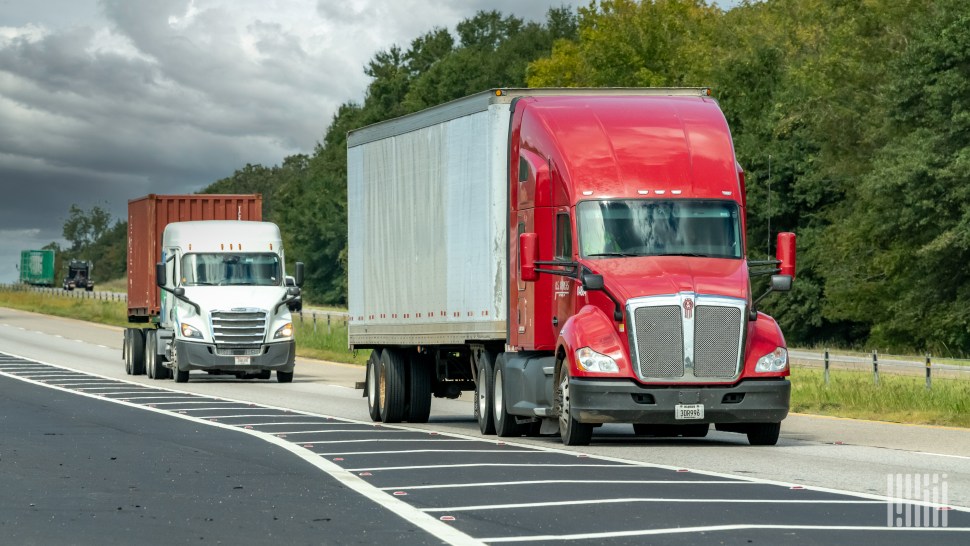
Truckload and less-than-truckload rate indexes established fresh highs in the second quarter as the freight industry recovers from a nearly four-year downturn. Rates are expected to continue to move up and to the right in the third quarter, according to a Tuesday report from 3PL AFS Logistics and financial services firm TD Cowen.
Supply-side correction favors large TL carriers
Truckload rates hit a cycle high during the second quarter and are expected to step higher in the third quarter.
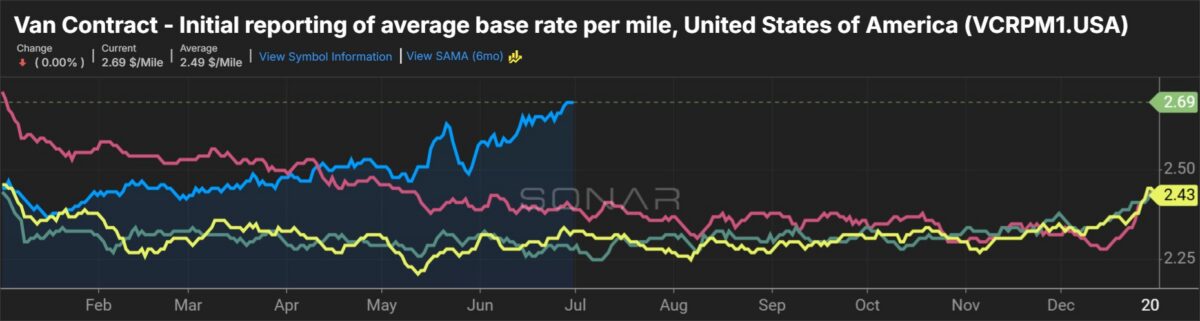
Capacity constraints and a surge in diesel fuel prices pushed the TL rate-per-mile component of the TD Cowen-AFS Freight Index to a 14-quarter high. The second-quarter rate-per-mile reading came in 16% above the January 2018 baseline. That was up 6.6 percentage points from the first quarter and 10.1 points higher year over year.
The index is expected to increase to a level that is 17.7% above the baseline in the third quarter. That would be 11.7 points higher y/y.
The report said more than 48,000 non-compliant drivers have been forced out of the industry over the past year. It also said small carriers may be sitting on the sidelines due to still-depressed economics and fuel price headwinds. (Most small carriers struggle to recoup rising fuel costs through surcharge programs.)
“Smaller truckload carriers working on tight margins may park trucks and wait for fuel prices to revert to more palatable levels before returning to operation, further restraining capacity amid a supply-side market correction,” said AFS Logistics CEO Andy Dyer.
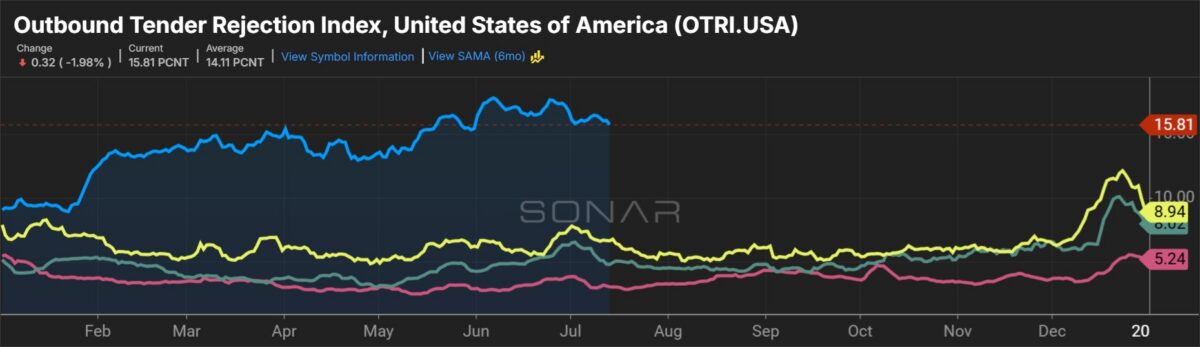
Appearing at an investor conference last month, public carrier management teams said mini-bid activity has spiked as routing guides crumble. They said contractual rates set with shippers early in the 2026 bid season proved too low. The carriers are now eyeing double-digit contractual rate increases this year and next to restore margins.
The Tuesday data showed TL linehaul cost per shipment increased 3.1% sequentially in the second quarter even though miles per shipment fell 1.8%. The report noted an increase in shipments of 500 miles or less, as some longer-haul moves were lost to cheaper intermodal options.
Accelerated GRI schedule signals LTL carrier pricing power
A steady drumbeat of contractual rate increases along with higher fuel prices pushed the LTL rate-per-pound component of the index to an all-time high in the second quarter. Large public carriers are also taking general rate increases earlier in the year given favorable market fundamentals.
The index stood 76.5% above the 2018 baseline in the second quarter. That was 9.6 points higher sequentially and 13.3 points higher than the year-ago level. Fuel surcharges captured by the dataset were more than 60% above the June 2025 benchmark during the period, as retail diesel prices were 51% higher y/y. (Less-than-truckload fuel surcharge mechanisms include a step function as diesel prices rise, typically resulting in margin accretion.)
The index is expected to increase 30 basis points sequentially in the third quarter, which would be nearly 10 points higher y/y.
“Q2 showed that carriers’ pricing strategies include the ability to not only secure rate increases and strategically valuable volumes, but capture volatile fuel costs,” said Mich Fabriga, vice president of LTL pricing at AFS Logistics.
General rate increases (GRIs), which usually apply to one-quarter of carrier shipments, have again been pulled forward from a typical annual cadence.
ArcBest (NASDAQ: ARCB) implemented a 5.9% GRI on June 22. The increase was flat y/y but installed approximately six weeks ahead of the 2025 rate hike. Saia (NASDAQ: SAIA) implemented a 7.1% GRI on July 6. The increase was 120 bps higher and 3 months earlier than last year’s bump.
The report showed LTL cost per shipment was up 0.7% sequentially in the second quarter even though weight per shipment fell 4.8%. Elevated fuel prices were behind the increase in costs.
Public carriers reported y/y increases in weight per shipment during April and May. XPO (NYSE: XPO) was the outlier, but the company’s freight mix now includes more shipments from SMBs, which tend to have lower shipment weights but better margins.
The heavier shipment weights are due to weak prior-year comps and as some freight lost to a depressed TL market comes back. Also, industrial activity improved for a sixth consecutive month in June, according to manufacturing data released by the Institute for Supply Management. The data typically leads LTL volumes by a few months, as roughly two-thirds of carrier revenue is tied to industrial output.
(Two-year-stacked tonnage comparisons, which smooth out prior-year volatility, turned positive for public LTL carriers in May following a prolonged downturn.)
The report flagged FedEx Freight’s (NYSE: FDXF) narrowed commercial focus as a standalone entity and Amazon’s (NASDAQ: AMZN) full entry into LTL as potential headwinds for pricing.
The second-quarter earnings season begins Wednesday when J.B. Hunt Transport Services (NASDAQ: JBHT) reports after the market closes.
AFS Logistics is a non-asset-based 3PL providing audit and cost management services, managed transportation, and freight brokerage. It has visibility into more than $39 billion in annual freight spend.
Brokerage Compliance Symposium
The day before F3. Every compliance issue you face - fraud exposure, carrier liability, FMCSA rules, cargo theft, insurance gaps - navigated by attorneys and operators defining best practices in a changing industry.
F3 Awards Dinner
The night before F3. FreightTech100 companies honored. FreightTech 25 and Shipper of Choice winners revealed live. Cocktail reception into dinner and live music - 300 industry leaders in one purpose-built room.
F3: Future of Freight Festival
Industry-defining keynotes, rapid-fire technology demos, and industry leaders networking in experiences across Chattanooga - plus the inaugural F3 Awards Dinner featuring the FreightTech and Shipper of Choice reveals.
The day before F3. Every compliance issue you face - fraud exposure, carrier liability, FMCSA rules, cargo theft, insurance gaps - navigated by attorneys and operators defining best practices in a changing industry.
The Signal at Chattanooga Choo Choo • Chattanooga, TN Register NowThe night before F3. FreightTech100 companies honored. FreightTech 25 and Shipper of Choice winners revealed live. Cocktail reception into dinner and live music - 300 industry leaders in one purpose-built room.
The Signal at Chattanooga Choo Choo • Chattanooga, TN Register NowIndustry-defining keynotes, rapid-fire technology demos, and industry leaders networking in experiences across Chattanooga - plus the inaugural F3 Awards Dinner featuring the FreightTech and Shipper of Choice reveals.
The Signal at Chattanooga Choo Choo • Chattanooga, TN Register Now