




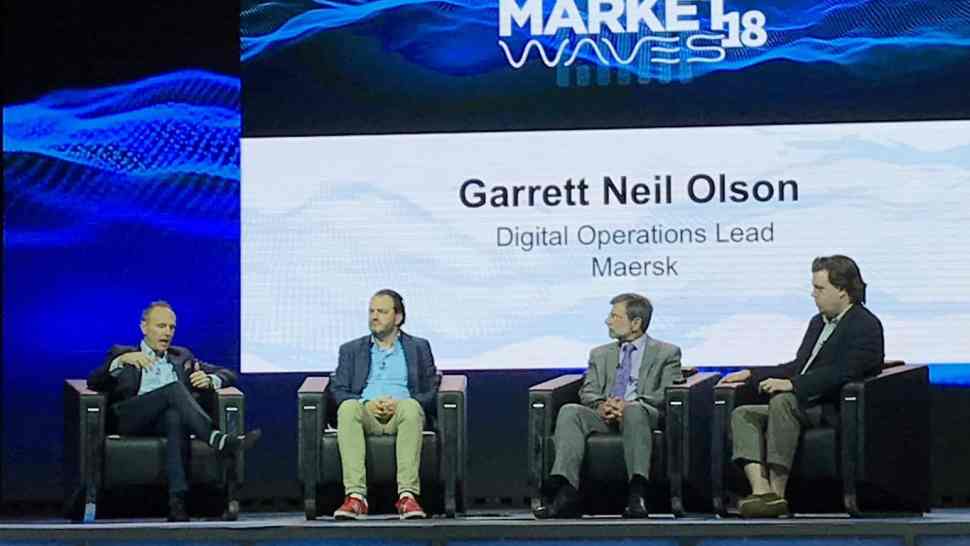
Economist and journalist Marc Levinson kicked off a MarketWaves 2018 panel discussion about global trade impacts on freight with a Power Point showing high inventory levels as shippers stock up in response to supply chain risks.
International maritime businesses should prepare for slower growth, he said. “We went through a period of 30 years when growth of shipping was 2-3 times the growth in international economy. I don’t think those times are coming back.”
The news is not all bad. Pressure to simplify supply chains is mounting as trade costs surge. Manufacturers are moving production back to this hemisphere, and reintegrating vertically. “That bodes well for truck freight,” Levinson said.
Philip von Mecklenburg-Blumenthal, vice president of enterprise solutions, Freightos, pointed to the “huge bubble” in container rates in cargo coming from China to the U.S. Tariffs are contributing to price surges, but the bubble will likely pop. “We see a wave coming and probably a slump.”
In its time, the container revolutionized international trade by commoditizing maritime capacity, said moderator JP Hampstead, of Freightwaves. How will digitization alter the economics of international trade?
Technology efficiencies like cargo tracking data services can help differentiate Maersk from competitors and compensate for the slowdown, answered Garrett Neil Olson, Maersk. “Margins are not going to rebound, so removing waste throughout the supply chain is critical.”
Smart data solutions also put more control in the hands of the customer. That’s critical to drive the industry forward but also creates other expectations, as customers now want to know such details as how long the container has been sitting in terminal and how long it’s been on the truck.
Plus, knowing where your container is in every part of the world is not a cheap proposition. “It requires satellites, governments, a lot of different entities,” Olson said.
It’s important to co-invest with certain customers on solutions, he said. “We’re taking a pragmatic approach, focusing on ambition and expertise segments first.”
Containerization converted shipping from a labor intensive to capital intensive industry, Levinson said. “The major cost of shipping goods used to be workers on docks. That’s all gone.” Today, shippers have to buy a ship “for $150 million a pop and have got to keep it filled.”
Brokerage Compliance Symposium
The day before F3. Every compliance issue you face - fraud exposure, carrier liability, FMCSA rules, cargo theft, insurance gaps - navigated by attorneys and operators defining best practices in a changing industry.
F3 Awards Dinner
The night before F3. FreightTech100 companies honored. FreightTech 25 and Shipper of Choice winners revealed live. Cocktail reception into dinner and live music - 300 industry leaders in one purpose-built room.
F3: Future of Freight Festival
Industry-defining keynotes, rapid-fire technology demos, and industry leaders networking in experiences across Chattanooga - plus the inaugural F3 Awards Dinner featuring the FreightTech and Shipper of Choice reveals.
The day before F3. Every compliance issue you face - fraud exposure, carrier liability, FMCSA rules, cargo theft, insurance gaps - navigated by attorneys and operators defining best practices in a changing industry.
The Signal at Chattanooga Choo Choo • Chattanooga, TN Register NowThe night before F3. FreightTech100 companies honored. FreightTech 25 and Shipper of Choice winners revealed live. Cocktail reception into dinner and live music - 300 industry leaders in one purpose-built room.
The Signal at Chattanooga Choo Choo • Chattanooga, TN Register NowIndustry-defining keynotes, rapid-fire technology demos, and industry leaders networking in experiences across Chattanooga - plus the inaugural F3 Awards Dinner featuring the FreightTech and Shipper of Choice reveals.
The Signal at Chattanooga Choo Choo • Chattanooga, TN Register Now