




Transportation metrics soured in August, according to a monthly survey of supply chain professionals.
The Logistics Managers’ Index – a diffusion index in which a reading above 50 indicates expansion while one below 50 signals contraction – returned a 57.3 reading for available transportation capacity in August. That was 4.7 percentage points higher than in July and the highest capacity reading since May 2024.
Transportation utilization (54.7) fell 4.8 points in August. The dataset held a 61.5 reading for the first three weeks of the month but fell to a neutral 50 reading by the last week of August.
Transportation pricing (56.1) dropped 6.9 points, logging the lowest reading for the subindex since April 2024. Inventories have moved downstream in the supply chain, with retailers pointing to higher transportation prices (66.1) while upstream wholesalers signaled more muted expansion (51.5).
“While these are not necessarily seismic shifts on their own, the fact that Transportation Capacity is now expanding faster than Transportation Prices is significant as it represents a mild negative freight inversion,” the Tuesday report said.
A pull forward of inventories ahead of tariff implementations produced stronger freight metrics earlier in the year. With some shipper demand already filled ahead of the traditional peak season, the back half of the year may continue to see muted trends, the report said.
“The fact that we have moved towards a negative inversion in August, at the start of what should normally be peak season, renders the chances of a boom market happening any time soon as fairly unlikely,” the report said. “Again, this does not mean that we will slide into a freight recession, and respondent future predictions actually point to that not happening.”
Survey respondents returned a slightly contractionary one-year-forward forecast of 49 for the transportation capacity index. However, the group is bracing for higher rates one year from now, returning a 71.9 pricing outlook.
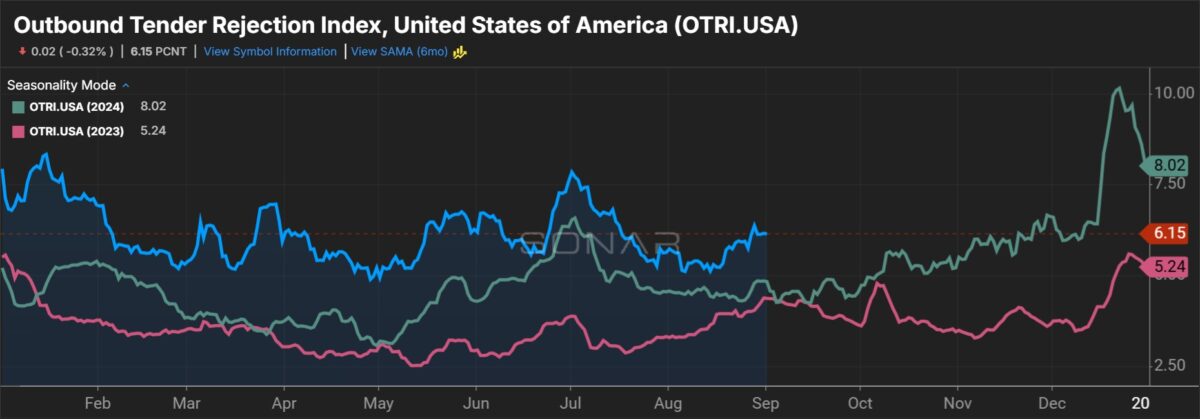
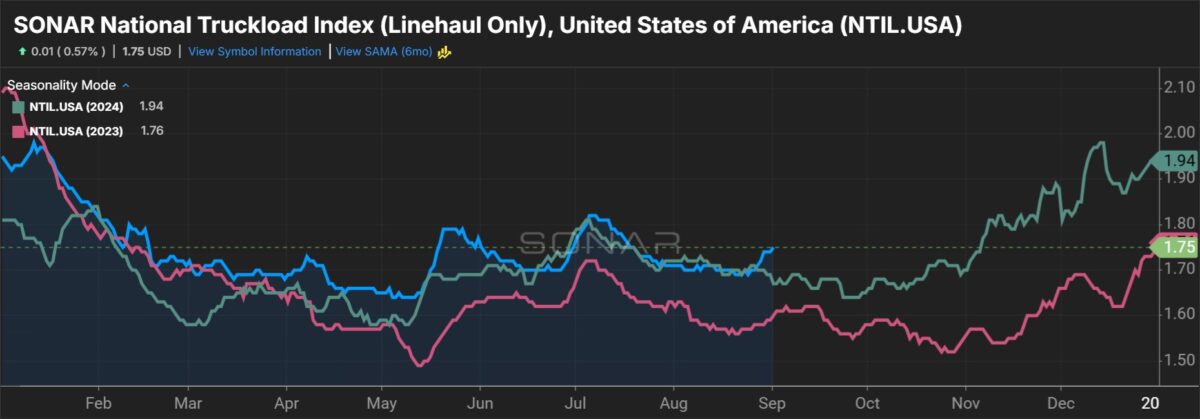
The overall LMI (59.3) was largely unchanged in August. Higher inventories and growth in the warehousing metrics drove the increase in the index.
Inventories (58.2) were up 2.7 points sequentially, pushing inventory costs (79.2) 7.3 points higher. This was the second-highest reading for inventory costs since October 2022. Smaller companies, or those with less than 1,000 employees, reported higher inventories and tighter capacity.
The report cautioned that “it is likely that some of these costs will be passed along to consumers in the near future,” but said it’s still too early to assess any impact to future retail sales.
Warehousing capacity (50.5) was only slightly expansionary as warehouse utilization (62.1) stepped 2.6 points higher. The changes drove warehouse prices (72.2) 3.9 points above July’s reading.
The LMI is a collaboration among Arizona State University, Colorado State University, Florida Atlantic University, Rutgers University and the University of Nevada, Reno, conducted in conjunction with the Council of Supply Chain Management Professionals.
Brokerage Compliance Symposium
The day before F3. Every compliance issue you face - fraud exposure, carrier liability, FMCSA rules, cargo theft, insurance gaps - navigated by attorneys and operators defining best practices in a changing industry.
F3 Awards Dinner
The night before F3. FreightTech100 companies honored. FreightTech 25 and Shipper of Choice winners revealed live. Cocktail reception into dinner and live music - 300 industry leaders in one purpose-built room.
F3: Future of Freight Festival
Industry-defining keynotes, rapid-fire technology demos, and industry leaders networking in experiences across Chattanooga - plus the inaugural F3 Awards Dinner featuring the FreightTech and Shipper of Choice reveals.
The day before F3. Every compliance issue you face - fraud exposure, carrier liability, FMCSA rules, cargo theft, insurance gaps - navigated by attorneys and operators defining best practices in a changing industry.
The Signal at Chattanooga Choo Choo • Chattanooga, TN Register NowThe night before F3. FreightTech100 companies honored. FreightTech 25 and Shipper of Choice winners revealed live. Cocktail reception into dinner and live music - 300 industry leaders in one purpose-built room.
The Signal at Chattanooga Choo Choo • Chattanooga, TN Register NowIndustry-defining keynotes, rapid-fire technology demos, and industry leaders networking in experiences across Chattanooga - plus the inaugural F3 Awards Dinner featuring the FreightTech and Shipper of Choice reveals.
The Signal at Chattanooga Choo Choo • Chattanooga, TN Register Now