




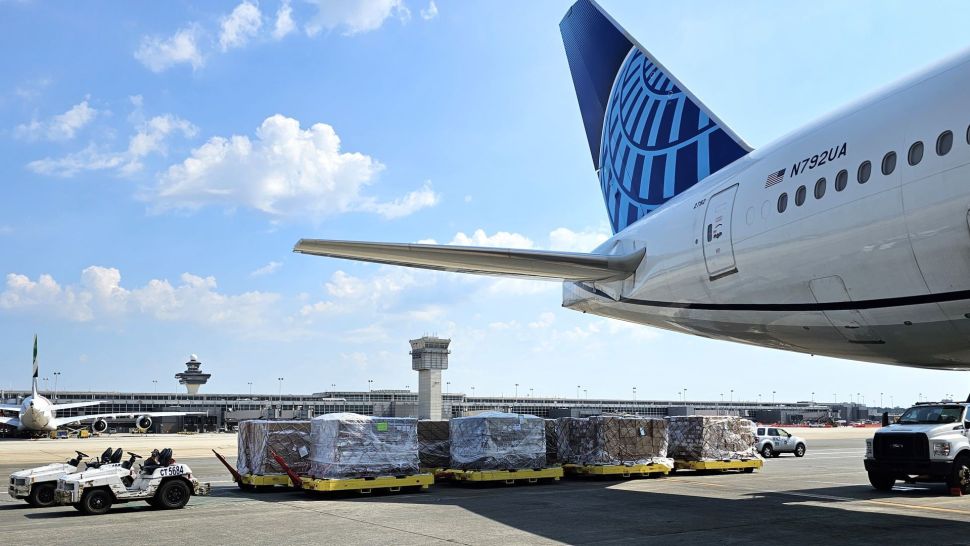
Cargo customers at United Airlines will be assessed a “market disruption fee” starting May 1 designed to help offset the rising cost of jet fuel and a variety of other operating expenses triggered, or exacerbated, by the Iran war. The move preceded earnings results that show a surprising decline in United’s cargo revenue during the first quarter.
United Cargo (NASDAQ: UAL) last week notified shippers of the pending surcharge, saying it covers the increased cost of doing business globally. The fee will vary by region and customers were advised to contact their United sales representative for applicable rates for specific trade lanes.
The price of jet fuel, typically the second largest expense for an airline after labor, has nearly doubled since the United States and Israel attacked Iran on Feb. 28. Many transportation companies have increased their fuel surcharges in recent weeks, but the United fee encompasses a variety of cost inputs. It is similar to the approach taken by the U.S. Postal Service, which will impose an 8% surcharge starting Sunday on parcel products to cover a range of soaring transportation costs.
“United Cargo is experiencing rising costs imposed on us by suppliers, partners, and by broader market conditions. The fee reflects a combination of external pressures across the air cargo ecosystem, including impacts imposed by our suppliers, partners, and by broader market conditions. It is not tied to a single factor, but rather a combination of multiple elements,” said United Cargo spokeswoman Stephanie Robbe Kramer, in a message to FreightWaves.
The airline has not indicated a specific duration for the disruption fee, only saying it will “evaluate conditions closely and communicate any adjustments to this fee as conditions evolve.”
United Airlines cargo revenue was $422 million during the first quarter, a 1.6% decline year over year, the company reported Tuesday afternoon. The sales shrink was a surprise considering the global air cargo market grew about 6.5% in the first two months of the year, compared to 2024, and spot-market shipping rates have jumped 25% to 40% since March 1 as demand grows amid reduced industry capacity because of Middle East flight restrictions related to the war. Delta Airlines posted a 9% gain in first-quarter cargo revenue to $226 million, while rival American Airlines on Thursday said cargo revenue increased 12.9% to $219 million.
Robbe Kramer declined to provide an explanation for the cargo revenue contraction.
Overall, United Airlines reported pre-tax earnings of $900 million or adjusted earnings per share of $1.19, surpassing analysts estimates, with operating revenue up 10.6%. It plans to cut 5% of its capacity the rest of the year to help contain costs during a volatile period.
Amsterdam Schiphol response
In related news, Amsterdam Schiphol airport on Thursday announced a temporary discount of more than 10% on airport charges to help airlines cope with the sharp rise in jet fuel prices caused by the Iran war and ensure carriers maintain service to The Netherlands as many are reducing capacity to reduce costs. The discounts will be in effect from April 27 to March 31, 2027.
Lufthansa Group this week said it would cut 20,000 flights at its European hubs over the next six months to save on fuel.
Click here for more FreightWaves/American Shipper stories by Eric Kulisch.
Contact: ekulisch@freightwaves.com.
(Correction: An earlier version of this story had a typo that omitted Iran as the country attacked by the U.S. and Israel.)
RELATED READING:
Postal Service can proceed with 8% parcel surcharge, regulator says
Brokerage Compliance Symposium
The day before F3. Every compliance issue you face - fraud exposure, carrier liability, FMCSA rules, cargo theft, insurance gaps - navigated by attorneys and operators defining best practices in a changing industry.
F3 Awards Dinner
The night before F3. FreightTech100 companies honored. FreightTech 25 and Shipper of Choice winners revealed live. Cocktail reception into dinner and live music - 300 industry leaders in one purpose-built room.
F3: Future of Freight Festival
Industry-defining keynotes, rapid-fire technology demos, and industry leaders networking in experiences across Chattanooga - plus the inaugural F3 Awards Dinner featuring the FreightTech and Shipper of Choice reveals.
The day before F3. Every compliance issue you face - fraud exposure, carrier liability, FMCSA rules, cargo theft, insurance gaps - navigated by attorneys and operators defining best practices in a changing industry.
The Signal at Chattanooga Choo Choo • Chattanooga, TN Register NowThe night before F3. FreightTech100 companies honored. FreightTech 25 and Shipper of Choice winners revealed live. Cocktail reception into dinner and live music - 300 industry leaders in one purpose-built room.
The Signal at Chattanooga Choo Choo • Chattanooga, TN Register NowIndustry-defining keynotes, rapid-fire technology demos, and industry leaders networking in experiences across Chattanooga - plus the inaugural F3 Awards Dinner featuring the FreightTech and Shipper of Choice reveals.
The Signal at Chattanooga Choo Choo • Chattanooga, TN Register Now