




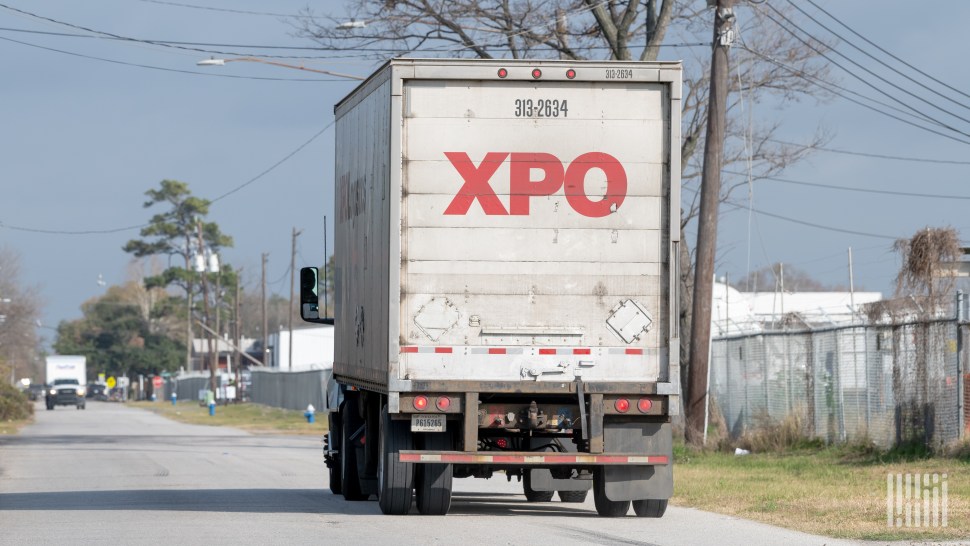
XPO reported Wednesday that tonnage per day in its less-than-truckload unit was down 4.7% year over year in August, an improvement from an 8.7% y/y decline in July. The August tonnage change was driven by a 3.4% decline in shipments and a 1.3% dip in weight per shipment.
The August tonnage result appears to be modestly ahead of typical seasonal trends. On a two-year-stacked comparison, July and August were down by 9.5% and 9.3%, respectively, in what remains a soft but stable demand environment.
The Greenwich, Connecticut-based carrier’s prior-year comps continue to ease through the rest of the year. (It averaged mid-single-digit y/y tonnage declines in the back half of last year.)

The Purchasing Managers’ Index (PMI) – a bellwether for manufacturing activity – remained in contraction territory during August at 48.7. (The PMI is a diffusion index in which a reading above 50 indicates expansion while one below 50 signals contraction.) The index has signaled softness in the manufacturing complex in 32 of the past 34 months. The dataset typically leads inflections in LTL volumes by approximately three months.
The PMI new orders subindex – a proxy for future activity – moved into expansion territory (51.4) after six straight months of decline. The index increased 4.3 percentage points from July but remained below 52.1, a level historically needed for a sustained period to garner an increase in manufacturing orders.
“Despite the index’s move into expansion territory, for every positive comment about new orders, there were 2.5 comments expressing concern about near-term demand, primarily driven by tariff costs and uncertainty,” the Tuesday report said.
XPO doesn’t alter industry’s only positive Q3 margin outlook
XPO (NYSE: XPO) didn’t alter its third-quarter margin guidance in the Wednesday news release.
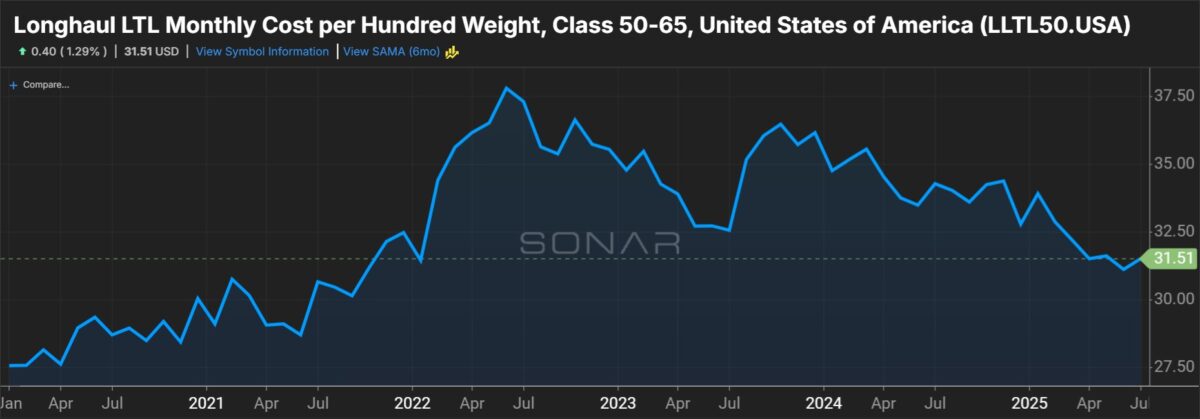
The company said on its second-quarter call at the end of July that it expects to see no sequential change to its adjusted operating ratio (inverse of operating margin) during the third quarter. That implies an 82.9% OR and 130 basis points of y/y improvement. By comparison, XPO normally sees 200 to 250 bps of OR degradation from the second to the third quarter.
The guide assumes a moderation in tonnage declines and further sequential improvement in revenue per shipment and yields. Third-quarter yield is expected to increase y/y by an amount similar to the 6.1% y/y increase captured in the second quarter. (XPO doesn’t provide revenue-based metrics in its intraquarter updates.)
XPO’s operating results continue to benefit from several self-help initiatives.
A shift in freight mix toward small-to-midsize businesses and selling more premium services incurring accessorial surcharges are some of the pricing catalysts.
The carrier also has several AI-enabled initiatives in place to reduce linehaul miles, improve pickup-and-delivery functions and cull labor hours per shipment. It also continues to reduce its reliance on third-party capacity for linehaul runs.
XPO has delivered nearly 400 bps of margin improvement during the current freight downturn while other public carriers are seeing margins move in the opposite direction.
Brokerage Compliance Symposium
The day before F3. Every compliance issue you face - fraud exposure, carrier liability, FMCSA rules, cargo theft, insurance gaps - navigated by attorneys and operators defining best practices in a changing industry.
F3 Awards Dinner
The night before F3. FreightTech100 companies honored. FreightTech 25 and Shipper of Choice winners revealed live. Cocktail reception into dinner and live music - 300 industry leaders in one purpose-built room.
F3: Future of Freight Festival
Industry-defining keynotes, rapid-fire technology demos, and industry leaders networking in experiences across Chattanooga - plus the inaugural F3 Awards Dinner featuring the FreightTech and Shipper of Choice reveals.
The day before F3. Every compliance issue you face - fraud exposure, carrier liability, FMCSA rules, cargo theft, insurance gaps - navigated by attorneys and operators defining best practices in a changing industry.
The Signal at Chattanooga Choo Choo • Chattanooga, TN Register NowThe night before F3. FreightTech100 companies honored. FreightTech 25 and Shipper of Choice winners revealed live. Cocktail reception into dinner and live music - 300 industry leaders in one purpose-built room.
The Signal at Chattanooga Choo Choo • Chattanooga, TN Register NowIndustry-defining keynotes, rapid-fire technology demos, and industry leaders networking in experiences across Chattanooga - plus the inaugural F3 Awards Dinner featuring the FreightTech and Shipper of Choice reveals.
The Signal at Chattanooga Choo Choo • Chattanooga, TN Register Now