




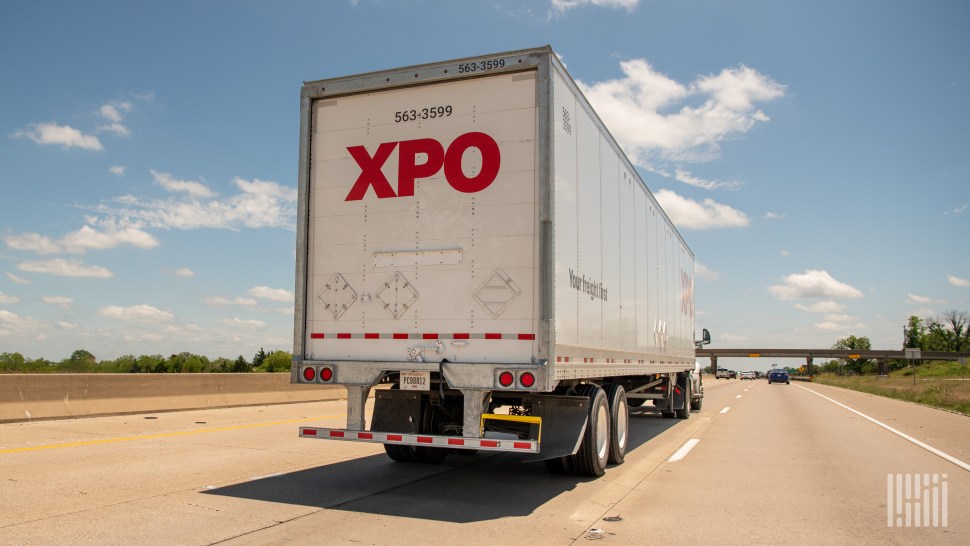
XPO reported a January tonnage surprise on Thursday, sending shares more than 11% higher in early trading. A modest uptick in demand from the less-than-truckload carrier’s manufacturing customers combined with in-house growth initiatives resulted in no change to tonnage during the month. That ended an 18-month stretch of year-over-year declines.
Manufacturing data released on Monday showed industrial activity turned positive for the first time in 12 months. The Purchasing Managers’ Index registered a 52.6 reading in January, 470 basis points higher than December. (A reading above 50 signals expansion while one below 50 indicates contraction.) The dataset has been underwater for the majority of the past three years.
The new orders subindex—an indicator of future activity—surged 970 bps to 57.1 (the highest reading since February 2022).
XPO (NYSE: XPO) also has idiosyncratic growth programs in place.
Last year, it added 10,000 local accounts (small and midsize shippers), which typically have better yield and margin profiles. This group accounts for 25% of the company’s LTL revenue book (up from 20%), but the plan is to grow this segment to more than 30% of revenue over time.
XPO is also expanding its grocery consolidation offering, and it has recently added new customers from the healthcare sector.
Shipments that incur accessorial charges (“premium services”) have increased to 12% of revenue, up from less than 10% previously.
New account wins and service enhancements are allowing the carrier to close its pricing gap to best-in-class peers. XPO’s fourth quarter marked 12 consecutive quarters of sequential improvement in revenue per shipment. The changes are driving margins and earnings higher.
“By pairing world-class service with our proprietary technology, we’re building durable earnings power unique to our business,” said Mario Harik, chairman and CEO, in a news release. “We’re continuing to execute for market-leading margin expansion in the current environment, while positioning for outsized share and margin gains in a recovery.”

Q4 by the numbers
XPO’s fourth-quarter adjusted earnings came in 18% higher y/y, excluding one-off items and real estate gains.
The Greenwich, Connecticut-based company reported adjusted earnings per share of 88 cents (inclusive of gains). That was 12 cents ahead of the consensus estimate. The adjusted EPS number excluded transaction and restructuring costs but included 8 cents per share in gains from the sale of real estate. XPO recorded 21 cents per share in real estate gains in the 2024 fourth quarter.
Consolidated revenue of $2.01 billion was 5% higher y/y and better than the $1.95 billion consensus estimate.
The LTL unit reported revenue of $1.17 billion, a 1% y/y increase (2% higher on a per-day comparison). Tonnage per day declined 4.5% y/y but revenue per hundredweight (yield) was 6% higher (5% higher excluding fuel surcharges).
The tonnage decline resulted from a 1.5% decline in daily shipments and a 3% drop in weight per shipment. Tonnage was down 3.8% y/y in October, down 5.4% in November and down 4.5% in December.
January tonnage was flat y/y, in part due to an easier prior-year comp (negative-8.5%). However, management said tonnage would have been 3% higher during the month without the severe winter storms. October could mark the nadir for tonnage on a two-year-stacked comparison (down 11.8%).
The fourth-quarter yield metric benefitted from the decline in average shipment weight and a 1% increase in length of haul. Fourth-quarter yield was 11.4% higher on a two-year-stacked comparison.
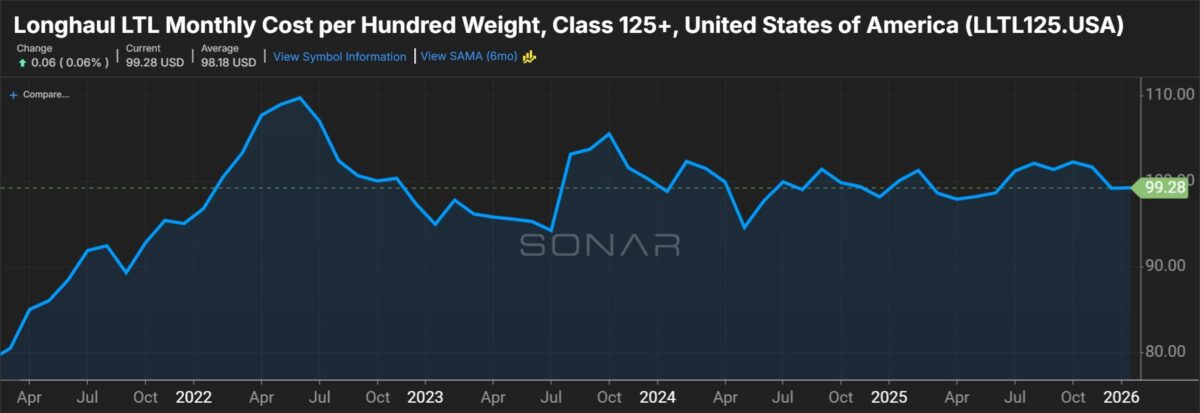
The unit reported an 84.4% adjusted operating ratio (inverse of operating margin), 180 bps better y/y, but 170 bps worse than the third quarter. The result was better than historical sequential deterioration of 200 to 250 bps, and near management’s 84% implied guide.
Salaries, wages and benefits (as a percentage of revenue) came in 100 bps lower y/y. Purchased transportation expense was 180 bps lower as outsourced miles have been reduced to just 5.1% of total miles.
Revenue per shipment outpaced adjusted cost per shipment by 220 bps in the quarter.
The company is calling for further margin improvement even if the broader economy doesn’t improve. It has implemented several AI-led efficiency initiatives (dock, linehaul and pickup-and-delivery), and maintenance costs are lower as the average tractor age has been reduced to 3.7 years.
The cost reductions combined with pricing levers are expected to produce 100 to 150 bps of y/y margin improvement in 2026. Cost per shipment is expected to increase by a low-single-digit percentage this year as general cost inflation is partially mitigated by productivity initiatives. Revenue per shipment should be up by a mid-single-digit percentage.
XPO sees a path to low-70s ORs over time. It has recorded 590 bps of margin improvement through the downturn.
The carrier is forecasting sequential OR improvement in the first quarter even though it typically experiences 50 bps of deterioration. Even if OR came in flat with the fourth quarter that would be 150 bps better y/y.
XPO’s European transportation segment reported an 11% y/y increase in revenue to $846 million. Adjusted EBITDA of $32 million was 19% higher y/y.
Shares of XPO were up 4.3% at 2:00 p.m. EST on Thursday compared to the S&P 500, which was down 1.1%. The stock is up more than 25% this week as PMI data and LTL earnings reports have surprised to the upside.
Brokerage Compliance Symposium
The day before F3. Every compliance issue you face - fraud exposure, carrier liability, FMCSA rules, cargo theft, insurance gaps - navigated by attorneys and operators defining best practices in a changing industry.
F3 Awards Dinner
The night before F3. FreightTech100 companies honored. FreightTech 25 and Shipper of Choice winners revealed live. Cocktail reception into dinner and live music - 300 industry leaders in one purpose-built room.
F3: Future of Freight Festival
Industry-defining keynotes, rapid-fire technology demos, and industry leaders networking in experiences across Chattanooga - plus the inaugural F3 Awards Dinner featuring the FreightTech and Shipper of Choice reveals.
The day before F3. Every compliance issue you face - fraud exposure, carrier liability, FMCSA rules, cargo theft, insurance gaps - navigated by attorneys and operators defining best practices in a changing industry.
The Signal at Chattanooga Choo Choo • Chattanooga, TN Register NowThe night before F3. FreightTech100 companies honored. FreightTech 25 and Shipper of Choice winners revealed live. Cocktail reception into dinner and live music - 300 industry leaders in one purpose-built room.
The Signal at Chattanooga Choo Choo • Chattanooga, TN Register NowIndustry-defining keynotes, rapid-fire technology demos, and industry leaders networking in experiences across Chattanooga - plus the inaugural F3 Awards Dinner featuring the FreightTech and Shipper of Choice reveals.
The Signal at Chattanooga Choo Choo • Chattanooga, TN Register Now