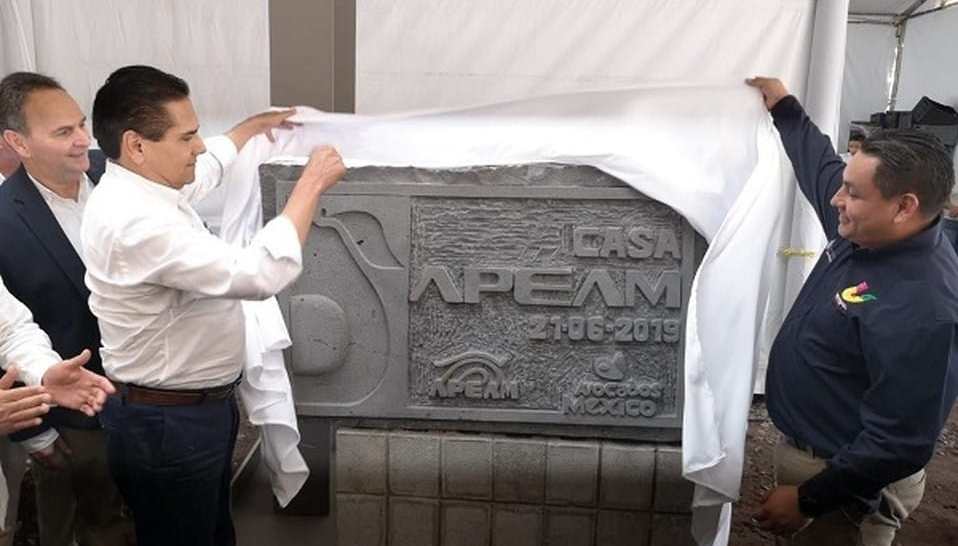
United States and Mexican avocado growers and importers recently broke ground on a partnership facility called “Casa APEAM” in Uruapan, Mexico.
The new $12 million facility will be a venture between the Association of Export Producers and Packers of Avocado from Mexico (APEAM), the Mexican Department of Agriculture and Agrarian Development (SADER), and also house the local offices for the U.S. Department of Agriculture (USDA).
Gabriel Villaseñor, president of APEAM, said one of the main objectives of having the new facility house different organizations was to “facilitate procedures to the avocado producers, that with better organization there is more commercialization to the United States.”
Casa APEAM will also be part of Mexican officials new strategy to find safer export routes for avocados out of Mexico, which has reported 440 avocado theft investigations between 2017 and 2019.
Avocado producers lose an average of four truckloads per day to organized crime – around 12 tons (26,448 pounds) – during the journey from the orchards to the packing zones on the highways, according to APEAM.
In an advertisement published in Mexican newspapers, APEAM said the government has done little to slow organized theft of avocados, known as “green gold,” the majority of which is grown in the fertile fields in the state of Michoacán.
“It’s impossible to continue taking these losses. Failing to stop the theft of these lorries will have an irreparable impact on the avocado industry,” APEAM wrote June 14.
Silvano Aureoles, the governor of Michoacán, said he is working with avocado producers to plot new trucking routes to avoid the theft of trucks and merchandise.
Part of these new actions could be exporting the avocados from the Port of Lázaro Cárdenas instead of the Port of Manzanillo, putting surveillance cameras on the road to Lázaro Cárdenas and increasing surveillance of truck shipments out of Michoacán.
“Uruapan has been very attractive to criminals for understandable reasons – but we will not rest until we have absolute control of the safety of the region producing avocado,” Aureoles said during the ground-breaking ceremony for Casa APEAM.
Uruapan is located in western central Mexico in the state of Michoacán, which accounted for 92 percent of Mexico’s avocado production in 2018, according to SADER.
Mexico is the top supplier of fruits and vegetables to the U.S., with $13 billion imported from the country last year. Mexican-grown avocados made up 78 percent of the U.S. market in 2018, according to Hass Avocado Board data.
The majority of avocados consumed in the U.S. from Mexico are transported from Michoacán to the Texas border cities of Laredo and Pharr, around 680 miles.
Avocados are a key import at the Pharr-Reynosa International Bridge on the Texas-Mexico border. For the last two years, Pharr has been the U.S.’s largest land port of entry for produce, including the number 1 importer of avocados.
Currently, avocado prices are skyrocketing. According to the most recent USDA weekly retail price report, the average national price of Haas (Michoacán) avocados was $2.10 on July 5, compared to $1.17 from the July 6, 2018.
As Mexico’s 2019-20 avocado season gets underway, APEAM is forecasting that its exports to the U.S. will break the one-million-ton mark for the first time ever.
The new APEAM facility, which will be completed in two years, will be 13,000 square feet on a 10-acre site. Villaseñor said the new facility will also “have an experimental field and a laboratory – where we can investigate how to eradicate pests, diseases, safety problems, certification so that it is not contaminated.”
APEAM was founded in 1977 and its main task is to promote the export of Mexican avocados. APEAM has more than 28,000 avocado producers and 58 packers working on 341,000-acres in Michoacán.
Brokerage Compliance Symposium
The day before F3. Every compliance issue you face - fraud exposure, carrier liability, FMCSA rules, cargo theft, insurance gaps - navigated by attorneys and operators defining best practices in a changing industry.
F3 Awards Dinner
The night before F3. FreightTech100 companies honored. FreightTech 25 and Shipper of Choice winners revealed live. Cocktail reception into dinner and live music - 300 industry leaders in one purpose-built room.
F3: Future of Freight Festival
Industry-defining keynotes, rapid-fire technology demos, and industry leaders networking in experiences across Chattanooga - plus the inaugural F3 Awards Dinner featuring the FreightTech and Shipper of Choice reveals.
The day before F3. Every compliance issue you face - fraud exposure, carrier liability, FMCSA rules, cargo theft, insurance gaps - navigated by attorneys and operators defining best practices in a changing industry.
The Signal at Chattanooga Choo Choo • Chattanooga, TN Register NowThe night before F3. FreightTech100 companies honored. FreightTech 25 and Shipper of Choice winners revealed live. Cocktail reception into dinner and live music - 300 industry leaders in one purpose-built room.
The Signal at Chattanooga Choo Choo • Chattanooga, TN Register NowIndustry-defining keynotes, rapid-fire technology demos, and industry leaders networking in experiences across Chattanooga - plus the inaugural F3 Awards Dinner featuring the FreightTech and Shipper of Choice reveals.
The Signal at Chattanooga Choo Choo • Chattanooga, TN Register Now