




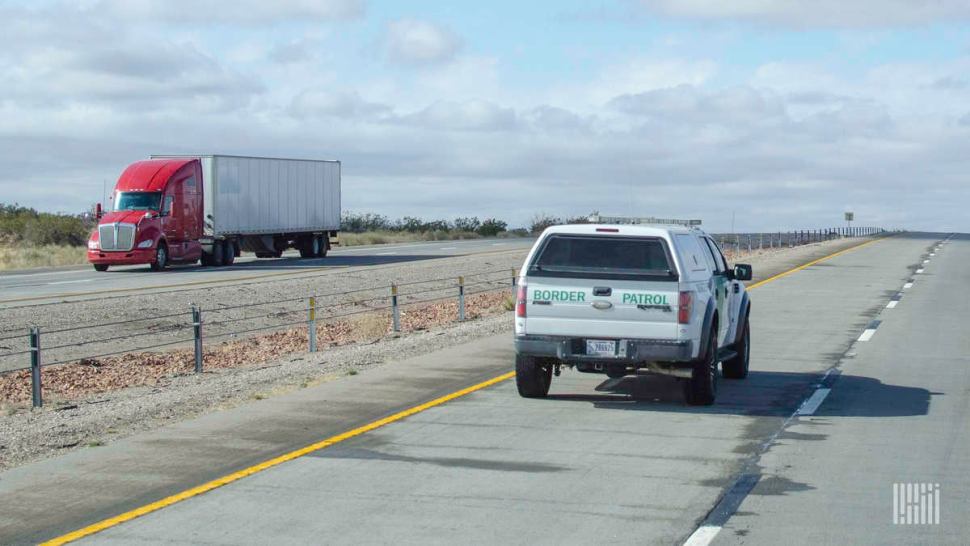
Under most circumstances, commercial trucks based in foreign countries — Canada and Mexico — cannot haul domestic freight between two points in the U.S. That principle stems from laws and regulations governing cabotage: the point-to-point transportation of goods within a country by a foreign operator.
Things get a little more complicated, though, when it comes to the finer points of law. A section of the Code of Federal Regulations relating to customs technically creates an opening for domestic moves of freight that are “incidental” to the cross-border run and in the same direction of travel.
But in most cases, this provision — under “Entry of foreign-based trucks, busses, and taxicabs in international traffic” — is meaningless because of the following sentence: “An alien driver will not be permitted to operate a vehicle under this paragraph, unless the driver is in compliance with the applicable regulations of the Immigration and Naturalization Service.”
The trouble is that Canadian and Mexican drivers don’t allow them to engage in these kinds of moves under the terms of their entry into the United States. As U.S. Customs and Border Protection explains on its website: “No. For Immigration purposes, that is considered point-to-point hauling within the United States and is not permitted. The driver may only take goods loaded in the United States to Canada or Mexico.”
So, in short: the Mexican or Canadian tractor-trailer might be able to do one of these “incidental” moves, but the drivers can’t. Though if the driver happened to be a U.S. citizen as well, it would seem to be permissible.
This is part of FreightWaves’ AskWaves series. If you have a question for our editorial team to explore, click here. For more AskWaves articles, click here.
Brokerage Compliance Symposium
The day before F3. Every compliance issue you face - fraud exposure, carrier liability, FMCSA rules, cargo theft, insurance gaps - navigated by attorneys and operators defining best practices in a changing industry.
F3 Awards Dinner
The night before F3. FreightTech100 companies honored. FreightTech 25 and Shipper of Choice winners revealed live. Cocktail reception into dinner and live music - 300 industry leaders in one purpose-built room.
F3: Future of Freight Festival
Industry-defining keynotes, rapid-fire technology demos, and industry leaders networking in experiences across Chattanooga - plus the inaugural F3 Awards Dinner featuring the FreightTech and Shipper of Choice reveals.
The day before F3. Every compliance issue you face - fraud exposure, carrier liability, FMCSA rules, cargo theft, insurance gaps - navigated by attorneys and operators defining best practices in a changing industry.
The Signal at Chattanooga Choo Choo • Chattanooga, TN Register NowThe night before F3. FreightTech100 companies honored. FreightTech 25 and Shipper of Choice winners revealed live. Cocktail reception into dinner and live music - 300 industry leaders in one purpose-built room.
The Signal at Chattanooga Choo Choo • Chattanooga, TN Register NowIndustry-defining keynotes, rapid-fire technology demos, and industry leaders networking in experiences across Chattanooga - plus the inaugural F3 Awards Dinner featuring the FreightTech and Shipper of Choice reveals.
The Signal at Chattanooga Choo Choo • Chattanooga, TN Register Now