




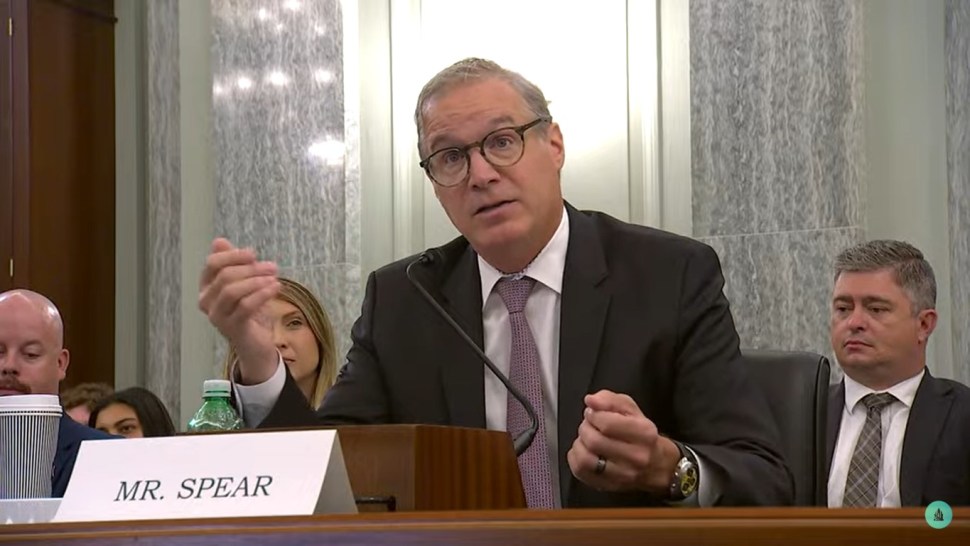
WASHINGTON — As Congress begins work on the next highway bill set to go into effect next year, the American Trucking Associations said it’s ready to transition from a gas tax to an annual vehicle registration fee to help pay for maintaining and improving roads and bridges.
“We’re looking seriously at advocating for a registration fee that applies to everybody – trucks, cars, electric vehicles,” ATA President Chris Spear told the lawmakers at a Senate Commerce Committee subcommittee hearing on Tuesday.
“You already register your vehicle at the state [motor vehicle agencies], you simply pay for what you normally would pay in fuel costs at the pump. You get rid of the gas tax, the tire tax, and put it in a registration fee.”
Spear said the cost of the annual fee could be roughly $200 to $250 for cars, with payments spread out over the course of the year. “It would be more for the trucking industry, but that’s fine, we’re willing to do that,” he said. “It would capture everyone, and it’s fair.”

Speaking on behalf of small carriers and owner operators, Lewie Pugh, executive vice president of the Owner-Operator Independent Drivers Association, told the subcommittee that while he supports a registration fee to capture electric vehicles – which do not pay fuel taxes to pay for infrastructure – OOIDA is not yet ready to abandon fuel taxes.
“I think we need the intestinal fortitude to raise the gas tax, because it hasn’t been raised” since 1993, he said. “You pay it at the pump, and it works. Why create something new, other than having electric vehicles pay an additional registration fee.”
Congress has for years been making up for gas-tax shortfalls in the Highway Trust Fund (HTF) by transferring money from the Treasury Department’s general fund. But with the HTF estimated to be depleted by 2028, lawmakers are considering alternative payment options by the trucking industry to keep it viable, including weight-based user fees.
Debating automation, drug testing
While there was agreement at the hearing on how to address some issues lawmakers want to see tackled in the next highway bill such English proficiency requirements, commercial driver license fraud and expanding truck parking, there was less agreement on a path forward for autonomous vehicles.
Asked by U.S. Sen. Ted Cruz, R, Texas, about an AV framework to be included in the legislation, Spear and Teamsters President Sean O’Brien sparred over whether automation would kill jobs are create them.
“This is always portrayed as a threat to jobs, but there are 65 ports in this country and not one ranks in the top 50 in the world for efficiency and productivity,” Spear said.
“To grow the economy we’re going to need both jobs and autonomy. We’re going to need technologies to get throughput in and out of those ports and on our roads. You’re going to need both those hard-working union jobs and technology to assist them.”
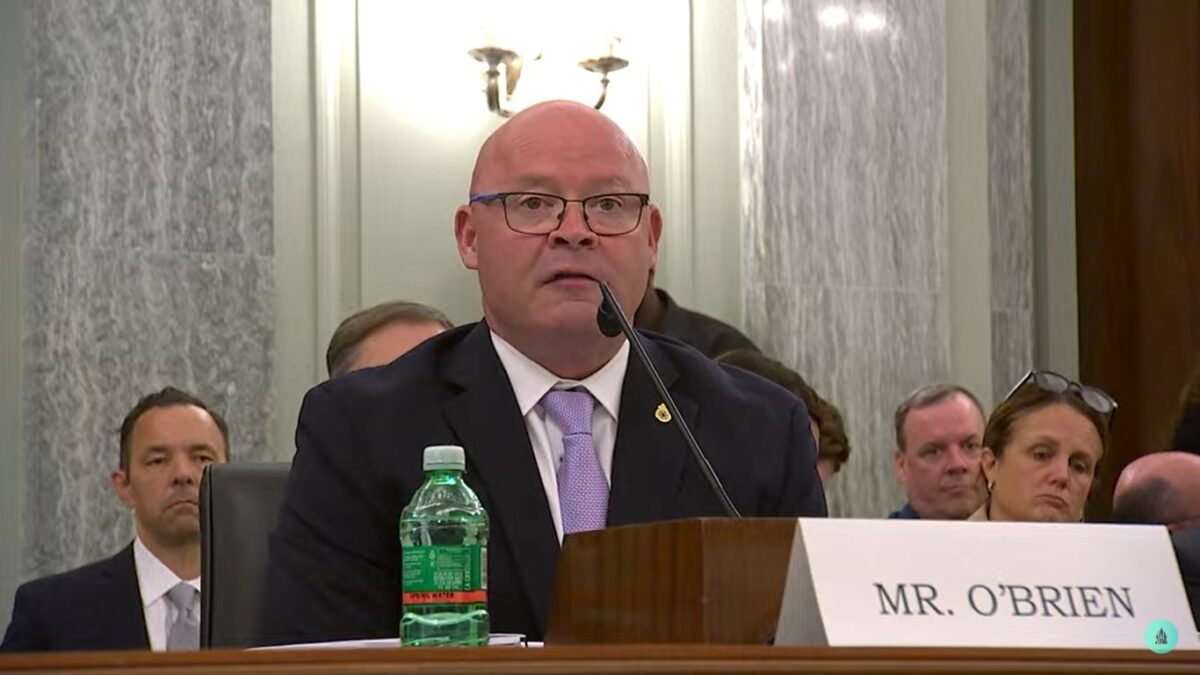
O’Brien insisted that human drivers remain in truck cabs no matter the level of automation. “I’m all for efficiencies – there are efficiencies built into [the labor agreement with port workers]. But there are also job protections in that agreement as a result of implementing new technology. So a priority would be that upon implementation, you protect and create new jobs.”
ATA would also like to see a hair testing requirement for the trucking industry included in the next reauthorization as well – a hard “no” for OOIDA.
“We support post-crash testing for sure, but not hair testing,” Pugh said. “We don’t feel there’s enough data to support it.”
Driver shortage?
A driver shortage debate played out at the hearing as well, with Spear pointing out that driver pay “does not go up 19% during a freight recession unless there is a shortage of qualified drivers.”
But Sen. Ed Markey, D, Mass., contended that millions of people holding CDLs are competing for about 900,000 long-haul trucking jobs.
“In fact 90% of truck drivers leave their job after a year. This high level of turnover suggests the issue might not be whether there are enough drivers, but whether existing drivers are getting enough out of the job.”
O’Brien added that the small number of unionized carriers had closer to a 10-15% turnover rate. “That means people are happy with their wages and benefits. When you have a race to the bottom, and people keep leaving the industry after a year – there’s a breakdown somewhere.”
Related articles:
Brokerage Compliance Symposium
The day before F3. Every compliance issue you face - fraud exposure, carrier liability, FMCSA rules, cargo theft, insurance gaps - navigated by attorneys and operators defining best practices in a changing industry.
F3 Awards Dinner
The night before F3. FreightTech100 companies honored. FreightTech 25 and Shipper of Choice winners revealed live. Cocktail reception into dinner and live music - 300 industry leaders in one purpose-built room.
F3: Future of Freight Festival
Industry-defining keynotes, rapid-fire technology demos, and industry leaders networking in experiences across Chattanooga - plus the inaugural F3 Awards Dinner featuring the FreightTech and Shipper of Choice reveals.
The day before F3. Every compliance issue you face - fraud exposure, carrier liability, FMCSA rules, cargo theft, insurance gaps - navigated by attorneys and operators defining best practices in a changing industry.
The Signal at Chattanooga Choo Choo • Chattanooga, TN Register NowThe night before F3. FreightTech100 companies honored. FreightTech 25 and Shipper of Choice winners revealed live. Cocktail reception into dinner and live music - 300 industry leaders in one purpose-built room.
The Signal at Chattanooga Choo Choo • Chattanooga, TN Register NowIndustry-defining keynotes, rapid-fire technology demos, and industry leaders networking in experiences across Chattanooga - plus the inaugural F3 Awards Dinner featuring the FreightTech and Shipper of Choice reveals.
The Signal at Chattanooga Choo Choo • Chattanooga, TN Register Now